

Table of Contents
 Set as a preferred Google source
TL;DR
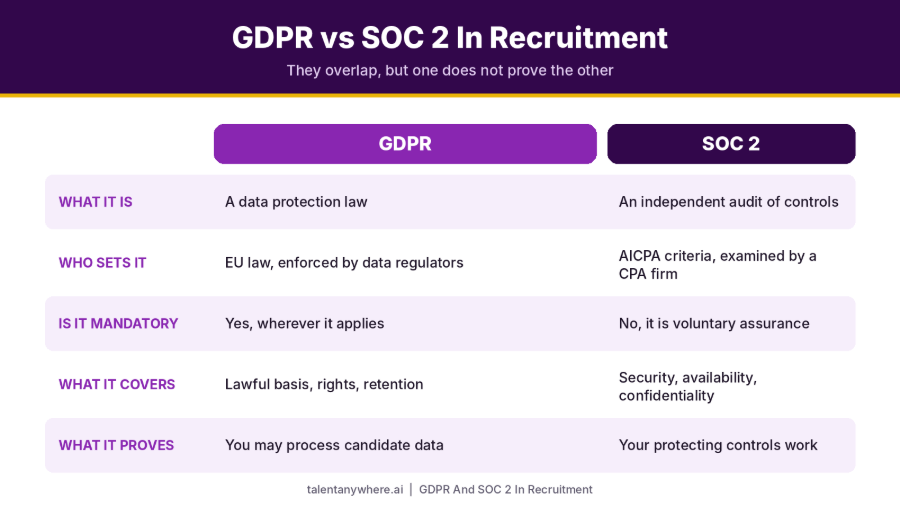
- GDPR sets the legal rules for handling candidate data, while SOC 2 is an independent audit of security controls. One does not prove the other.
- Define what candidate data you collect, assign a lawful basis to each activity and publish clear privacy notices. Consent is not required for every recruitment activity.
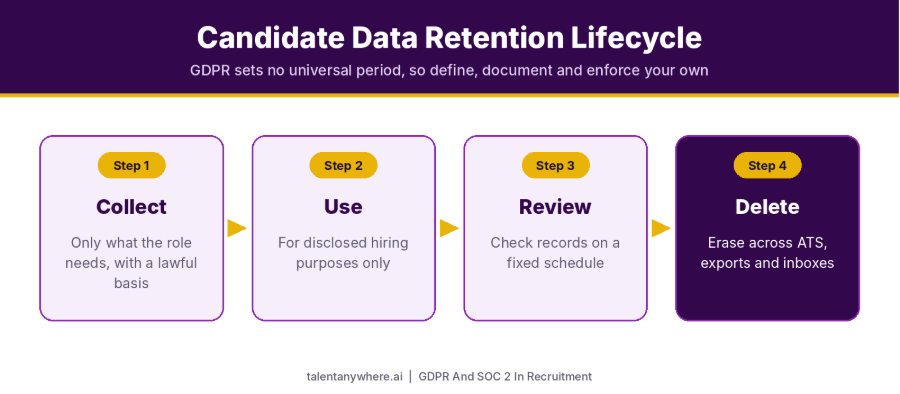
- GDPR has no universal retention period, so firms must set, document and enforce their own.
- Role-based access, MFA, encryption, vendor DPAs and transfer safeguards protect candidate data across clients and borders.
- AI hiring tools need transparency and human oversight, and EU AI Act high-risk obligations for recruitment AI apply from 2 December 2027.
- An applicant tracking system supports compliance, but it never guarantees it.
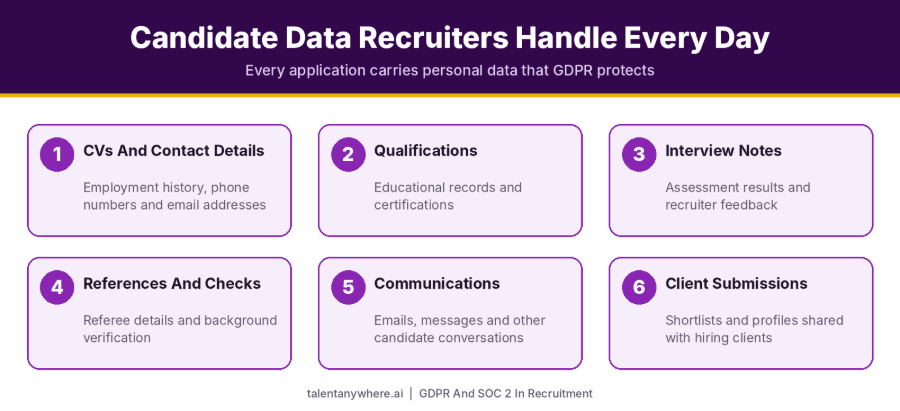
A single open role can bring in hundreds of applications, and every one carries personal data. Across sourcing, screening and client submissions, recruiters routinely handle:
- CVs, contact details and employment history
- Educational qualifications and certifications
- Interview notes and assessment results
- References and background verification details
- Emails, messages and other candidate communications
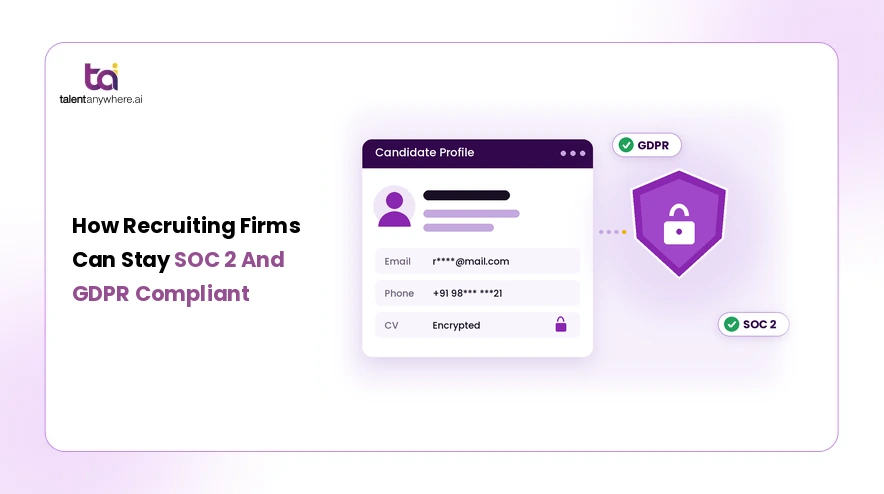
Keeping that data safe gets harder when a firm hires across borders, serves several clients and adds third-party and AI tools. This is where GDPR in recruitment and SOC 2 come in. GDPR sets the legal rules for handling personal data, while SOC 2 gives clients independent assurance that your security controls work. They overlap, but they are not the same thing.
This guide covers practical steps to protect candidate data and build trust with candidates and clients.
Understanding GDPR And SOC 2 Compliance In Recruitment
GDPR and SOC 2 often appear side by side in client questionnaires and GDPR recruitment audits, so it helps to know what each covers.
What Is GDPR In Recruitment?
The General Data Protection Regulation (GDPR) governs how recruiters collect, store, use, share and delete candidate personal data. Its core requirements include:
- Lawful processing under a valid Article 6 legal basis
- Transparency about what you collect and why
- Data minimisation and purpose limitation
- Candidate rights, including access, rectification and erasure
- Security and accountability, backed by records
GDPR is not limited to EU-based firms. Under Article 3, it can apply to an agency outside the EU that offers services to people in the EU or monitors their behaviour there.
What Is SOC 2 Compliance For Recruiting Firms?
SOC 2 is an independent examination, carried out by a licensed CPA firm, of a service organisation’s controls against the AICPA Trust Services Criteria. The criteria span five categories: security, availability, processing integrity, confidentiality and privacy. Security is included in every examination, and the others depend on the services offered.
Clients may ask for your report, and you should ask your ATS and cloud vendors for theirs. SOC 2 is not a GDPR certification. A clean SOC 2 report does not prove GDPR compliance, and a GDPR-compliant firm may have no SOC 2 report at all.
Why Recruiting Firms Need To Consider Both
GDPR decides whether and how you may process candidate data, while SOC 2 shows whether the protecting controls hold up. An agency may have a lawful basis to collect a CV for a live vacancy, but that means little if the CV then sits in a shared inbox or with an unvetted vendor. Strong GDPR SOC 2 compliance hiring practices treat the legal and security questions as one workflow.
Common Data Protection And Compliance Risks In Recruitment
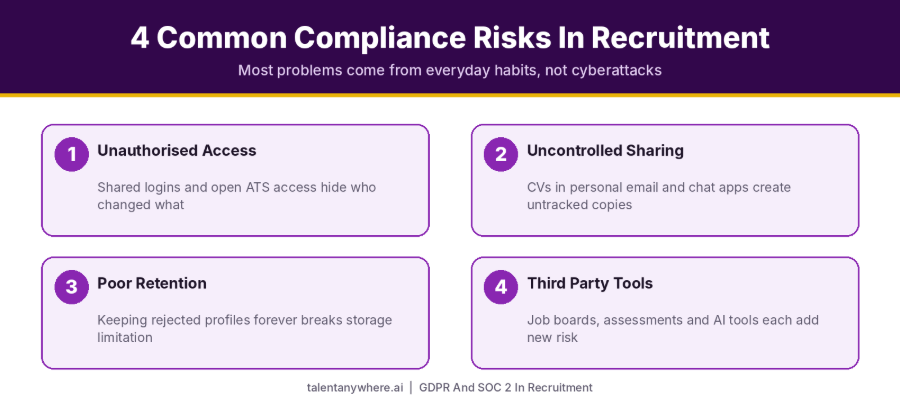
Most problems with GDPR in recruitment come from everyday habits, not cyberattacks.
Unauthorised Access To Candidate Records
Shared logins and unrestricted ATS access expose data to people who do not need it and hide who changed what.
Uncontrolled Candidate Data Sharing
CVs forwarded from personal email, shortlists in messaging apps and spreadsheet trackers create untracked copies that deletion requests often miss.
Poor Data Retention Practices
Keeping every rejected applicant’s profile indefinitely conflicts with GDPR’s storage limitation principle.
Third-Party Recruitment Technology Risks
Job boards, screening providers, assessment platforms and AI tools all process candidate data, each adding a contract and security posture to check.
Also Read: Top Job Portals In India
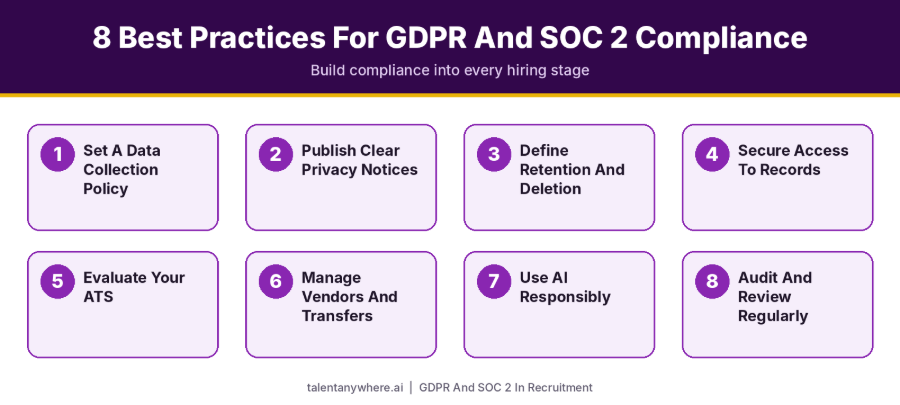
8 Best Practices For Maintaining GDPR And SOC 2 Compliance In Recruitment
Compliance works best when built into every hiring stage, not filed away as a one-time policy. These practices cover where GDPR in recruitment and SOC 2 controls meet most often.
1. Establish A Clear Candidate Data Collection Policy
Good GDPR recruitment practice starts with deciding what each hiring process needs. Your policy should:
- Define the data each role type requires
- Exclude information irrelevant to hiring
- Record why each data category is collected and its source
- Assign a lawful basis to each processing activity
Consent is not required for every recruitment activity. Many rely on legitimate interests or on steps taken at the candidate’s request before entering into a contract. Special category data, such as health information, needs an additional condition under Article 9.
2. Maintain Transparent Candidate Privacy Notices
Under Articles 13 and 14, a recruitment privacy notice should explain:
- Your identity and contact details
- Purposes, lawful bases, data categories and sources
- Who receives the data, including hiring clients
- Retention periods or the criteria used to set them
- Candidate rights and any international transfers
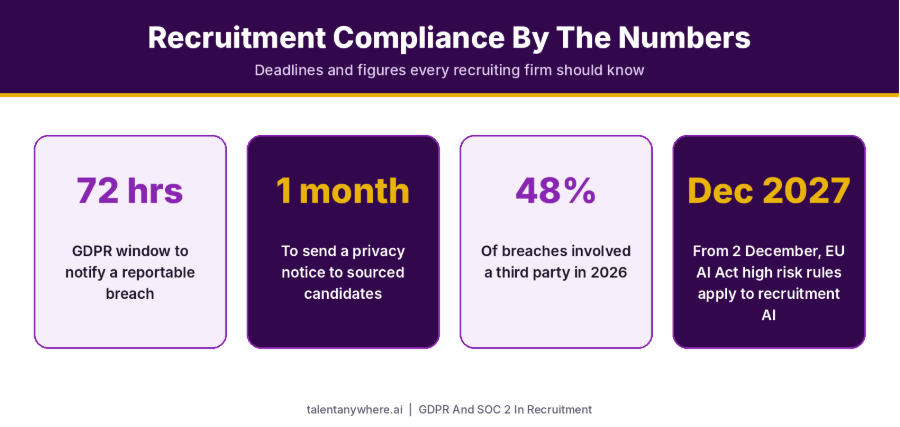
For profiles sourced from job boards, Article 14 generally requires providing this within one month, or at first contact if sooner.
3. Implement Defined Candidate Data Retention And Deletion Policies
GDPR sets no single retention period for recruitment records. Firms must justify and document retention based on purpose and national legal requirements.
- Set retention periods for each data category
- Review unsuccessful candidates’ records on a fixed schedule
- Run a separate talent pool process, using consent where that is your chosen basis
- Act on valid erasure requests promptly
- Extend deletion to connected systems, exports and other storage locations
4. Secure Candidate Information Through Access Controls
Access control is where GDPR’s Article 32 security requirement and the SOC 2 security and confidentiality criteria overlap most clearly. Core controls include:
- Role-based access and multi-factor authentication
- Strong password policies
- Encryption in transit and at rest
- Access logs, audit trails and regular access reviews
- Secure, expiring links for sharing shortlists with clients
The cost of weak controls keeps climbing. IBM’s 2027 Cost of a Data Breach Report puts the global average cost of a data breach at a record $4.99 million.
5. Evaluate Your Applicant Tracking System For GDPR And SOC 2 Requirements
Most applicant tracking system GDPR questions come down to one thing: can the software help you apply your policies consistently? When comparing GDPR compliant recruiting software, look for:
- Centralised candidate records
- Configurable retention and deletion workflows
- Consent records where consent is used
- Role-based permissions and audit logs
- Secure document storage
- Data export and deletion tools
- Security documentation, a recent SOC 2 report and a Data Processing Agreement
Even a well-built GDPR compliant applicant tracking system supports compliance without guaranteeing it. Your firm remains responsible for what it collects, who sees it and how long it stays.
Keep Every Candidate Record In One Place
Create job descriptions, shortlist with AI, run assessments and interview candidates from a single recruitment platform.
6. Manage Third-Party Vendors And International Data Transfers
Recruiters share data constantly with clients and vendors. Verizon’s 2027 Data Breach Investigations Report found a third party involved in 48% of breaches, a 60% rise on the previous year. To manage that exposure:
- Map every party that receives candidate data
- Decide whether each is a controller, joint controller or processor
- Sign Article 28 Data Processing Agreements with processors
- Review vendor security practices and subprocessors
- Know where candidate data is stored and accessed
- Use transfer safeguards such as adequacy decisions or Standard Contractual Clauses
This is the core of how to ensure GDPR compliance in global hiring. A cloud ATS hosted outside the EU is not automatically unlawful, but transfers must meet GDPR Chapter V requirements.
7. Establish Responsible AI Recruitment And Data Processing Practices
AI screening and interview tools raise specific AI recruitment GDPR questions around transparency, fairness and security. Good practice includes:
- Telling candidates when AI assists in processing
- Using data only for disclosed purposes
- Restricting access to assessment results
- Testing recommendations for bias and accuracy
- Keeping meaningful human review in hiring decisions
- Checking vendors’ data handling, model training and retention
GDPR Article 22 restricts solely automated decisions with significant effects, such as automatic rejection without human involvement. The EU AI Act also classifies AI used for recruitment and candidate selection as high-risk. Following the 2027 Digital Omnibus amendments, those obligations apply from 2 December 2027, while some rules, including the ban on workplace emotion recognition, already apply.
Also Read: Resume Keywords Hiring Managers Look For
8. Conduct Regular Security Audits And Compliance Reviews
Recurring reviews keep GDPR SOC 2 compliance hiring practices current as teams and tools change. Cover:
- User permissions and access logs
- Retention and deletion workflows
- Vendor agreements and security documentation
- Incident response, including GDPR’s 72-hour breach notification window
- Records of processing, risk assessments and DPIAs where required
- Staff training and security policies
Collect evidence throughout the year, since SOC 2 auditors test controls over time.
How A GDPR-Compliant Applicant Tracking System Supports Secure Hiring
Software cannot make a firm compliant, but it makes compliant habits easier. Whether you are choosing GDPR compliant recruiting software or auditing your current tool, these are the areas where it supports data protection and recruitment most directly.
Centralised Candidate Data Management
One system of record replaces scattered spreadsheets and inboxes, making rights requests easier to handle.
Automated Retention And Deletion Workflows
Configurable rules flag records that reach their retention limit, so deletion happens on schedule.
Role-Based Access And Auditability
Permissions limit access and audit trails record activity. This is often the most revealing applicant tracking system GDPR feature to test in a demo.
Secure AI-Assisted Recruitment Workflows
Check how AI features handle data, who sees outputs and where people step in. This is where AI recruitment GDPR obligations become practical.
Also Read: Best ATS Resume Checkers
Building A More Secure And Compliant Recruitment Process With talentanywhere.ai
talentanywhere.ai is an AI-powered recruitment platform that brings job description creation, AI candidate search and shortlisting, skill assessments and Interview Lifecycle management into one place.
Fewer side channels make candidate data easier to track, though technology supports your privacy notices, access policies and retention rules rather than replacing them. Explore how talentanywhere.ai can help streamline your recruitment workflows while keeping responsible candidate data management in focus.
Conclusion
GDPR in recruitment is not a one-off project, and neither is SOC 2. Both depend on daily discipline: collecting only what you need, controlling access, deleting on time, vetting vendors and reviewing regularly. Firms that treat data protection and recruitment as one responsibility protect candidates, pass client due diligence and build lasting trust.
The right technology makes that consistency easier. See how talentanywhere.ai can help your team organise hiring workflows and keep candidate data management on track.
Hire Faster Without Losing Track Of Candidate Data
talentanywhere.ai brings your recruitment workflow into one organised, AI-powered platform.
FAQs
What Does GDPR Mean For Recruitment Agencies?
Is SOC 2 Compliance Mandatory For Recruiting Firms?
Does Using A GDPR-Compliant ATS Make A Recruitment Agency GDPR-Compliant?
How Long Can Recruitment Agencies Retain Candidate Data Under GDPR?
Can Recruitment Agencies Use AI To Screen Candidates Under GDPR?
How Can Recruitment Firms Manage GDPR Compliance When Hiring Globally?


talentanywhere.ai
Build professional resumes with AI, improve your ATS score, and apply with confidence. talentanywhere.ai empowers job seekers with smarter resume creation and career tools for every stage.