


Table of Contents
 Set as a preferred Google source
TL;DR
- Part-time employees work fewer hours than full-time staff, but the exact threshold depends on local law, benefits rules, and company policy.
- Full-time roles bring stability, deeper commitment, and easier long-term planning. Part-time roles bring flexibility and lower fixed costs.
- Benefits are the biggest practical gap. In the US, full-time workers are far more likely to have access to employer-provided medical care.
- Choose based on the workload, total cost, growth plans, and the kind of candidate you need, not salary alone.
- State hours, pay, and benefits clearly in every job post so candidates know exactly what they are applying for.
Every new hire starts with a basic question: does this role need someone full-time, or would a part-time employee do the job just as well? The answer shapes your budget, your benefits obligations, your scheduling, and even the kind of candidates who apply.
This guide breaks down part-time vs full-time employment from the employer’s side. It starts with the basics, what is part-time employment and how full-time status is usually defined, then moves through costs, compliance, pros and cons, and a simple framework for choosing the right option for each role.
What Is Part-Time Employment
Part-time employment refers to a role with fewer regular working hours than the employer’s standard full-time schedule. There is no single global definition. The threshold depends on the country, the specific law or program involved, and the employer’s own policies.
How Part-Time Hours Are Usually Defined
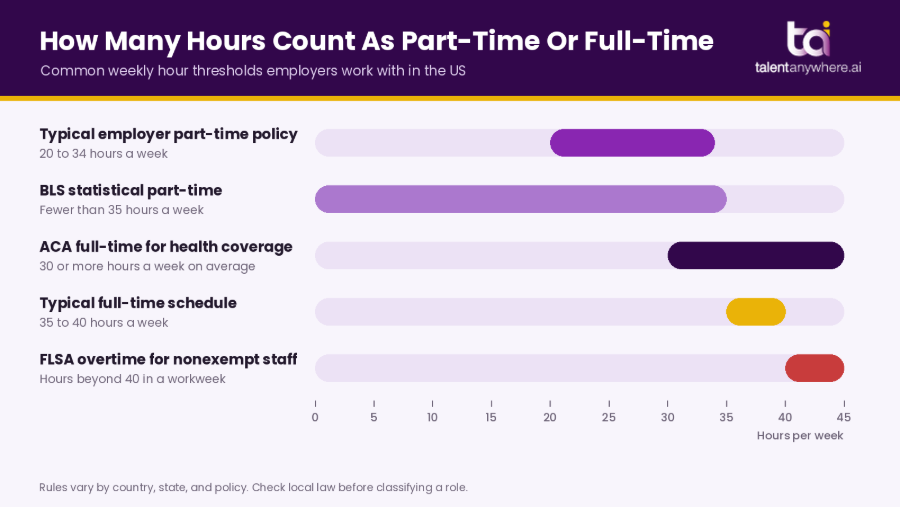
In the United States, the Fair Labor Standards Act does not define part-time or full-time employment, which leaves the distinction largely to employers. For statistical purposes, the US Bureau of Labor Statistics counts people who usually work fewer than 35 hours a week as part-time. Many employers set their own internal threshold somewhere between 20 and 34 hours a week, often tied to benefits eligibility. Outside the US, employment laws and definitions vary widely, so always check local regulations before classifying a role.
Common Types Of Part-Time Roles
Part-time work takes several forms, and each suits a different business need.
- Regular part-time: A permanent role with a consistent, reduced schedule, such as 20 hours a week.
- Seasonal part-time: Roles that cover predictable peaks, like retail holidays or tax season.
- Temporary part-time: Short-term coverage for projects, employee leave, or uncertain demand.
- Job sharing: Two part-time employees splitting the responsibilities of one full-time role.
Also Read: What Is an Applicant Tracking System (ATS) and How Does It Work
What Is Full-Time Employment
Full-time employment is a role on the employer’s standard working schedule, typically 35 to 40 hours a week in many countries. Like part-time work, it has no single universal legal definition, and different rules use different thresholds.
Full-Time Status Under Benefits Rules
In the US, the Affordable Care Act treats an employee who averages at least 30 hours of service per week, or 130 hours per month, as full-time for its employer shared responsibility provisions. Those provisions apply to applicable large employers, generally those with 50 or more full-time employees, including full-time equivalents. In practice, an employee you consider part-time internally could still count as full-time for health coverage purposes.
Why Full-Time Status Still Signals Stability
For many candidates, full-time status means predictable income, access to benefits, and a clearer path for growth. For employers, it usually means deeper commitment, more institutional knowledge, and easier long-term planning. That is why core, ongoing roles are still most often filled on a full-time basis.
Part-Time Vs. Full-Time Key Differences For Employers
The headline difference is hours, but the practical differences reach much further. The table below summarizes the main areas employers need to plan for, followed by a closer look at each.
| Factor | Part-time employees | Full-time employees |
| Typical hours | Below the standard schedule, often 20 to 34 a week | Standard schedule, often 35 to 40 a week |
| Pay structure | More often hourly | More often salaried |
| Benefits | Often limited or prorated | Usually eligible for the full package |
| Scheduling | Flexible, shift-based | Fixed and predictable |
| Overtime (US) | Applies to nonexempt staff beyond 40 hours a week | Same rule applies |
| Fixed cost per head | Lower | Higher, including benefits |
| Retention | Varies, can be lower | Typically higher |
Hours And Scheduling
Part-time staff give you the flexibility to cover peak hours, weekends, or specific shifts without paying for idle time. Full-time staff give you continuity and make it easier to plan projects that span weeks or months. Many teams need both.
Pay And Overtime
Part-time employees are more often paid hourly, while full-time roles are more often salaried, though both arrangements exist on either side. Overtime rules depend on how a worker is classified, not on whether they are labeled part-time or full-time. Under the US Fair Labor Standards Act, nonexempt employees must receive overtime pay for hours worked beyond 40 in a workweek, whatever their schedule is called internally.
Benefits Eligibility
Benefits are where the gap between the two groups is widest. According to the US Bureau of Labor Statistics, 89% of full-time civilian workers had access to employer-provided medical care benefits in March 2025, compared with just 25% of part-time workers. Among those with access, 67% of full-time workers enrolled, versus 44% of part-time workers.
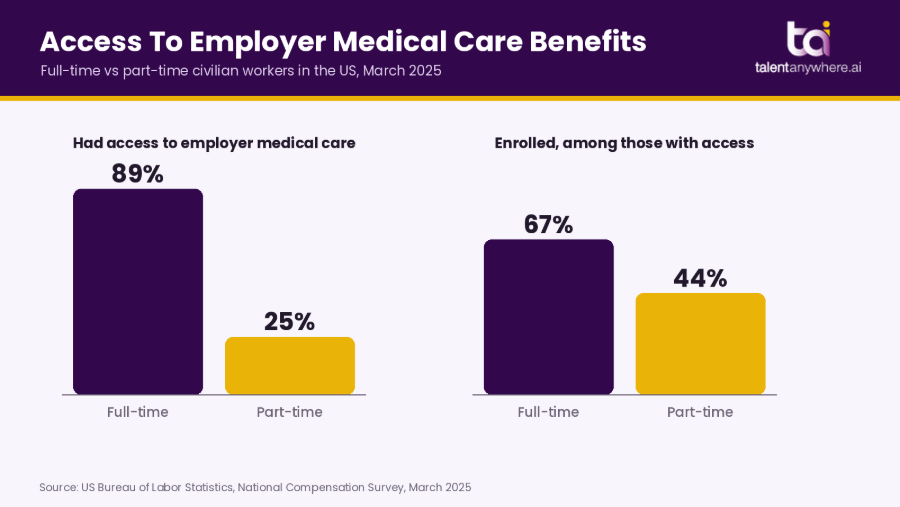
For employers, this means part-time roles typically carry lower benefit costs, but it can also make those roles harder to fill for candidates who need coverage. Some organizations offer prorated or selected benefits to part-timers to stay competitive.
Legal And Compliance Obligations
Classification can affect health coverage obligations, leave eligibility, retirement plan participation, and in some places, scheduling and notice rules. Requirements vary by country, state, and city, so document your definitions clearly in company policy and review them with legal or HR counsel.
Hiring part-time, full-time, or both?
Create clear, candidate-ready job posts for every employment type with talentanywhere.ai’s AI-powered hiring tools.
Pros And Cons Of Hiring Part-Time Employees
Part-time hiring is a powerful tool when it is used for the right roles. It also comes with trade-offs that are easy to underestimate.
Advantages Of Part-Time Employees
- Flexibility: Staff up for busy periods and scale back when demand drops.
- Lower fixed costs: Fewer hours and, often, fewer benefit obligations reduce payroll commitments.
- Wider talent pool: Students, parents, semi-retired professionals, and people with other commitments often prefer part-time schedules.
- Specialist access: You can bring in expertise for a few days a week without funding a full-time position.
Drawbacks Of Part-Time Employees
- Turnover risk: Part-time staff may leave when a full-time opportunity comes along.
- Coordination overhead: Managing more people across more shifts takes extra scheduling effort.
- Knowledge gaps: Fewer hours can mean less context on ongoing projects and decisions.
- Engagement challenges: Part-timers can feel disconnected if they regularly miss team meetings and updates.
Also Read: 15 Best Interview Questions To Ask Candidates
Pros And Cons Of Hiring Full-Time Employees
Full-time roles remain the backbone of most organizations, but they come with higher fixed commitments that need to be justified by the workload.
Advantages Of Full-Time Employees
- Continuity: Full-time staff build deep knowledge of your products, customers, and processes.
- Commitment: Predictable income and benefits tend to support stronger loyalty and retention.
- Easier planning: Consistent availability simplifies project timelines and team coordination.
- Leadership pipeline: Full-time employees are typically the pool you promote into senior roles.
Drawbacks Of Full-Time Employees
- Higher total cost: Salary, benefits, and overhead add up quickly.
- Less flexibility: Scaling a full-time team down when demand drops is slower and more disruptive.
- Longer hiring cycles: Candidates weigh full-time offers more carefully, which can extend time-to-hire.
How To Choose Between Part-Time And Full-Time Hires
The part-time vs full-time decision should start with the work, not the job title. The talent market matters too. The US Bureau of Labor Statistics reported that 4.5 million people were employed part time for economic reasons in September 2026, meaning they would have preferred full-time work but had their hours cut or could not find a full-time job. For employers, that is a reminder that a meaningful share of part-time talent is open to more hours when the right role comes along.
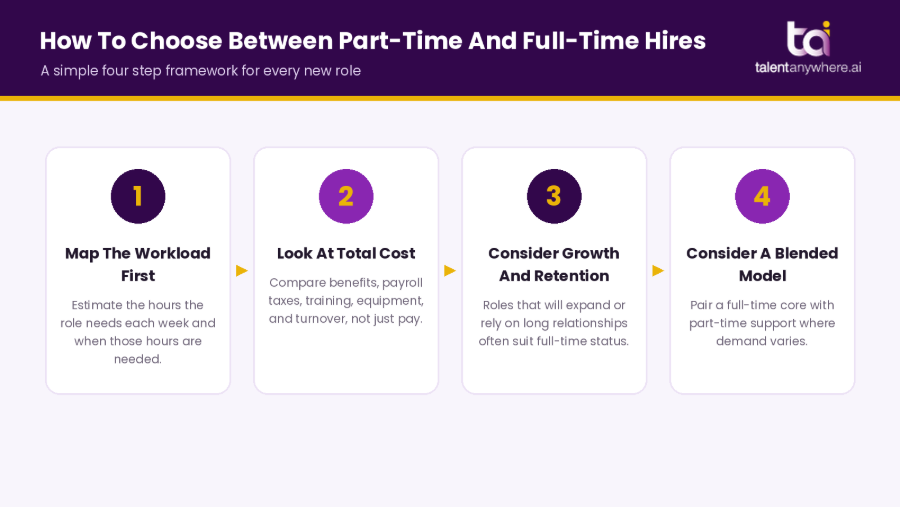
Map The Workload First
Estimate the hours the role genuinely requires each week, and when those hours are needed. If the work is steady and close to a full schedule, a full-time hire is usually the better fit. If it clusters around specific times or fluctuates, part-time coverage may be more efficient.
Look At Total Cost, Not Just Pay
Compare the full cost of each option, including benefits, payroll taxes, training, equipment, and the cost of turnover. A part-time role with high churn can end up costing more than a stable full-time position.
Consider Growth And Retention
If the role is likely to expand, or if it depends on long-term relationships with customers or colleagues, full-time status often pays off. If you are testing a new function, a part-time hire can be a lower-risk way to prove the need before committing.
Consider A Blended Model
Many teams combine a full-time core with part-time support. This gives you continuity where it matters most and flexibility where demand varies. A clear path from part-time to full-time can also become a strong retention tool.
Managing A Mixed Workforce Well
Most growing teams end up with a mix of part-time and full-time staff. The mix itself is rarely the problem. Problems appear when the two groups are treated so differently that part-timers feel like outsiders.
Keep Communication Equal
Record key meetings, share written updates, and rotate meeting times so part-time staff are not always the ones missing out. Equal access to information is one of the simplest ways to keep engagement high across the whole team.
Apply Policies Consistently
Write down how hours, overtime, leave, and benefits work for each employment type, and apply those rules the same way every time. Consistency protects you from compliance risk and from the perception of favoritism.
Review Classifications Regularly
Hours have a way of creeping up. A part-time employee who now regularly works close to a full schedule may need to be reclassified, both for fairness and for benefits compliance. A quarterly check on actual hours worked keeps classifications accurate.
Also Read: AI Recruitment Tools Every Hiring Team Should Know in 2026
Writing Job Posts That Make Employment Type Clear
Whichever option you choose, say it plainly. Ambiguity about hours is one of the fastest ways to attract the wrong applicants and lose the right ones.
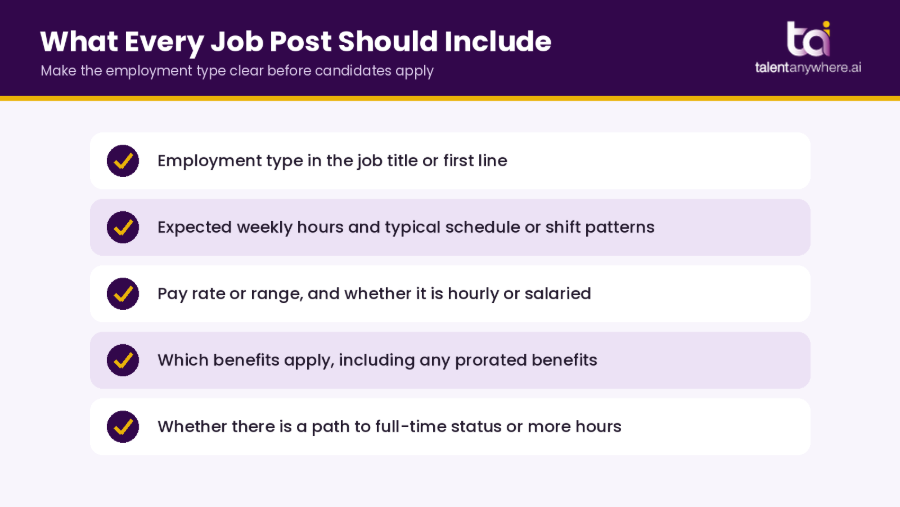
What To Include In Every Post
- The employment type in the job title or first line, such as “Customer Support Associate (Part-Time, 25 Hours a Week)”
- Expected weekly hours and typical schedule or shift patterns
- The pay rate or range, and whether it is hourly or salaried
- Which benefits apply, including any prorated benefits for part-time staff
- Whether there is a path to full-time status or additional hours
talentanywhere.ai’s AI-powered hiring tools help you build job posts that spell out these details from the first draft, so the candidates who apply already know what the role involves and whether it fits their life.
Choosing The Right Fit For Each Role
There is no universally better answer in the part-time vs full-time debate. Full-time employees bring continuity, commitment, and a leadership pipeline. Part-time employees bring flexibility, cost control, and access to talent who cannot or do not want to work a full schedule.
Start with the workload, weigh the total cost, check your local legal obligations, and be transparent with candidates about hours and benefits. Get those fundamentals right and you can build a team that is both stable and adaptable.
Build a team that fits the work
From flexible part-time support to long-term full-time hires, talentanywhere.ai helps you find the right people faster.
FAQs
What Is Part-Time Work In Terms Of Weekly Hours?
Do Part-Time Employees Get Benefits?
Can A Part-Time Employee Become Full-Time?
Is 30 Hours A Week Considered Full-Time?
Which Costs Less, Part-Time Vs. Full-Time Staff?


talentanywhere.ai
Build professional resumes with AI, improve your ATS score, and apply with confidence. talentanywhere.ai empowers job seekers with smarter resume creation and career tools for every stage.