


Table of Contents
 Set as a preferred Google source
TL;DR
In short, this article covers the following:
- Strong interviews rely on role-relevant questions that surface evidence of past behavior, not clever or unusual prompts.
- Each of the 15 questions comes with what it assesses, what to look for and a follow-up that gets past rehearsed answers.
- Ask every candidate for the same role the same core questions, then adapt the follow-ups.
- Score answers on a shared 1 to 5 scale against competencies defined before the interview.
- Skip vague, trick, leading and overly personal questions.
A resume tells you what a candidate has done. A well-run interview tells you how they think, communicate, solve problems and approach the work you are hiring for. Closing that gap depends on the interview questions to ask candidates and how consistently you ask them.
When every interviewer improvises, candidates face different conversations and their answers become impossible to compare. The most common interview questions are not the problem on their own. The problem is asking them without a clear purpose or a shared standard for what a strong answer sounds like.
This guide covers 15 questions to ask in an interview that produce useful, job-related evidence. For each one, you will find what it assesses, what to look for in the answer and a follow-up that pushes past rehearsed responses. It closes with a scoring framework, questions to avoid and answers to common hiring questions.
What Makes A Good Interview Question?
A good interview question earns its place by producing evidence you can act on. Before building a list of interview questions to ask candidates, agree on what “good” means. The strongest questions are
- Relevant to the role and its day-to-day demands
- Designed to draw out specific examples rather than opinions
- Focused on one skill, behavior, motivation or competency
- Consistent across everyone applying for the same role
- Possible to evaluate against predefined criteria
Also Read More How AI Resume Shortlisting Improves Candidate Quality
Why Structured Interview Questions Matter
Structured interview questions give every candidate the same core prompts. When a panel works from the same interview questions to ask candidates, score differences reflect the candidates rather than the interviewers. That does not mean reading from a rigid script. Standardize the core questions, then use relevant follow-ups to explore each answer.
The research supports this. A 2022 meta-analysis in the Journal of Applied Psychology by Paul Sackett and colleagues found that structured interviews had a mean operational validity of .42 for predicting job performance, ranking them among the strongest selection methods reviewed. Candidates notice too. Google’s re:Work team reported that rejected candidates who had a structured interview were 35% happier than rejected candidates who did not.
Stop Hiring On Gut Feel
Give every candidate the same fair, structured evaluation with AI-powered interviews and assessments from talentanywhere.ai.
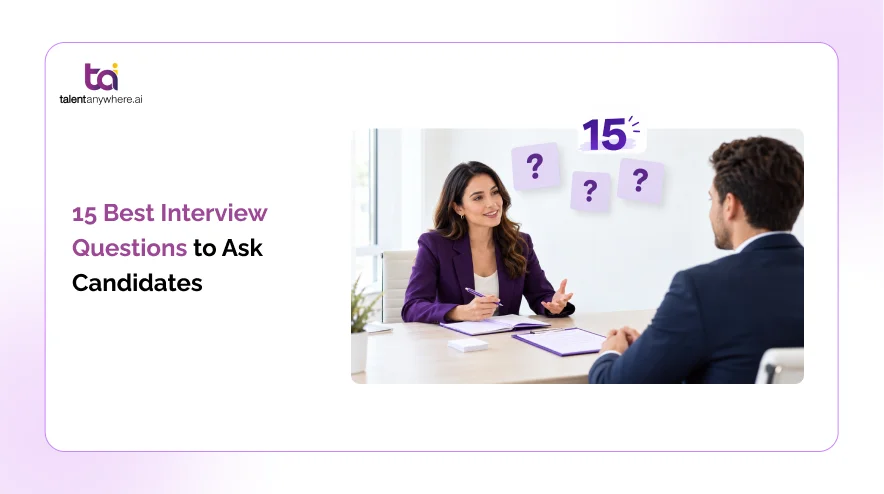
15 Best Interview Questions To Ask Candidates
These are good interview questions to ask candidates for most roles because they favor evidence over cleverness. Most are behavioral interview questions about past actions, since what someone has already done is a more reliable signal than what they say they would do. Each question below explains what it assesses, what to look for, what a strong answer sounds like, which weak signals to note and a follow-up to go deeper.
1. Can You Walk Me Through Your Relevant Experience?
What it assesses: Relevant experience, communication and understanding of the role. It also shows whether the candidate can select what matters instead of repeating the whole resume.
What to look for: A strong answer is selective. The candidate picks two or three experiences that map to the job description, explains what they were responsible for and names a result for each. Listen for whether they connect their background to the role themselves or leave you to do it. An answer that runs through every job in chronological order often points to weak preparation or poor prioritization.
What a strong answer sounds like: “The most relevant part is the last two years I spent running recruitment operations for our sales team. I owned the interview process end to end and introduced a scorecard that cut drop-offs between rounds. That is very close to what this role needs.”
Weak signals: A resume recital, vague claims of “being involved” in projects or no mention of results.
Follow-up: Which part of your experience will matter most in this role, and why?
2. What Interested You About This Role?
What it assesses: Motivation, preparation and genuine interest. It separates candidates who want this job from candidates who want any job.
What to look for: Specific references to the responsibilities, the team, the product or where the company is heading. Of all the strategic interview questions to ask candidates, this one quickly shows who has done their homework. Strong candidates link what attracts them to their own experience or goals, which also tells you what will keep them engaged after they join.
What a strong answer sounds like: “The job description mentions building the onboarding process from scratch. I did something similar at my last company and want to do it at a larger scale. I also read about your expansion into new markets, and that kind of growth is where I do my best work.”
Weak signals: Praise that could apply to any employer, such as “great culture,” with nothing specific behind it.
Follow-up: What specifically about this role stood out to you compared with others you are considering?
3. What Are You Looking For In Your Next Role?
What it assesses: Career expectations, motivation and role alignment. It tests whether what the candidate wants overlaps with what the role can honestly offer.
What to look for: Clear, realistic priorities such as more ownership, a particular kind of problem, a steeper learning curve or a specific working arrangement. Compare these against the role as it really is, not as the job ad presents it. A highly qualified candidate can still be a poor match if they want scope, growth speed or flexibility the position cannot provide, and it is far better to discover that now than six months after they join.
What a strong answer sounds like: “I want to move from executing campaigns to owning strategy for a product line. I am also looking for a team where I can learn from someone more senior in analytics.”
Weak signals: Goals that directly conflict with the role, such as wanting to lead a team when the position has no reports, left unexplored.
Follow-up: What would make this role a successful next step for you a year from now?
4. Tell Me About A Difficult Problem You Had To Solve
What it assesses: Problem-solving, critical thinking, ownership and judgment under uncertainty.
What to look for: Ask for a real situation, not a hypothetical. A strong answer covers the problem and why it mattered, what the candidate personally did, the reasoning behind their approach, the outcome and what they learned. Pay attention to how they diagnosed the problem before acting, because that step often separates strong problem-solvers from people who simply work hard. If the answer is all “we,” ask directly what their own contribution was.
What a strong answer sounds like: “Our weekly reports kept landing two days late, and managers had stopped trusting the numbers. I traced the delay to three manual data exports, automated two of them and agreed a new handover time with finance for the third. Reports have gone out on time since, and now I look for manual steps first whenever a process slows down.”
Weak signals: A problem with no clear stakes, a solution with no reasoning or an outcome that is never mentioned.
Follow-up: What alternatives did you consider before choosing that approach?
5. Tell Me About A Time You Had To Make A Difficult Decision
What it assesses: Judgment, decision-making, trade-off analysis and accountability.
What to look for: A clear path of situation → options → decision → reasoning → result. The best answers show that the candidate recognized the trade-offs, gathered what information they could in the time available and owned the outcome, including any downside. Judge the quality of the reasoning, not whether you would have made the same call. Two strong candidates can make opposite decisions and both justify them well.
What a strong answer sounds like: “We had to choose between launching on time with a known bug or delaying a week. I checked how many users the bug would affect, asked support what ticket volume to expect and decided to launch with a clear workaround in the release notes. Tickets stayed manageable, but I would have briefed sales earlier, because two clients were caught off guard.”
Weak signals: A decision presented as obvious, no alternatives considered or blame placed on others when it went wrong.
Follow-up: What information did you wish you had at the time?
6. How Do You Prioritize When You Have Multiple Deadlines?
What it assesses: Organization, time management, prioritization and stakeholder communication.
What to look for: A repeatable method rather than a personality trait. Strong candidates describe how they weigh impact against urgency, how they confirm priorities with a manager or stakeholders and what they do when something has to slip. “I make a to-do list” is a starting point, not an answer. The most useful signal is whether they communicate trade-offs early instead of quietly missing a deadline.
What a strong answer sounds like: “Every Monday I list what is due and rank it by business impact and deadline. When two urgent items clash, I take both to my manager, explain what each delay would cost and agree which one moves. I would rather renegotiate a deadline on Tuesday than miss it on Friday.”
Weak signals: Claims of never missing a deadline, heavy reliance on working late or no mention of involving anyone else.
Follow-up: Tell me about a time two priorities conflicted. How did you decide what came first?
7. Tell Me About A Time You Failed Or Made A Mistake
What it assesses: Self-awareness, accountability, learning ability and resilience.
What to look for: A genuine mistake with real consequences, described plainly. Strong candidates take reasonable ownership without excessive self-criticism, explain what went wrong, describe how they fixed or contained it and, most importantly, show what they do differently now. Changed behavior is the evidence you are listening for.
What a strong answer sounds like: “I sent a client proposal with last year’s pricing because I reused an old template. The client noticed, and we had to honor part of the old rate. I owned it with my manager straight away, and since then I use a pre-send checklist and never edit live templates.”
Weak signals: A disguised strength such as “I care too much,” a story where the mistake belonged to someone else or no lesson learned.
Follow-up: What would you do differently if you faced the same situation today?
Also Read More Top 10 AI Recruitment Tools In 2026
8. Tell Me About A Time You Worked With Someone Who Disagreed With You
What it assesses: Collaboration, conflict resolution, communication skills and emotional intelligence.
What to look for: The ability to disagree without becoming defensive. Strong answers show the candidate listened to understand the other person’s view, raised their concern directly and respectfully and focused on the best outcome for the work rather than on winning. It is also a good sign when they can describe what the other person got right.
What a strong answer sounds like: “A designer and I disagreed on whether to cut a feature to hit a launch date. I asked what worried her and realized she had user research I had not seen. We agreed to launch a simpler version and add the rest in the next release, which worked better than either of our original plans.”
Weak signals: The other person is cast as the villain throughout, the conflict was escalated without any attempt to resolve it or the candidate claims never to disagree with anyone.
Follow-up: What did you learn from their point of view?
9. How Do You Handle Constructive Feedback?
What it assesses: Coachability, self-awareness, growth mindset and professional maturity.
What to look for: A concrete example of feedback received, how the candidate reacted in the moment and the specific change it produced. Almost everyone says they welcome feedback, so the original question invites a polished answer and the follow-up does most of the work. Strong candidates can name feedback that was uncomfortable to hear and explain how they judged whether it was fair.
What a strong answer sounds like: “My manager told me my updates to leadership were too detailed and buried the decision they needed to make. It stung, but she was right. I now open every update with the decision required, and I have since been given ownership of the monthly leadership report.”
Weak signals: No example at all, feedback that was really praise or an example where the candidate explains why the feedback was wrong.
Follow-up: Tell me about a piece of feedback that changed how you work.
10. Tell Me About A Time You Had To Learn Something Quickly
What it assesses: Adaptability, learning ability, initiative and curiosity.
What to look for: How the candidate approached unfamiliar territory. Strong answers explain how they broke the subject into parts, which resources or people they used, how they tested their understanding and how quickly they became productive. This question works well for candidates with limited experience, because the example can come from study, an internship or a personal project.
What a strong answer sounds like: “I joined a team that used a reporting tool I had never touched, and I had to present with it within two weeks. I took the vendor’s free course, rebuilt one existing report myself to learn the logic and asked a colleague to review it. By the presentation I was confident enough to take questions.”
Weak signals: Waiting to be trained, relying entirely on others or no clear sense of how long it took.
Follow-up: What did you do when you got stuck?
11. What Motivates You To Do Your Best Work?
What it assesses: Motivation, engagement drivers, work preferences and role alignment.
What to look for: Genuine motivators such as learning, ownership, problem-solving, meaningful work, collaboration, autonomy or achievement, backed by an example. Then compare those motivators with the real conditions of the role. Someone driven by autonomy may struggle in a heavily process-led position, however talented they are. Compensation is a legitimate motivator and should not count against anyone.
What a strong answer sounds like: “I do my best work when I own a problem from start to finish and can see the result. The projects I am proudest of at my last job were the ones where I was trusted to run things and report back, rather than follow a set plan.”
Weak signals: Generic lines like “I am motivated by success” with no example, or motivators the role clearly cannot satisfy.
Follow-up: Which project made you feel most engaged, and what made it different?
12. What Kind Of Work Environment Helps You Perform At Your Best?
What it assesses: Working preferences, team compatibility, autonomy versus structure and communication style.
What to look for: Specific, honest preferences about pace, structure, feedback and communication. Then check them against how the team actually works. This matters most for remote, hybrid and distributed teams, where communication habits can make or break performance. Focus on concrete working behaviors rather than a vague sense of “culture fit,” which tends to reward similarity instead of suitability.
What a strong answer sounds like: “I work best with clear goals and room to decide how to reach them. On a remote team, I like a short weekly check-in with written updates in between, and I am comfortable being the one who flags when something is unclear.”
Weak signals: “I can work anywhere” with nothing more specific, or preferences that conflict directly with how the team operates.
Follow-up: How do you stay aligned with a team you rarely see in person?
13. What Is One Professional Achievement You Are Most Proud Of?
What it assesses: Achievement orientation, skills, values, ownership and impact.
What to look for: A clear challenge → action → result → impact story. What candidates choose to highlight reveals what they value, whether that is solving a hard problem, helping a team grow or delivering a measurable result. Check whether their strongest work relates to what this role needs, and whether they can separate their own contribution from the team’s.
What a strong answer sounds like: “I rebuilt our customer onboarding emails after noticing most trial users never finished setup. I interviewed ten customers, rewrote the sequence around their biggest questions and tested it against the old version. More users completed setup, and the approach became the template for our other products.”
Weak signals: An achievement with no result, no clear personal role or no connection to the work involved here.
Follow-up: What made this achievement harder than it looks?
14. What Would Your Previous Manager Or Teammates Say You Do Well?
What it assesses: Self-awareness, reputation, collaboration and interpersonal skills.
What to look for: Strengths that are specific, plausible and consistent with the rest of the interview. Asking what others would say often draws a more honest answer than asking candidates to describe themselves. The best answers include a quick story that shows the strength in action, and candidates who volunteer an area their manager wanted them to improve are showing useful self-awareness.
What a strong answer sounds like: “My last manager would say I bring order to messy projects. When our team took over a delayed migration, I set up the tracker and weekly check-ins that got it back on schedule. She would also say I need to delegate more, which I am working on.”
Weak signals: Broad adjectives like “hardworking” or “a team player” with nothing to support them.
Follow-up: Can you give me an example that supports that? This turns a self-description into evidence.
15. What Would You Do In Your First 90 Days In This Role?
What it assesses: Preparation, initiative, understanding of the role, strategic thinking and prioritization.
What to look for: A plan that starts with learning before changing. Strong answers include understanding the organization and its priorities, meeting key stakeholders, reviewing existing processes, identifying a few quick wins and setting realistic goals. If you want unique interview questions to ask candidates that still produce evidence, this beats “Where do you see yourself in five years?” because it shows how someone thinks about this specific job.
What a strong answer sounds like: “In the first month I would meet each stakeholder and understand what success looks like for them. In the second month I would pick one or two quick wins based on what I learn. By day 90 I would want agreed goals for the next two quarters.”
Weak signals: Sweeping changes proposed before understanding the context, or a plan so vague it could apply to any role.
Follow-up: What would you want to learn before making any changes?
Better Questions. Better Hires.
Turn every interview into comparable evidence with talentanywhere.ai’s AI-powered candidate assessment.
How To Choose The Right Interview Questions For A Role
These 15 questions are a starting point, not a universal checklist. The right interview questions to ask candidates depend on four factors.
The Role
Technical roles need technical and problem-solving questions alongside behavioral ones. Customer-facing roles call for communication and judgment under pressure.
The Seniority Level
Assess entry-level candidates on potential, learning ability and motivation. Assess senior candidates on strategic thinking, leadership skills and influence.
The Core Competencies
Identify four to six competencies that drive success, such as communication, problem-solving, collaboration or adaptability, and map every question to at least one.
The Interview Stage
The interview questions to ask at candidate screening differ from those in a technical round or final interview. Assign questions by stage so candidates are not asked the same thing three times.
How To Get Better Answers From Candidates
Even well-chosen interview questions to ask candidates produce thin answers if the interviewer accepts the first response. Three habits make the difference.
Ask For Specific Examples
Instead of “Are you good at handling pressure?”, ask “Tell me about a time you had to deliver under significant pressure.” Past behavior is harder to rehearse and easier to verify.
Use Follow-Up Questions
Short prompts such as “What was your specific role?”, “Why did you choose that approach?” and “What would you do differently now?” turn a general answer into behavioral evidence.
Focus On Evidence Over Impressions
A confident candidate is not necessarily a strong one. Note evidence of behavior, decisions and outcomes as the candidate speaks, rather than relying on how the conversation felt.
Also Read More What Is An Applicant Tracking System And How Does It Work
How To Evaluate Candidate Answers Consistently
Consistent evaluation turns a set of interview questions to ask candidates into a fair, defensible hiring process. Treat interview questions and answers as a record of evidence, scored on the same scale for every candidate. Structure saves time as well. Google’s re:Work guide reports that pre-made questions, guides and rubrics save interviewers an average of 40 minutes per interview.
| Score | Meaning |
| 1 | Little or no relevant evidence |
| 2 | Limited evidence |
| 3 | Meets expectations |
| 4 | Strong evidence |
| 5 | Exceptional evidence |
Score The Same Competencies Across Candidates
Define competencies and what each score looks like before interviews begin. Interviewers should score independently, then compare notes. This limits the pull of first impressions and gives the hiring manager comparable evidence.
Interview Questions To Avoid
Knowing which interview questions to ask is only half the job. Several of the most common interview questions waste time or introduce bias.
Questions That Are Too Vague
“Are you a team player?” invites a quick yes and reveals nothing about how the candidate collaborates.
Trick Questions
Brainteasers may feel clever, but cleverness in an interview does not reliably predict job performance.
Leading Questions
“You don’t have a problem working under pressure, right?” signals the expected answer.
Irrelevant Or Overly Personal Questions
Keep every question job-related. Questions about family plans, age, religion or health add bias and legal risk without improving the decision.
Conclusion
The best hiring interview questions are not the most unusual ones. The search for unique interview questions to ask candidates often ends in riddles that reveal very little. The questions that work are the ones that produce clear evidence about whether someone can succeed in the role.
That evidence comes from relevant questions, a consistent process, strong follow-ups and objective evaluation working together. With those in place, candidate interview questions become a reliable input to better hiring decisions.
Keeping that consistency across every panel is where the right platform helps. talentanywhere.ai brings AI-powered interviewing and candidate assessment into one hiring workflow, so recruiters and hiring managers can measure every candidate against the same standard and build a smarter candidate evaluation process from the first conversation.
FAQs
What Are The Best Interview Questions To Ask Candidates?
What Are Good Interview Questions To Ask Candidates?
What Are Strategic Interview Questions To Ask Candidates?
How Many Questions To Ask In An Interview?
Should You Ask Every Candidate The Same Interview Questions?
What Questions Should You Ask A Candidate With No Experience?
What Questions Should You Ask At The End Of An Interview?
How Do You Evaluate Candidate Answers?


talentanywhere.ai
Build professional resumes with AI, improve your ATS score, and apply with confidence. talentanywhere.ai empowers job seekers with smarter resume creation and career tools for every stage.
![10 Best ATS Resume Checkers to Improve Your Resume [Free + Paid]](https://www.talentanywhere.ai/wp-content/uploads/2026/09/Hero-10-Best-ATS-Resume-Checkers-to-Improve-Your-Resume-FREE-Paid-1-300x168.webp)


