

Table of Contents
 Set as a preferred Google source
TL;DR
- Remote roles attract far more applicants than on-site ones, so beginners need sharper positioning, not more applications.
- Customer support, virtual assistance, data annotation, content writing, QA testing, and remote sales are realistic starting points.
- No experience” usually means no formal job history. Employers still expect tool fluency, clear writing, and self-management.
- Build small proof of work, tailor every resume, and apply within the first few days of a posting.
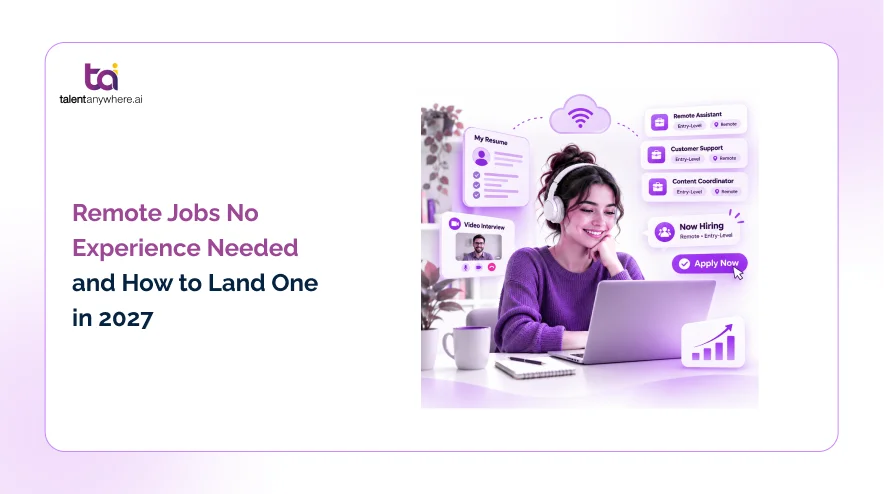
Remote work looks like the easiest door to walk through when you’re starting out. No commute, no relocation, and employers from anywhere. In practice, it is one of the most crowded corners of the job market.
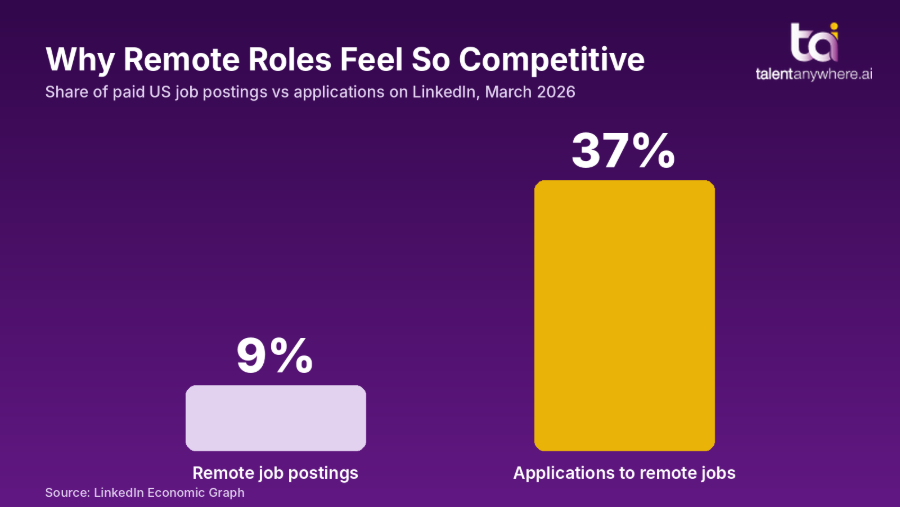
LinkedIn’s Economic Graph data shows that in March 2026, remote roles made up just 9% of paid US job postings on the platform but drew 37% of all applications. That gap sits behind every search for remote jobs no experience required. Beginners still get hired, though. They simply approach it differently:
- They target roles built for training. Support, operations, and annotation teams expect to teach new hires.
- They show proof, not promises. A writing sample, a test project, or a short screen-recorded walkthrough stands in for missing job history.
- They signal remote readiness. Comfort with Slack, Google Workspace, and video calls matters almost as much as the core skill.
- They apply early and specifically. A tailored application in the first few days of a posting beats a generic one sent in week three.
Most of that starts with a resume that makes a recruiter stop scrolling.
Remote Roles Get Flooded. Make Your Resume The One That Stands Out
Tailor your resume to every remote listing so it clears ATS filters and lands in front of a real recruiter, with talentanywhere.ai.
What No Experience Really Means In Remote Hiring
Very few remote employers hire someone with zero skills. When a listing says no experience required, it usually means no prior job in that exact role. The hiring team still expects a baseline:
- Reliable internet and a quiet workspace for calls
- Clear written communication, since most remote work happens in chat threads and shared docs
- Working knowledge of collaboration tools such as Slack, Zoom, Google Workspace, and a tracker like Trello or Asana
- The discipline to manage your own day without someone checking in every hour
Show those four clearly and you already qualify for more entry-level remote roles than you might expect.
Also Read: How To Write A Resume With No Experience
Best Remote Jobs For Beginners In 2027
These roles combine steady demand with genuine on-the-job training. Several also lead straight into better-paid remote careers once you have a year of experience behind you. When choosing between them, think less about what sounds easiest and more about which daily work you could do well for a year, because that consistency is what earns the next step.
Customer Support Representative
Support teams hire beginners at scale and train them on the product. You handle tickets, chats, and emails, and you learn how a business really works from the customer’s side.
Get ready by learning a help desk tool like Zendesk or Freshdesk through a free trial and drafting replies to a few tricky customer complaints.
Virtual Assistant
Founders, consultants, and small agencies need help with scheduling, inbox management, research, and documentation. It is one of the most flexible remote roles for beginners, with both freelance and full-time options.
Get ready by getting fluent in Google Workspace, calendar tools, and Notion, then offering a short paid trial to one client to earn a reference.
Data Annotation Specialist
AI companies need people to label, review, and rate the data that trains their models. Much of this work rewards careful attention more than technical background, and specialist projects in areas like medicine, law, or coding tend to pay more.
Get ready by practicing careful, rule-based work and applying directly to annotation teams. Read every guideline twice, since accuracy scores usually decide who gets more tasks.
Content Writer
Brands, SaaS companies, and agencies need blogs, product copy, and emails. Clients judge you almost entirely by your samples, which makes this a fair field for newcomers.
Get ready by publishing three samples in the niche you want to write for and learning basic SEO, since most content briefs come with target keywords.
Social Media Coordinator
Small businesses often hand their social channels to a junior coordinator who schedules posts, replies to comments, and tracks basic metrics.
Get ready by running an account for a local business or community group and documenting its growth over 60 days with screenshots.
Online Tutor
If you’re strong in a school subject, a language, or a skill like coding or music, tutoring platforms let you start quickly and set your own hours.
Get ready by recording a short demo lesson and listing your subjects on established tutoring platforms.
QA Tester
Software teams need people who find bugs before users do. Manual testing has a low barrier to entry and leads naturally into automation testing.
Get ready by learning to write a clear bug report, trying crowdtesting platforms for real practice, and picking up Selenium or Playwright basics later.
Transcriptionist And Captioner
Podcasters, researchers, and video teams need accurate transcripts and captions. Speed matters, but accuracy and careful formatting matter more, and the work suits people who want flexible hours.
Get ready by taking a free typing test to benchmark your speed, practicing with clear and messy audio, and learning the style rules most platforms publish for their transcribers.
Remote Sales Development Representative
Remote SDRs book meetings through email, LinkedIn, and calls. Employers hire for drive and communication, then teach the process.
Get ready by writing three sample cold emails for a real product and learning the basics of a CRM like HubSpot.
High Paying Remote Jobs You Can Grow Into
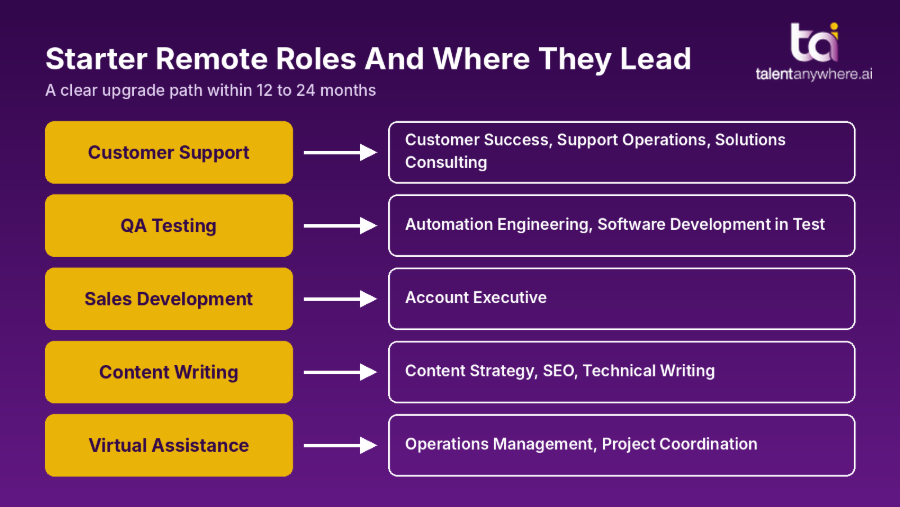
The starter role is rarely where the money is. Remote pay tends to follow specialization, and each role above has a clear upgrade path within 12 to 24 months:
- Customer support leads to customer success, support operations, or solutions consulting.
- QA testing leads to automation engineering and software development in test.
- Sales development leads to account executive roles, where commission drives earnings.
- Content writing leads to content strategy, SEO, and technical writing.
- Virtual assistance leads to operations management and project coordination.
Fully remote work is also more durable than the return-to-office headlines suggest. Gallup’s Hybrid Work Indicator found that as of May 2026, 26% of remote-capable US employees work exclusively remote and another 52% work hybrid. The best remote jobs at the senior end tend to go to people who used their first role to build a specialty.
How To Land A Remote Role With Zero Experience
With so many applicants per opening, volume isn’t a strategy. Precision is. These six steps separate candidates who land remote jobs no experience required from those who send 200 applications and hear nothing back.
Set Up A Remote-Ready Wor Gall kspace
Fix the basics first: a stable connection with a backup like a mobile hotspot, a working headset, and a quiet corner for calls. Many remote interviews include a live video round, and a dropped call creates doubt fast.
Learn The Remote Tool Stack
Spend a week getting comfortable with Slack, Zoom, Google Workspace, Notion, and Trello or Asana. List them in a dedicated tools section on your resume, because recruiters hiring for remote jobs no experience roles screen for exactly these.
Create Proof Of Work
Build one small asset that mirrors the job. A support candidate can write a mock FAQ for a real product. A VA can put together a sample travel itinerary and meeting brief. A QA tester can file three bug reports on a public app. Link it directly in your resume and cover note.
Write A Resume That Signals Remote Readiness
Highlight anything that shows self-management: freelance gigs, online college projects, volunteer work coordinated over email. Use the job post’s exact keywords so applicant tracking systems pick up the match, and keep it to one page. Add your time zone and working-hour overlap near the top. For employers hiring across countries, that single line answers a question they would otherwise have to ask, and it quietly shows you understand how distributed teams operate.
Apply Early And Apply Less
Popular remote postings can fill up with applications within days. Set job alerts, apply in the first 48 hours, and send ten tailored applications instead of fifty generic ones. A short, specific note to the hiring manager on LinkedIn can move you up the pile. Smaller companies and early-stage startups are worth extra attention, since their listings draw fewer applicants and they are often more open to training someone who shows initiative.
Prepare For Async And Video Interviews
Many remote employers use written assessments, one-way video interviews, or paid test tasks. Practice answering on camera, keep each answer under two minutes, and treat every written instruction as part of the test. If a task asks for a file in a specific format or a reply by a specific time, following that exactly is often what the reviewer is really checking.
Also Read: Why Your Resume Is Not Getting Shortlisted
A 30-Day Plan To Get Remote-Ready
Knowing the steps is easier than sequencing them. If you are starting from scratch, this four-week plan gets you from idea to applications without spreading yourself thin:
- Week 1. Choose one target role, read 15 job posts for it, and note the tools and skills that keep repeating.
- Week 2. Learn the two or three tools that came up most and set up your workspace, headset, and backup connection.
- Week 3. Build one proof-of-work asset, publish it with a shareable link, and rewrite your resume and LinkedIn headline around it.
- Week 4. Set daily job alerts, send two or three tailored applications a day, and follow up with a short message to each hiring manager.
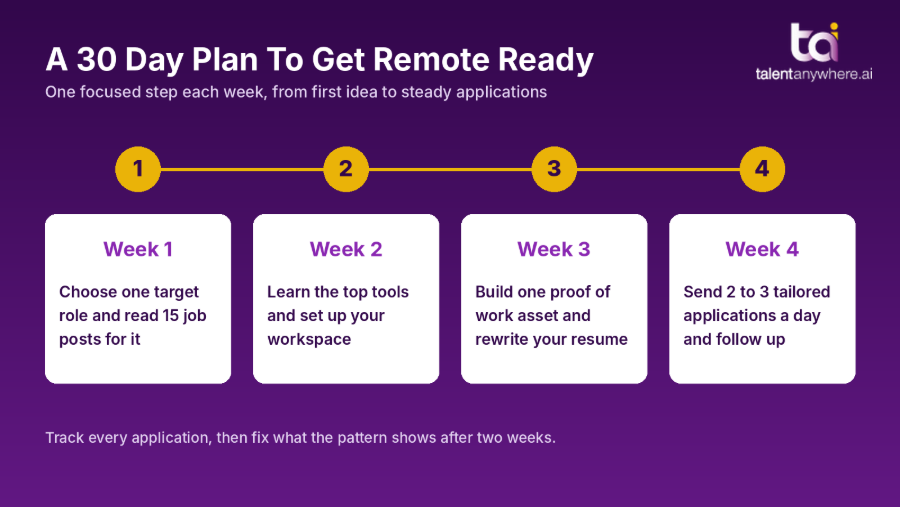
Keep a simple tracker of where you applied, when, and what happened. After two weeks of applications, the pattern usually tells you what to fix, whether that is your resume, your sample, or the roles you are targeting.
Red Flags To Watch For In Remote Job Listings
Beginners are the main target for remote job scams, so screening listings matters as much as polishing your resume. Legitimate employers rarely rush you or ask for money. Walk away if you see any of these:
- A request to pay for training, equipment, or a registration fee before you start
- Interviews conducted only through WhatsApp or Telegram chat
- A check sent to you for buying equipment, followed by a request to send part of the money back
- Pay far above market for simple tasks like liking videos or typing data
- No verifiable company website, LinkedIn page, or named recruiter
Final Thoughts
Remote work rewards beginners who treat the job search like a project. Pick a starter role with a clear upgrade path, build one piece of proof, learn the tool stack, and apply early with a tailored resume. That combination turns remote jobs no experience listings from a lottery into a realistic plan, and it sets you up for better-paid remote work within a year or two.
The step most beginners skip is tailoring. talentanywhere.ai helps you align your resume with each remote listing so your application reaches a real recruiter instead of getting lost in the pile.
Ready To Work From Anywhere?
Discover remote roles that match your skills and prepare for every interview with talentanywhere.ai.
FAQs
What Are The Easiest Remote Roles To Get As A Beginner?
Where Can I Find Remote Jobs No Experience Required?
Can Beginners Get High Paying Remote Jobs?
Do Remote Jobs For Beginners Require A Degree?
How Do I Spot A Fake Remote Job Offer?


talentanywhere.ai
Build professional resumes with AI, improve your ATS score, and apply with confidence. talentanywhere.ai empowers job seekers with smarter resume creation and career tools for every stage.