

Table of Contents
 Set as a preferred Google source
TL;DR
- Leadership on a resume is proven through actions and outcomes, not adjectives like “natural leader.”
- You do not need a manager title. Project ownership, mentoring, coordinating, and taking initiative all count.
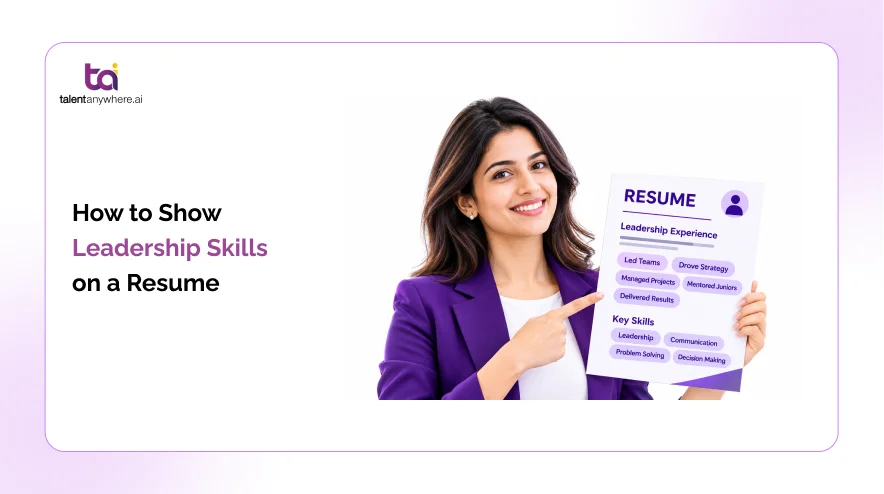
- Place your evidence in the summary, work experience, skills, and projects sections.
- Write each bullet with the Action + Context + Result formula, and add numbers only when you can verify them.
- Use the 30+ adaptable statements below as templates, then tailor them to the job description.
Employers look for leadership at almost every level, and it is not reserved for people with “manager” in their title. In practice, leadership can look like:
- Taking ownership of a project from start to finish
- Helping colleagues work through a problem
- Mentoring or training new employees
- Coordinating tasks so the team meets its deadlines
- Making a sound decision when a situation gets difficult
- Motivating people to work towards a shared goal
Yet most candidates stop at one line in the skills section: “leadership, team management, good communication.” In NACE’s Job Outlook 2026 Spring Update, more than half of the surveyed employers named 10 or more skills they look for on resumes, and NACE’s chief executive stressed that employers want to see examples, not just a list.
This guide shows you how to present leadership skills on a resume with real evidence. You will find 30+ leadership resume examples you can adapt, plus practical tips for every career stage.
Turn Your Leadership Into Resume Bullets That Stand Out
Build a clean, ATS-friendly resume with talentanywhere.ai’s AI resume builder and put your strongest examples where recruiters will see them.
What Are Leadership Skills On A Resume?
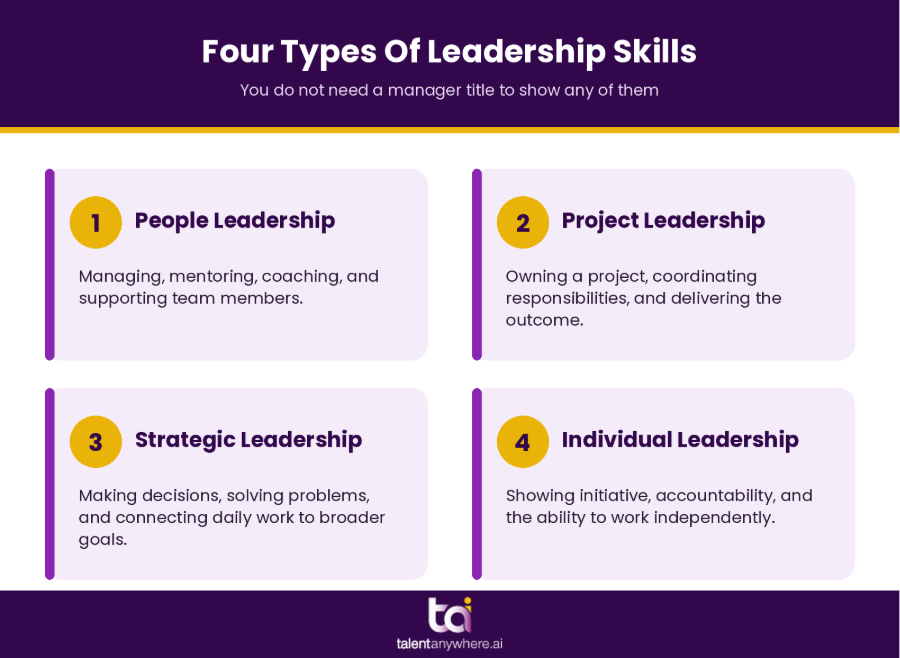
Leadership skills are the abilities that show you can guide, influence, motivate, organise, and support others while working towards a shared goal. They do not require a formal managerial position. Most fall into four types:
- People leadership: managing, mentoring, coaching, and supporting team members.
- Project leadership: owning a project, coordinating responsibilities, and delivering the outcome.
- Strategic leadership: making decisions, solving problems, and connecting daily work to broader goals.
- Individual leadership: showing initiative, accountability, and the ability to work independently.
A recruiter reading a leadership qualities resume section wants proof of the types that match the role, backed by what you actually did.
Also Read: How To Show A Promotion On Your Resume
30+ Leadership Skills Examples To Include On Your Resume
The right leadership skills examples depend on the job, the industry, and how much responsibility you have held.
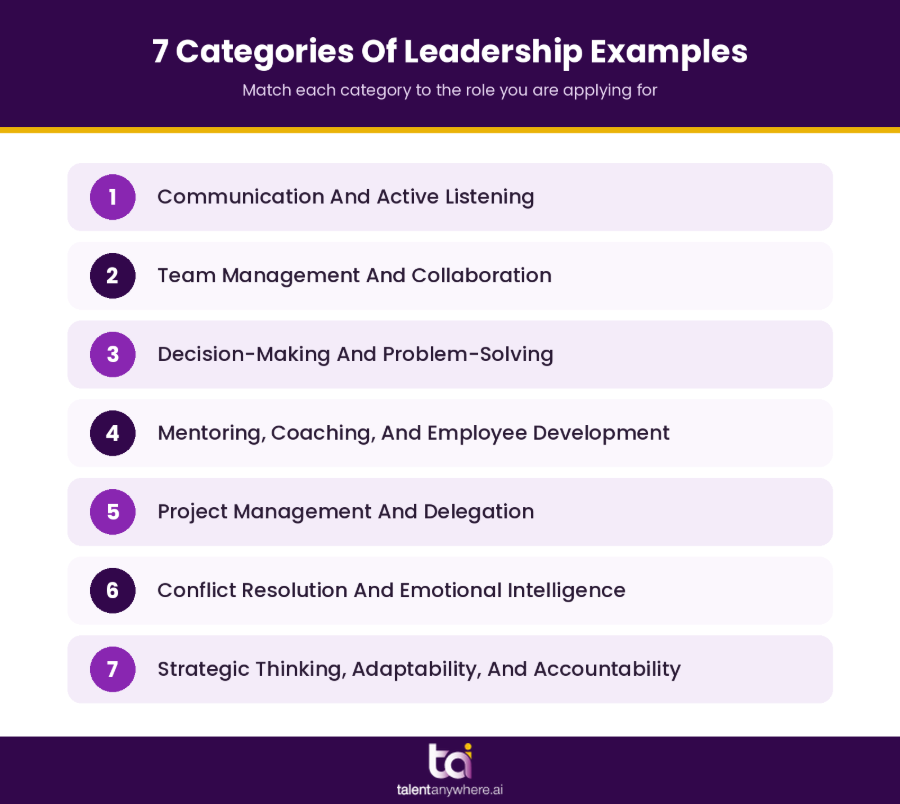
The statements below are grouped into seven categories. Each example names a role so you can see how the skill looks in a real job. The figures are illustrative, so swap in your own projects, tools, and team sizes, and only use numbers you can verify.
Communication And Active Listening
Good leaders set clear expectations, share information early, and listen. On a resume, this shows up as coordination between teams and stakeholders.
1. Project Coordinator: Ran a weekly 30-minute sync between design, development, and QA teams, reducing missed handoffs during a website relaunch that was delivered on schedule.
2. Business Analyst: Presented monthly customer churn findings to the leadership team, which led to a revised onboarding flow for new customers.
3. Team Lead, Customer Support: Introduced fortnightly team check-ins to surface workload concerns, helping reduce escalations from the team by 15% over one quarter.
4. Account Executive: Acted as the single point of contact between a key client and three internal teams, resolving 40+ change requests within agreed timelines.
Team Management And Collaboration
Leadership often means bringing people together and matching tasks to strengths. According to NACE’s Job Outlook 2026 Spring Update, 85% of employers look for teamwork skills on a candidate’s resume.
5. Engineering Team Lead: Led a team of five developers to ship a payment gateway integration two weeks ahead of the planned release date.
6. Event Manager: Assigned vendor, logistics, and guest management roles across a 12-member team, based on individual strengths, for a 500-attendee conference.
7. Operations Executive: Partnered with finance and procurement to fix an invoice approval bottleneck, cutting average approval time from 10 days to 4.
8. Marketing Intern: Built a shared campaign tracker that a four-person team used to monitor task owners, deadlines, and progress.
Decision-Making And Problem-Solving
Leaders weigh options, assess risk, and choose a direction. Show the problem you faced and what your decision changed.
9. Product Manager: Recommended dropping two low-usage features from a release after reviewing customer data, keeping the launch on schedule.
10. Supply Chain Analyst: Analysed recurring stock-outs at two warehouses and introduced a reorder-point system that reduced stock-outs by 30%.
11. Site Supervisor: Reassigned crew schedules within hours of a supplier delay, avoiding a penalty clause on a commercial construction project.
12. QA Engineer: Traced repeated release bugs to a missing test stage and worked with developers to add automated checks before every deployment.
Mentoring, Coaching, And Employee Development
Mentoring proves you can share knowledge and help others improve. It is one of the easiest signals for individual contributors to claim honestly.
13. Senior Accountant: Mentored three new hires through the month-end close, helping all three handle reconciliations independently within two months.
14. Data Analyst: Ran monthly SQL workshops for the sales team, enabling eight colleagues to build their own performance reports.
15. Content Lead: Gave structured written feedback on 20+ drafts a month, helping junior writers reduce revision rounds before final approval.
16. Software Engineer: Paired with two junior developers on their first production features and guided their code reviews until they could ship independently.
Project Management And Delegation
Project leadership covers planning, prioritising, allocating resources, tracking progress, and delivering results.
17. Project Manager: Planned and delivered a CRM migration for 150 users across three departments within a six-month timeline and the approved budget.
18. Retail Store Manager: Delegated inventory, visual merchandising, and cashier scheduling across a 14-person team to handle the festive season sales peak.
19. Implementation Consultant: Flagged a data migration risk three weeks before go-live and set up a contingency plan that kept the launch date intact.
20. HR Executive: Spearheaded a digital onboarding checklist that replaced paper forms and was adopted by four departments.
Conflict Resolution And Emotional Intelligence
Leaders handle disagreements by listening, understanding different perspectives, and keeping working relationships productive.
21. Design Team Lead: Resolved a scope disagreement between design and engineering by running a joint prioritisation session, agreeing on a revised plan within a week.
22. HR Business Partner: Addressed shift allocation complaints through one-on-one conversations and introduced a transparent rota system the team agreed on.
23. Ward Nurse in Charge: Kept a 10-member nursing team working smoothly during a staff shortage by holding brief daily huddles and rebalancing patient loads.
24. Sales Manager: Added a monthly peer recognition slot to team meetings to acknowledge individual wins and ease friction over territory splits.
Strategic Thinking, Adaptability, And Accountability
This category is about seeing the bigger picture, adjusting when plans change, and owning the outcome.
25. Marketing Manager: Realigned the team’s content calendar with the company’s shift towards enterprise clients, focusing output on case studies and industry reports.
26. Operations Lead: Rebuilt the delivery plan within a week after a client expanded the project scope, while keeping the original launch date.
27. Finance Associate: Owned the quarterly audit file end to end and closed all auditor queries before the submission deadline.
28. Customer Support Specialist: Proposed a saved-replies library for the 10 most common customer queries, which the team adopted as standard practice.
29. Executive Assistant: Prioritised calendars, travel, and board meeting preparation for three senior leaders during a quarter with overlapping deadlines.
30. Operations Team Lead: Led the switch from spreadsheets to a project management tool for a 15-member team and ran training sessions for each shift.
These leadership resume statements are starting points. Rewrite each one around your actual responsibilities, and add metrics only when you can explain them in an interview.
Also Read: What Are Your Strengths And Weaknesses
Where To Include Leadership Skills On Your Resume
Leadership should not live only in a skills list. The leadership resume examples above work best when you spread them across sections, so your leadership reads as a pattern rather than a claim.
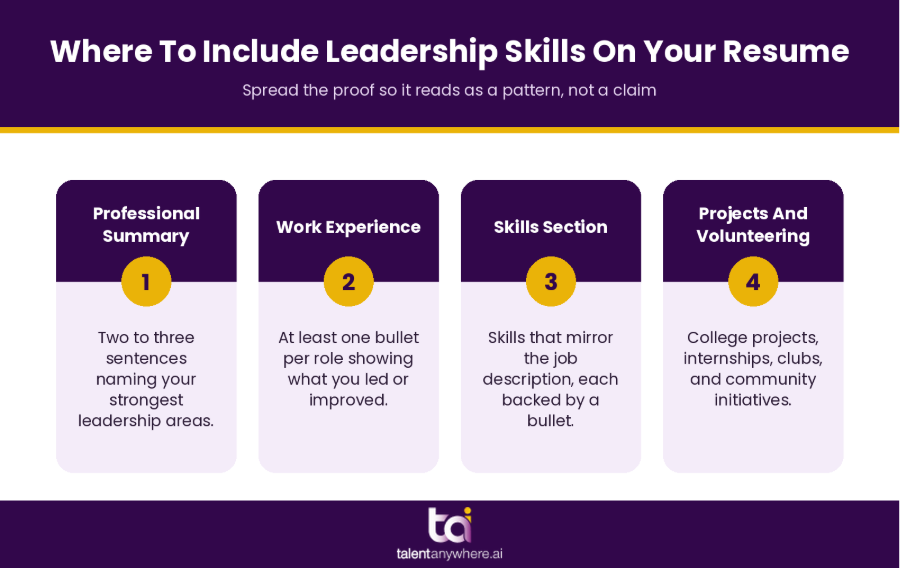
1. Professional Summary
Use two to three sentences to name your strongest leadership areas and where you applied them.
Example: “Marketing professional with experience coordinating cross-functional projects, mentoring junior colleagues, and improving team workflows. Skilled in stakeholder communication, project planning, and collaborative problem-solving.”
2. Work Experience Section
This is where your strongest proof belongs. Each role should include at least one bullet that shows you led, coordinated, or improved something. Your resume leadership experience carries the most weight here because it sits next to real job titles and dates.
Example: “Coordinated a team of six marketing professionals to plan and execute multi-channel campaigns, ensuring alignment between creative, content, and performance teams.”
3. Skills Section
Choose leadership skills for resume use that mirror the job description, such as:
- Team management
- Strategic planning
- Conflict resolution
- Delegation
- Mentoring and coaching
- Stakeholder management
- Decision-making
- Cross-functional collaboration
Every skill here should be backed by a bullet elsewhere on the page.
4. Projects, Volunteering, And Extracurricular Activities
Students and career changers can show leadership through college projects, internships, student clubs, volunteering, and community initiatives.
Example: “Led a five-member college project team, coordinated research activities, and organised the final presentation.”
Also Read: How To List Certifications On Your Resume
How To Write Strong Leadership Resume Statements
Strong statements focus on what you did and what changed, not on how you describe yourself.
Use Action Verbs That Demonstrate Leadership
Start each bullet with a verb that signals ownership: led, coordinated, spearheaded, mentored, delegated, guided, implemented, facilitated, directed, organised, improved, or resolved. Avoid openers like “responsible for,” which describe a duty, not an action.
Follow The Action + Context + Result Formula
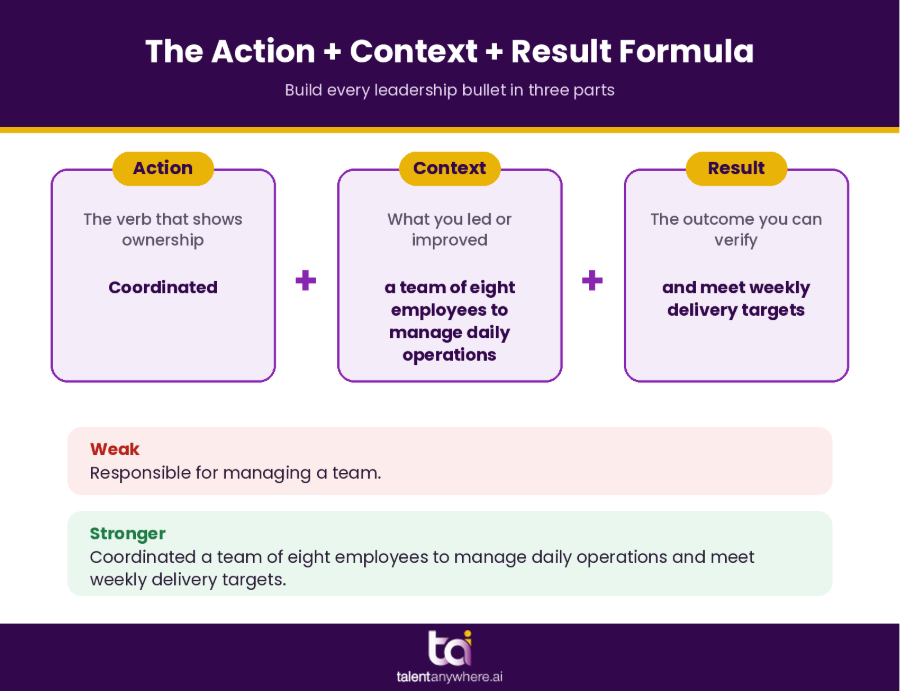
Build each bullet in three parts: the action you took, what you led or improved, and the result.
Weak: “Responsible for managing a team.”
Stronger: “Coordinated a team of eight employees to manage daily operations and meet weekly delivery targets.”
Add measurable outcomes wherever reliable data exists, such as team size, project completion time, revenue or cost improvements, customer satisfaction, productivity changes, or training and onboarding outcomes. Never invent a figure to make a bullet look impressive. Interviewers may ask how you measured it.
Also Read: Hobbies And Interests For Resume
How To Show Leadership Skills On A Resume Without Management Experience
You do not need to have managed anyone to show leadership potential. Initiative, accountability, influence, and collaboration all count, and even a fresher can build a credible leadership experience resume from college, internship, and volunteer work. Look for moments when you:
- Took ownership of a group project
- Trained or helped a new colleague
- Volunteered to coordinate a team activity
- Led a college or community initiative
- Spotted a problem and proposed a solution
- Took responsibility for an important deadline
- Coordinated work between colleagues
Here is what those moments look like as resume bullets:
31. Final-Year Student: Volunteered to coordinate a six-member capstone project, split research and design tasks, and delivered the final presentation a day before the deadline.
32. Marketing Intern: Trained two new interns on the team’s social media scheduling tool and created a quick-reference guide the team still uses.
33. Student Society Member: Spotted repeated event date clashes and proposed a shared calendar that the committee adopted for the academic year.
These are the leadership examples for resume bullets that work when your title does not say “lead.” Your resume leadership experience does not need a title. It needs a clear contribution.
Common Mistakes To Avoid When Listing Leadership Abilities
Watch for these six avoidable habits:
- Listing generic qualities without evidence: “Good leader” or “excellent team player” proves nothing. A leadership qualities resume section needs an example behind every word.
- Including irrelevant skills: Match your choices to the job description.
- Exaggerating responsibilities: Do not claim you managed people or projects you only supported.
- Repeating the same statement: Each bullet should show a different contribution.
- Ignoring measurable outcomes: Include genuine numbers or results when you have them.
- Keyword stuffing: Use leadership terms naturally. Adding more of them does not guarantee an ATS pass or an interview.
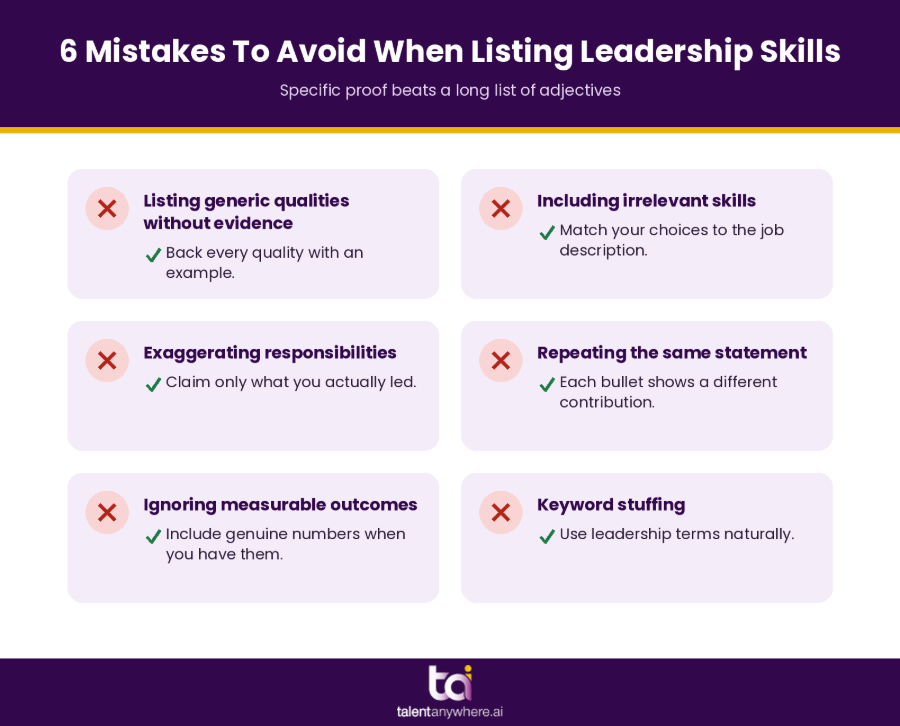
A few credible, specific examples will persuade a hiring manager far more than a long list of adjectives. The same rule applies whether you are writing leadership skills in CV format or a one-page resume.
Also Read: Why Your Resume Is Not Getting Shortlisted
Conclusion
Showing leadership skills on a resume comes down to proof. Recruiters want to see what you led and what changed as a result. Review your work history, projects, volunteering, and academic activities, and pick the moments that make the strongest leadership examples for resume bullets. Then write them with clear action verbs, relevant keywords, and outcomes you can verify.
When you are ready, talentanywhere.ai’s AI resume builder can help you turn these statements into a clean, ATS-friendly resume, and its mock interviews let you practise explaining your leadership examples out loud.
Ready To Back Up Every Leadership Bullet?
Practise answering leadership questions with AI mock interviews on talentanywhere.ai and walk into your next interview prepared.
FAQs
What Are The Best Leadership Skills To Put On A Resume?
How Can I Show Leadership With No Management Experience?
How Do You Describe Leadership Experience On A Resume?
Should I Include Leadership Skills In My Resume Summary?
What Are Some Examples Of Leadership Qualities For A CV?
How Many Leadership Skills Should I List On My Resume?


talentanywhere.ai
Build professional resumes with AI, improve your ATS score, and apply with confidence. talentanywhere.ai empowers job seekers with smarter resume creation and career tools for every stage.