

Table of Contents
 Set as a preferred Google source
TL;DR
A job offer is only as reliable as what is written down. Before you sign, confirm the role, the full CTC breakup and expected in-hand salary, joining conditions, probation, notice period, work arrangement, benefits, and any bond or recovery clause. Verify that the employer is genuine, never pay to secure a job, ask HR to clarify unclear terms in writing, and keep copies of every version and email.
You’ve cleared the last round, and the email finally lands. Most people want to reply yes right away. Hold off for a day.
An offer letter is the first time everything you heard in interviews gets put in writing, and the written version is what you’re actually agreeing to. If your manager promised two days a week from home, it only counts once it shows up on paper.
Below, we cover what’s normally in the document, the clauses people skim and later regret, how to spot a fake, and what to do when something doesn’t add up.
What Is An Offer Letter?
An offer letter is a written communication from an employer offering you a specific job on stated terms. It normally comes after the final interview and spells out your title, the company you’d work for, pay, joining date, location, and anything you need to complete before day one.
There’s no fixed template. A startup might send a short PDF, while a larger company might send a summary now and a detailed appointment letter closer to joining. Plenty of offers are also conditional on your background check, documents, or other stated requirements.
Is it legally binding? That depends on how it’s worded, the circumstances, and the law that applies, which is one more reason to read every page and annexure before you sign.
Compare Roles Before You Commit
Discover openings matched to your resume and skills with talentanywhere.ai’s AI-powered job search.
What Does A Job Offer Letter Usually Include?
Think of it as the employer’s proposal in writing. Most of what you’ll find falls into three buckets.
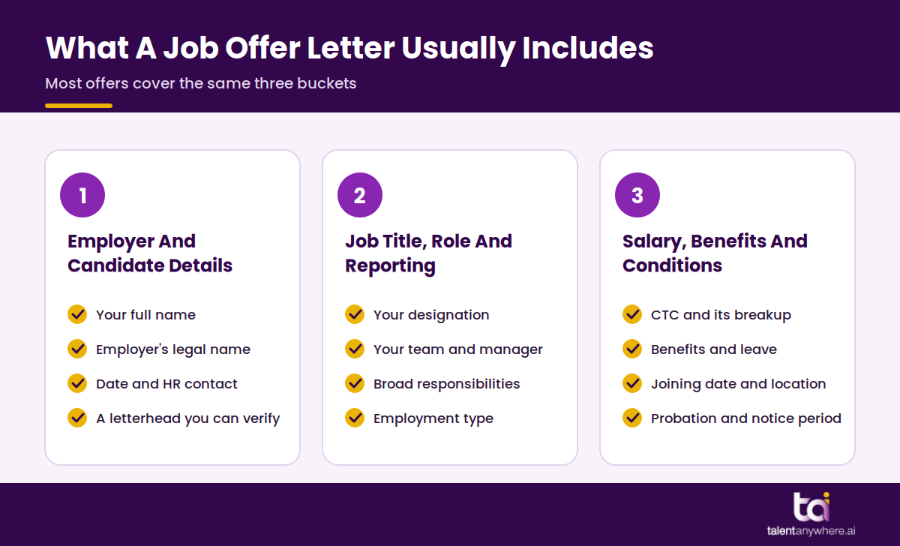
Employer And Candidate Details
Your full name, the employer’s legal name, the date, an HR contact, and a letterhead you can actually verify. Some groups hire through a subsidiary, so check whose name is on the document. That’s the company paying you.
Job Title, Responsibilities, And Reporting Structure
You should see your designation, your team, and a broad idea of what you’ll be doing. Some also name your manager and the employment type. If any of it sounds different from your interviews, ask now, not after you join.
Salary, Benefits, And Employment Conditions
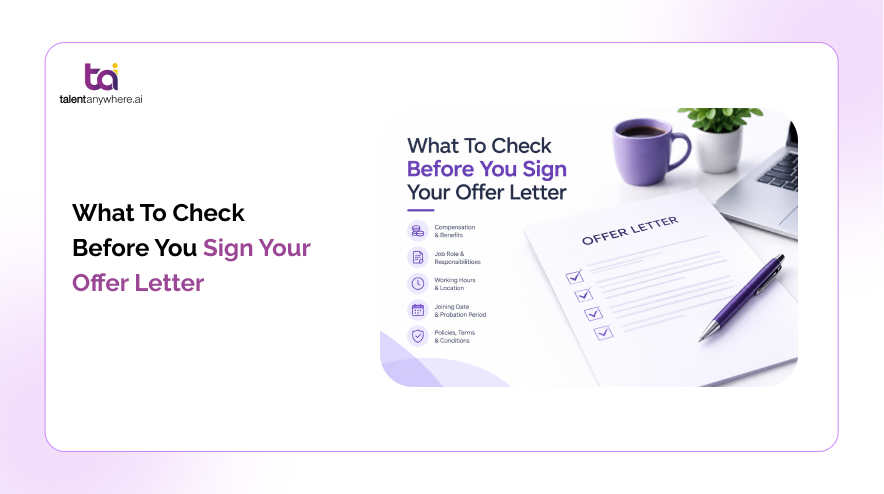
This is the part with the most numbers: cost to company (CTC) and its breakup, benefits, joining date and location, working hours, probation, notice period, and any conditions on the offer. The checklist below goes through each one.
Also Read: Most Common Interview Questions And Answers
10 Things To Check Before Signing An Offer Letter
Keep the document open as you go. Each point ends with a question you can send HR.
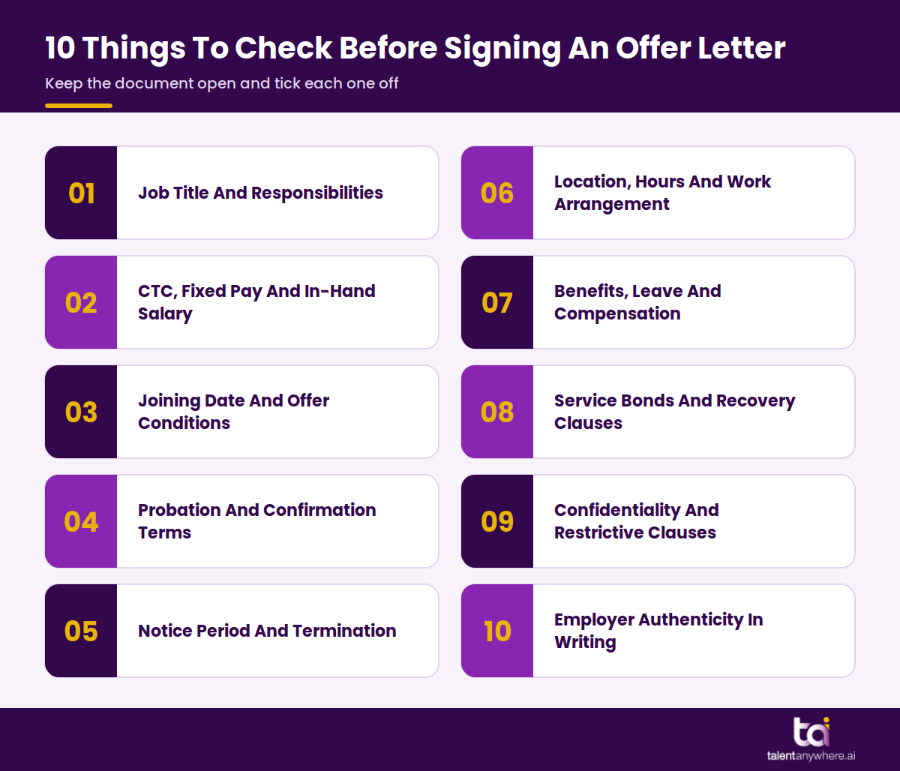
1. Job Title And Responsibilities
Does the title match the job you interviewed for? Titles do sometimes change between the final round and the paperwork. If you interviewed for an analyst role and the offer says “Associate, Operations”, ask what changed before you sign.
Ask HR: “Could you confirm the designation and the main responsibilities for this role?”
2. CTC, Fixed Pay, Variable Pay, And In-Hand Salary
CTC is what the company expects to spend on you in a year. It isn’t what lands in your account. Employer PF contributions, insurance premiums, and performance pay can all sit inside that number, and your own PF contribution and taxes come out before you see a rupee.
So two offers with the same CTC can pay quite differently each month. If a big chunk is variable, find out how it’s measured and when it’s paid, because that varies a lot from company to company.
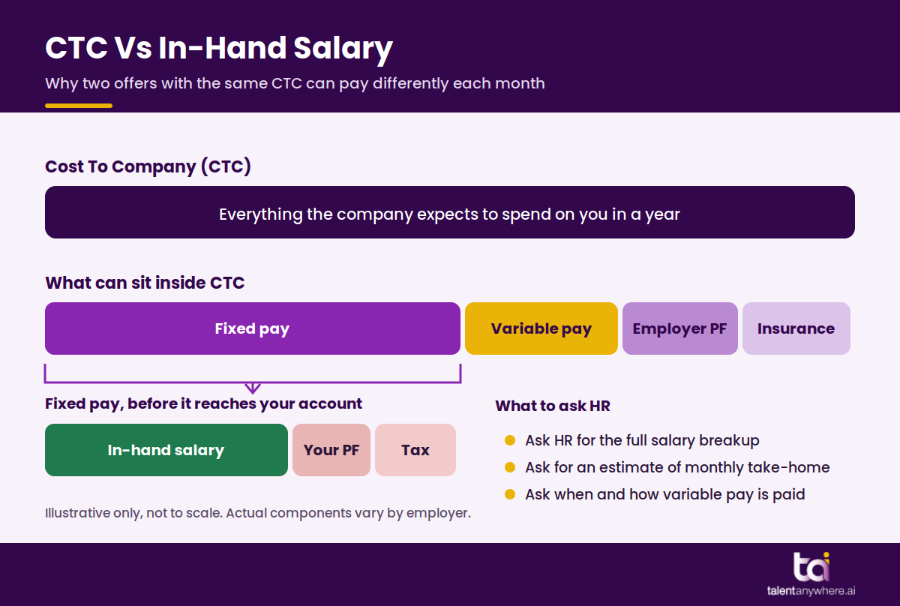
Ask HR: “Can you share the full salary breakup and an estimate of my monthly take-home? When and how is the variable part paid?”
3. Joining Date And Offer Conditions
Look for the joining date, the deadline to accept, the documents you need to submit, and any background or education checks. If you’re employed right now, line the joining date up against your notice period before accepting.
Ask HR: “If my notice period runs longer than expected, is the joining date flexible? And what needs to be cleared before I join?”
4. Probation Period And Confirmation Terms
Most companies start you on probation, a trial phase before your employment is confirmed. Find out how long it lasts, whether it can be extended, and how you’ll hear about confirmation. Also check whether your pay, leave, or notice period is different during this phase.
Ask HR: “How is confirmation decided, and can probation be extended?”
5. Notice Period And Termination Conditions
Your notice period affects your next move, not just this one. Check how long it is during probation and after confirmation, whether a buyout is allowed, and how resignation and termination are handled. A 90-day notice with no buyout option means a future employer has to wait three months for you.
Ask HR: “What’s the notice period before and after confirmation? Is a buyout possible?”
Walk Into Your Next Interview Prepared
Practise with AI mock interviews and get instant feedback before the final round.
6. Work Location, Working Hours, And Work Arrangement
Hybrid in the job post doesn’t always mean hybrid on paper. Check the office location, whether the role is remote, hybrid, or onsite, your hours and shifts, weekend work, travel, and any clause that lets the company transfer you. If the flexible setup isn’t written down anywhere, ask for it to be.
Ask HR: “Is the work arrangement documented in the offer or in a written policy I can refer to?”
Also Read: Top Job Portals In India
7. Benefits, Leave, And Other Compensation
Leave days, health insurance and whether it covers your family, PF and gratuity where applicable, allowances, bonuses, and reimbursements all add up. If the offer covers them in a line or two, ask for the actual policies.
Ask HR: “Could you share the leave policy and health insurance details, including dependant coverage?”
8. Service Bonds, Training Agreements, And Recovery Clauses
Some offers, or separate agreements sent with them, require you to stay for a minimum period or repay training costs, a joining bonus, or relocation support if you leave early. Find out the amount, how long the commitment lasts, what triggers repayment, and whether it sits in a document you haven’t seen yet.
Whether these clauses hold up depends on their terms and the applicable law. If the amount is large, a short consultation with a lawyer before signing is money well spent.
Ask HR: “When would the recovery amount apply, and how is it calculated?”
9. Confidentiality And Other Restrictive Clauses
Confidentiality, IP, and conflict-of-interest clauses are normal. What matters is how far they reach. Do any obligations continue after you leave? Could anything stop you from freelancing, running a side project, or joining a competitor later? The answer depends on the wording and the law, so ask instead of guessing.
Ask HR: “Which obligations continue after I leave, and do any restrictions apply to future roles?”
10. Employer Authenticity And Written Confirmation
Fake offers are more common than most freshers expect. In a written reply in the Rajya Sabha in December 2025, the Ministry of External Affairs said over 6,700 Indians had been rescued from scam centres in Cambodia, Myanmar, and Lao PDR after dubious firms lured them, mostly through social media, with fake recruitment offers. The US Federal Trade Commission reported that job and employment agency scam reports tripled between 2020 and 2024, and reported losses grew from $90 million to $501 million.
A few quick checks go a long way. Is the email from the company’s own domain? Is the recruiter listed anywhere official? And if anyone asks you to pay a registration, training, or “offer processing” fee, stop there, because that’s a serious warning sign. To verify, contact the company using details from its official website, not the ones in the message.
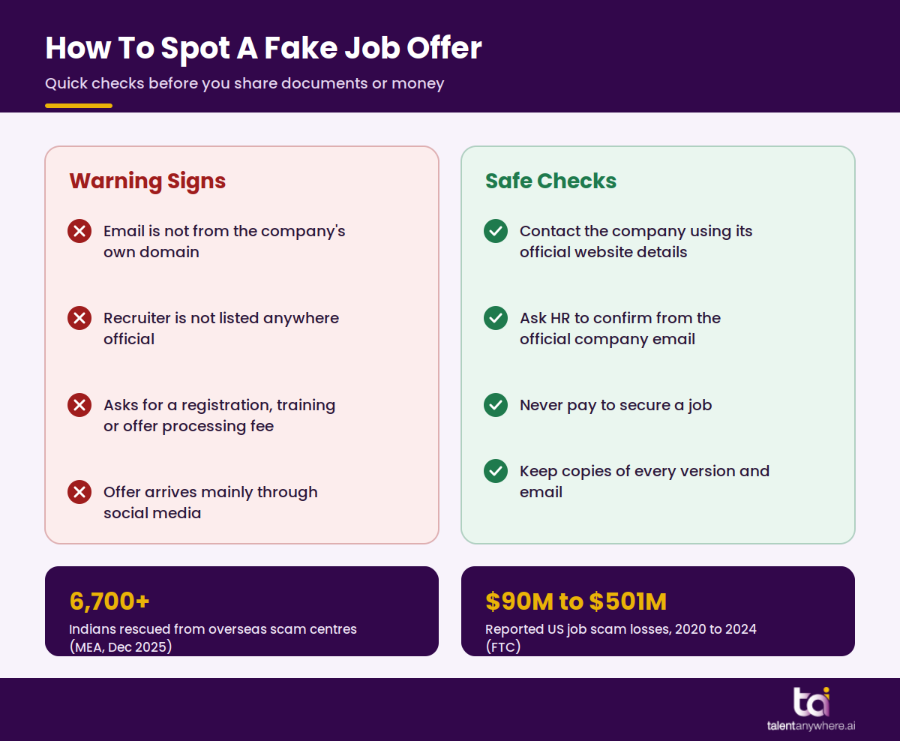
Ask HR: “Could you confirm this offer from the official company email address listed on your website?”
Offer Letter Format And What A Typical Job Offer Looks Like
There is no single universal offer letter format. Most documents still cover the same ground, though: company letterhead and date, your name, the job title, pay, joining date and location, key conditions, a deadline to accept, how to accept, and a signature from someone authorised to make the offer.
Here’s a short offer letter sample to show how those pieces usually fit together in a basic offer letter format. Treat it as an illustration, not a legal template.
Basic Offer Letter Sample
[Example Tech Solutions Private Limited letterhead]
Also Read: Follow Up Email After Job Application
What Should You Do If Something In Your Job Offer Is Unclear?
It’s normal for an offer to have a few gaps, and HR teams expect questions. Here’s how to handle them.
Ask HR For Clarification In Writing
Send a short email listing exactly what’s unclear, whether it’s a salary component, a clause, or a joining condition. A written reply beats a phone call you half remember.
Negotiate Before Accepting
Once you sign, your leverage drops. If the pay, joining date, or location doesn’t work, say so now and be specific. “Could the fixed component be revised, given my current salary?” lands better than “The offer feels a bit low.”
Request A Revised Offer If Terms Change
If HR agrees to a change on a call, ask for a revised document or at least an email confirming it. Don’t rely on the new terms until you have them in writing.
Keep Copies Of The Offer And Related Communication
Keep the original, every annexure, revised versions, and the email trail in one folder. And don’t resign from your current job on the strength of a verbal promise or an offer you haven’t verified.
Review Your Offer Letter Before You Sign
An offer is good news, but the CTC on page one doesn’t tell the whole story. Read the role, the pay breakup, joining conditions, benefits, probation, notice period, and anything that looks unusual, and make sure every change you agree on ends up in writing. If you’re still comparing options, talentanywhere.ai’s AI job search can show you roles that match your resume and skills.
Your Next Offer Starts With A Stronger Resume
Build an ATS-friendly resume with AI and get instant feedback on 13+ parameters before you apply.
FAQs
What Is The Meaning Of A Job Offer Letter?
Is A Job Offer The Same As An Appointment Letter?
What Should I Check Before Accepting A Job Offer?
Can I Negotiate After Receiving A Job Offer Letter?
Is A Job Offer Proof Of Employment?
What Should I Do If An Employer Withdraws My Offer?


talentanywhere.ai
Build professional resumes with AI, improve your ATS score, and apply with confidence. talentanywhere.ai empowers job seekers with smarter resume creation and career tools for every stage.