


Table of Contents
 Set as a preferred Google source
TL;DR
A recruitment agency gives you speed, reach and specialist networks for a per-hire fee, which suits urgent, niche, senior or one-off roles. In-house hiring costs more to set up but gets cheaper and sharper as volume grows, because your team owns the employer brand, the talent pipeline and the hiring data. Most growing companies end up running a deliberate mix of both.
Every open role forces the same decision. Hand the search to an outside partner, or run it through your own team? Get it wrong and you either pay fees on hires you could have made yourself, or watch a business-critical seat stay empty while your recruiters are buried in volume roles. The right answer depends on three things: how often you hire, how hard the role is to fill and how much hiring capability you want to own.
Agency Vs In-House Hiring At A Glance
Here is how the two models compare on the factors that usually decide the call.
| Agency | In-House | |
| Cost model | A fee per successful hire, usually a percentage of the hire’s first-year pay | Fixed costs for recruiters, tools and job ads, which fall per hire as volume grows |
| Speed to shortlist | Fast, because agencies start with warm candidate networks | Slower on new roles, faster on repeat roles once a talent pool exists |
| Culture fit | Learned second-hand from your brief | Built in, since recruiters know the managers and team dynamics |
| Specialist reach | Strong, especially with sector-focused firms that reach passive candidates | Limited to your own network and job ads |
| Control | Candidate relationships and data often stay with the agency | Relationships, employer brand and hiring data stay inside the business |
| Best fit | Urgent, niche, senior or occasional roles | Steady, repeatable hiring at volume |
Not Every Role Needs An Agency Fee
talentanywhere.ai gives in-house teams AI-powered screening and interviews, so your recruiters spend less time sifting resumes and more time on the hires that matter.
What Is A Recruitment Agency And How Does It Work
A recruitment agency is a third-party firm that sources, screens and presents candidates for your open roles, and it earns its fee when you make a hire. The agency handles the top of the funnel. Your team still owns the final interviews, the offer and every decision that follows. Where these firms differ is in how they charge and how deep they go.
Contingency Search
Contingency firms get paid only when their candidate is hired. That makes them low-risk to engage, but it also means they are often racing other firms on the same brief, so speed tends to win over depth. They work best for mid-level roles with a clear profile and a healthy supply of candidates.
Retained Search
Retained firms take part of the fee upfront and commit to running the full search. You get a dedicated consultant, market mapping and a structured shortlist. This is the model for leadership hires, confidential replacements and roles where a wrong hire is expensive to undo.
Contract And Temporary Staffing
Here the staffing firm employs the worker and bills you for their time. It suits seasonal peaks, project work and cover for long leave, and it lets you test a role before committing permanent headcount.
Specialist Vs Generalist Firms
A generalist job recruitment agency covers a broad mix of functions and levels, which works when you need volume across sales, operations or customer support. A specialist goes deep in one area. An IT recruitment agency, for example, knows the difference between a platform engineer and a DevOps generalist, keeps a bench of pre-vetted developers and understands what those candidates expect on pay and work model. For technical roles, that depth often shortens the search more than any fee discount would.
What Agencies Charge In India And The US
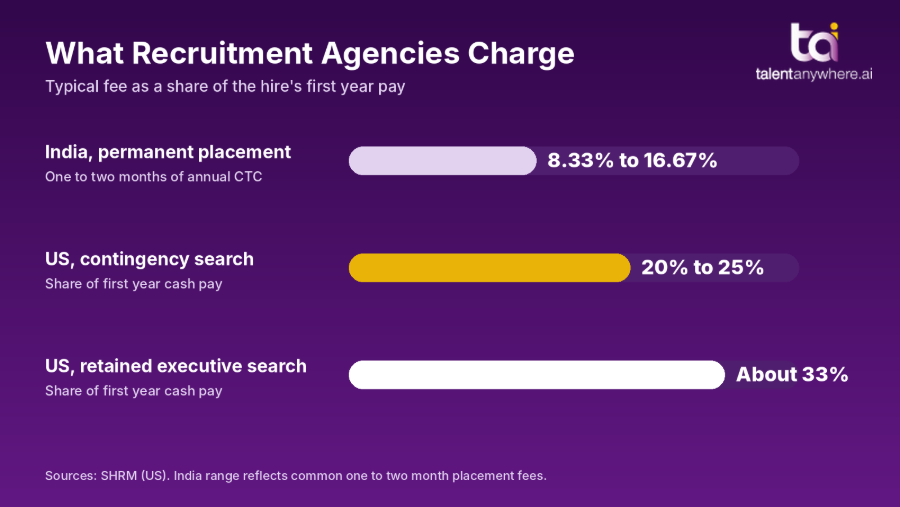
In the US, SHRM has reported that contingency recruiters usually charge around 20% to 25% of a role’s first-year cash compensation, which includes salary, bonus and signing bonus. Retained executive search runs at about 33%. In India, firms typically price permanent placements as a share of the hire’s annual CTC, most often one to two months of salary. That works out to roughly 8.33% to 16.67%, with senior and niche roles at the upper end. Retained search for leadership roles costs more and is billed in stages. In either market, confirm in writing whether the percentage applies to fixed pay or total compensation, because that one detail can shift the invoice significantly.
Also Read: How Recruiting Firms Can Stay SOC 2 And GDPR Compliant
How In-House Hiring Works
In-house hiring means your own people run recruitment end to end, from workforce planning to offer acceptance. That can be one HR generalist who recruits part-time, or a full talent team with sourcers, coordinators and recruiters aligned to business units.
What An Internal Team Owns
An internal team does more than fill seats. It works with managers to scope roles before they open, shapes the employer brand candidates see, runs the applicant tracking workflow and keeps relationships warm with the silver-medal candidates who nearly made it last time. Over a year or two, that pipeline becomes an asset no outside partner can sell back to you.
What It Takes To Get Started
You do not need a ten-person team on day one. Most companies begin with one dedicated recruiter, a simple applicant tracking workflow, a standard interview scorecard and protected time on hiring managers’ calendars. From there, add sourcing capacity as volume grows, and invest early in the things that compound: a careers page that sells the role honestly, a referral program employees actually use and a talent pool of strong candidates who were not hired the first time.
Where The Costs Actually Sit
The trade-off is fixed cost. You pay recruiter salaries, job board spend and tools whether you hire two people this quarter or twenty. SHRM’s 2026 Recruiting Executives Benchmarking data puts the median cost-per-hire for nonexecutive roles at $1,300, against $15,000 for executive positions, with nonexecutive roles taking a median of 39 calendar days to fill. These are US medians in US dollars, so treat them as a directional benchmark rather than an Indian figure, since salary levels, job board pricing and fee structures in India are different. What carries across markets is the pattern: senior hires are where costs spike, and they are exactly the roles many companies still send outside.
The Real Trade-Offs Between The Two Models
On paper, the choice looks like a simple fee comparison. In practice, five factors decide whether a model works for a given role.
Cost Per Hire Versus Cost Of Capacity
External fees are variable, so you only pay when a hire lands. Internal recruiting is a capacity cost. If your team is busy year-round, every extra hire lowers the average cost. If it sits idle between hiring spurts, you are paying for capacity you do not use. Run both numbers against your actual hiring forecast, not a best-case one.
Speed To Shortlist
External recruiters move fast on roles they already source for, because they start with known candidates. Internal teams are slower on unfamiliar roles but faster on repeat ones, especially once they have a talent pool and standard assessments in place.
Quality Of Hire And Retention
An outside firm is paid at the point of hire, so its incentive is to close the role. Replacement guarantees help, but they do not cover the cost of a disengaged hire who stays. Internal recruiters live with the outcome and hear directly from managers when a hire does not work out. That feedback loop sharpens selection over time.
Employer Brand And Candidate Experience
Candidates who come through a third party often meet your brand through someone else’s pitch. That is fine for a one-off search. If most of your hiring runs through intermediaries, though, you lose control of how the market sees you as an employer.
Ownership Of Hiring Data
Every search produces useful data: where strong candidates came from, where they dropped off and which interview stages predicted performance. In-house teams keep that data and act on it. With external partners, much of it stays on their side of the table.
When To Use A Recruitment Agency
Outside help earns its fee when a role is hard, urgent or rare for your business. Scarcity is the strongest signal. ManpowerGroup’s 2026 Global Talent Shortage Survey found that 72% of employers worldwide struggle to find the skilled talent they need, rising to 82% in India, with AI skills now the hardest capability to hire for. Bring in a partner in these situations.
- The skill set is scarce. For cloud, data or AI roles, an IT recruitment agency with an active bench can reach candidates your job posts never will.
- The seat is senior or confidential. Leadership hires and quiet replacements need the discretion and market mapping retained firms are built for.
- You are entering a new market. A new city or country brings unfamiliar salary norms, channels and candidate expectations. A local partner shortens that learning curve.
- Demand is a one-off spike. A new client contract, a store launch or a seasonal peak rarely justifies permanent recruiting headcount.
- The role has stayed open too long. When a vacancy has already cost weeks of lost output, the fee is often cheaper than more delay.
When To Build In-House Hiring
Internal capability pays off once hiring becomes predictable. These are the signals that it is time to bring more of it in-house.
- You hire the same roles again and again. Sales, support, operations and graduate roles follow patterns an internal team can turn into a repeatable process.
- Culture fit drives performance. Early-stage teams and client-facing roles need recruiters who understand the business from the inside.
- External spend keeps climbing. If you are paying a job recruitment agency for the fourth sales associate this quarter, those fees are funding a capability you could own.
- You want a long-term pipeline. Talent pools, alumni networks and referral programs only compound when someone inside the company runs them.
The Hybrid Model Most Growing Teams Land On
Few companies stay purely on one side. The practical setup is an internal team that owns core, repeatable hiring and the employer brand, with external partners brought in to cover specific gaps.
How To Split Roles Between Partners And Your Team
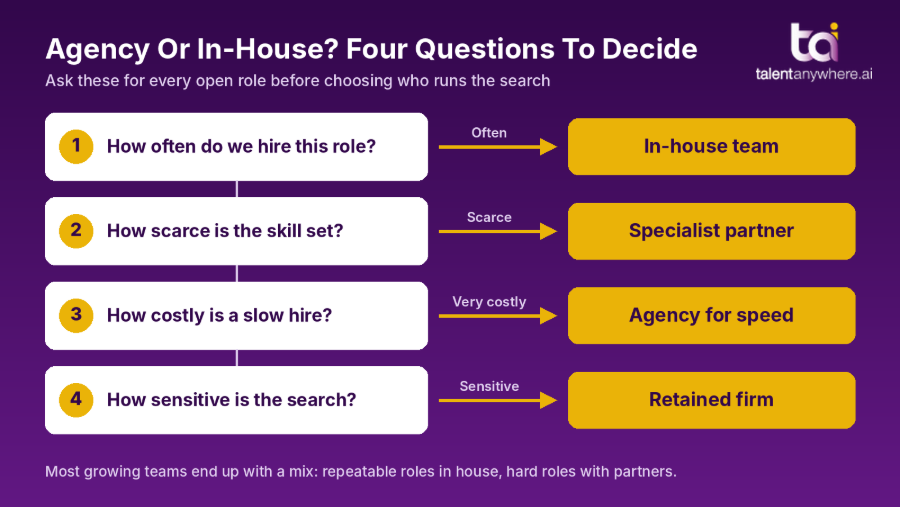
Sort every open role against four questions before you decide who runs the search.
- How often do we hire this role? Frequent hiring points to your internal team.
- How scarce is the skill set? Scarcity points to a specialist partner.
- How costly is a slow hire? A high cost of vacancy favors external speed.
- How sensitive is the search? Senior or confidential searches favor retained firms.
What The Split Looks Like In Practice
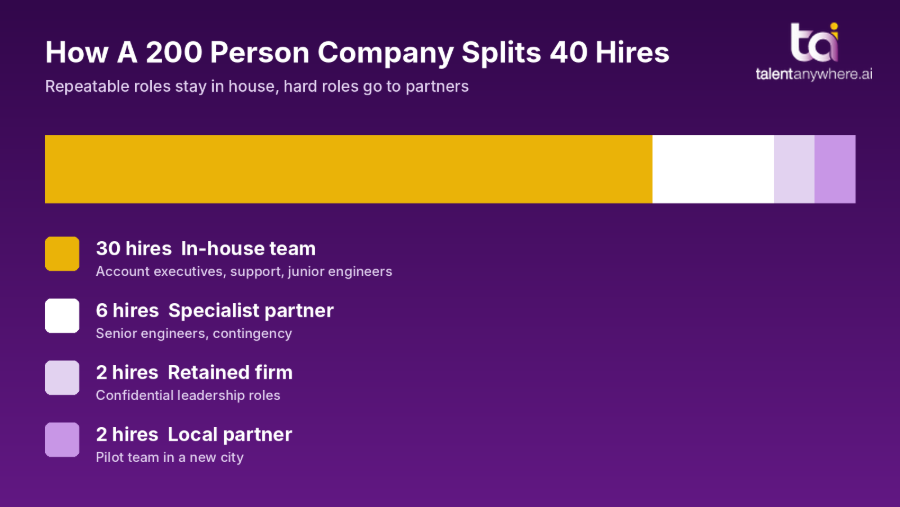
Picture a 200-person software company planning 40 hires next year. Thirty are account executives, support specialists and junior engineers, roles it fills every quarter. Those belong with the internal team, backed by a standing talent pool and a consistent interview loop. Six are senior engineers in a tight market, which go to a specialist partner on contingency. Two are leadership roles that need a confidential search, so they go to a retained firm. The last two are a pilot team in a new city, where a local partner makes the first hires while the internal team learns the market. The result is a predictable fee budget and a recruiting team focused where it adds the most value.
Making The Partnership Work
External partners perform best with a tight brief. Share the scorecard your hiring manager will actually use, agree on feedback timelines, cap the number of firms working each role and get the replacement period in writing. Then track partner hires against internal hires on retention and performance, so the next contract renewal is based on evidence rather than habit.
Also Read: AI Recruitment Tools Every Hiring Team Should Know
How AI Hiring Tools Change The Math
The strongest argument against in-house hiring has always been capacity. A small team cannot screen hundreds of applicants, run first-round interviews and still give hiring managers real attention. AI-powered hiring tools change that equation. Automated resume screening and AI-led first interviews take the repetitive load off recruiters, so a lean internal team can handle volume that once needed outside support.
That is the gap talentanywhere.ai is built to close. Your team keeps ownership of the brand, the pipeline and every hiring decision, while the platform handles the screening work that quietly eats recruiter hours. Outside partners then become a targeted tool for the hardest roles, not the default for every vacancy.
Making The Call For Your Next Hire
There is no permanent winner in the recruitment agency versus in-house debate, only the right model for each role. Use outside partners where speed, scarcity or seniority justify the fee, and invest in internal capability where hiring is frequent and culture-critical. Revisit the split every quarter against your hiring plan, because the right mix at 50 employees will not be the right mix at 500.
Build A Hiring Engine You Actually Own
Screen, interview and shortlist candidates with AI on talentanywhere.ai, and save agency budgets for the roles that truly need outside help.
FAQs
What Is A Recruitment Agency?
How Much Does A Recruitment Agency Charge?
Is An Agency Cheaper Than In-House Hiring?
When Should A Company Use An IT Recruitment Agency?
Can You Use An Agency And An In-House Team Together?
What Should You Check Before Signing With A Hiring Partner?


talentanywhere.ai
Build professional resumes with AI, improve your ATS score, and apply with confidence. talentanywhere.ai empowers job seekers with smarter resume creation and career tools for every stage.