

Table of Contents
 Set as a preferred Google source
TL;DR
The 15 interview questions employers ask most often cover your background, motivation, strengths, weaknesses, mistakes, achievements, and career goals. Prepare talking points tied to your own experience rather than memorised answers, use the STAR method for behavioural questions, and always come with a few questions of your own. talentanywhere.ai’s AI mock interview feature lets candidates rehearse these exact questions and get feedback before the real thing.
Most job interviews are not full of surprises. Employers tend to return to a familiar set of interview questions about your background, motivation, strengths, weaknesses, work experience, problem-solving skills, and career goals. Knowing the most common interview questions in advance is useful, but memorising a “perfect” answer for each one is not. What actually helps is understanding why an interviewer is asking a particular question and preparing talking points from your own experience.
This guide covers 15 common job interview questions, what each one is really trying to assess, how to structure your response, sample answers you can adapt, mistakes to avoid, and practical job interview tips for your next interview.
Know What They’re Really Asking
Every interview question tests something specific. talentanywhere.ai helps you prepare answers that hit the mark.
How To Use These Interview Questions To Prepare
Use these questions to prepare what you’ll say, not to memorise exactly how you’ll say it. Walk into the interview knowing your own stories and why they matter for this job, not with paragraphs learned by heart.
Understand The Question Before Answering
The same question can test different things depending on the role. “Tell me about a time you solved a problem” means something different for a support executive than a data analyst, so think about what the interviewer is likely trying to learn for that specific job.
Prepare Talking Points, Not Memorised Scripts
Overly rehearsed answers tend to sound unnatural and can fall apart at the first follow-up. A flexible outline for each likely question works better than a fixed script.
Connect Your Answer To The Job
Read the job description closely and note the skills and responsibilities it repeats. Then match your own experience to those points, so your answer feels built for the role rather than generic.
Also Read :How To Make A Perfect Resume That Gives A Job Winning Success
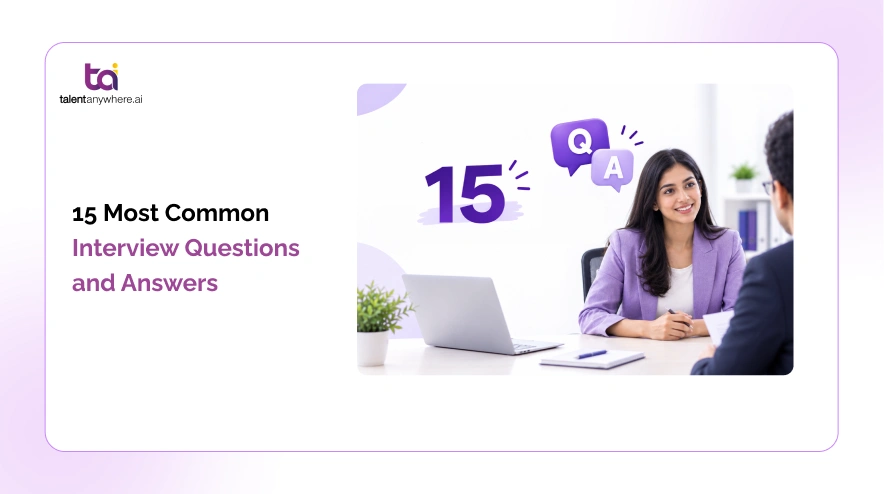
15 Most Common Interview Questions And Answers
For every question below, you will find what the interviewer wants to know, how to structure your answer, a sample response, and a quick tip. Use the structure as a template and swap in detail from your own career.
01 Tell Me About Yourself
This is usually the first question, and interviewers use it to gauge how well you can summarise your own career instead of listing every job you’ve held. They’re listening for a narrative that connects your current work to the role you’re applying for, not a chronological CV read aloud. A strong answer picks two or three relevant data points and explains why they matter here, while a weak one starts at your first job out of college and runs three minutes. Use a present, past, future structure, what you do now, the experience that brought you here, and why this role is the logical next step.
Sample answer: “I currently manage client onboarding for a mid-size SaaS company, where I rebuilt our onboarding checklist and cut average setup time from twelve days to eight. Before that, I spent two years in customer support, which is where I first noticed how much time customers lost to unclear onboarding steps. That’s actually what pulled me toward this kind of role, and it’s why I’m drawn to this position, since it’s focused entirely on improving that same first-mile experience for a larger customer base.”
02 Why Do You Want To Work Here
Interviewers ask this to see whether you’ve actually researched the company or whether you’d give this same answer to any employer in the industry. They’re checking for genuine interest because candidates who understand the company’s direction tend to ramp up faster and stay longer. A strong answer names something specific, a product launch, a market the company has entered, a value they’ve publicly emphasised, and ties it to what you can bring. A weak answer leans on reputation or size alone, which tells the interviewer nothing about fit.
Sample answer: “I’ve followed how your team expanded into the Southeast Asian market over the past year, and I read the case study your VP of Sales published on adapting your pricing model for that region. My last four years have been in regional sales operations for a similar mid-market SaaS company, so I’ve solved a lot of the same localisation and pricing problems your team is likely working through right now. That overlap is what made this opening stand out to me over other listings.”
03 Why Do You Want This Job
This question is deliberately narrower than the one above, and interviewers use it to separate candidates who want the company from candidates who want this specific work. They’re listening for whether you understand the day-to-day responsibilities, not just the job title. A strong answer references something concrete from the job description, a tool, a metric, a type of project, while a weak answer could be copy-pasted into an application for a completely different role at the same company.
Sample answer: “I noticed the job description puts a lot of weight on campaign measurement and attribution modelling, which is the part of marketing I enjoy most and have spent the last three years building expertise in. In my current role, I set up the attribution dashboard our team still uses to decide budget allocation across channels. This role looks like it would let me do more of that analytical work at a bigger scale, with a bigger budget to actually act on what the data shows.”
04 What Are Your Greatest Strengths
Interviewers ask this to see whether you can identify strengths that actually matter for the job, rather than generic traits everyone claims. They’re also quietly checking self-awareness, since candidates who name a strength but can’t back it with a specific moment tend to come across as reciting a list. Choose strengths that show up in the job description itself, not just ones you’re proud of, and be ready for a follow-up question that asks you to go deeper on the example you give.
Sample answer: “One of my strengths is project coordination, especially when a project involves multiple external vendors. On my last project, I was coordinating four different vendors on a product launch with a hard deadline, and I built a shared tracker that flagged dependency risks two weeks out instead of two days out. That gave us enough runway to solve two vendor delays before they became launch-blocking, and we still delivered two days ahead of schedule.”
05 What Is Your Greatest Weakness
This question tests honesty and whether you can talk about a real limitation without either downplaying it into a humblebrag or exposing something that would disqualify you. Interviewers are listening for evidence that you’ve actually done something about the weakness, not just named it. A strong answer describes a specific, believable weakness and a concrete step you took to manage it, while a weak answer relies on a cliché like “I’m a perfectionist” with no evidence of change.
Sample answer: “Early in my career, I avoided public speaking whenever I could, which was a real limitation once I moved into a role that involved presenting monthly results to leadership. I joined a workplace communication group and volunteered to lead our team’s weekly stand-up, specifically to get more comfortable speaking in front of people. It’s still not the part of the job I enjoy most, but I now run those leadership presentations myself instead of having my manager do it.”
06 Why Should We Hire You
This question gives you room to make your case directly, and interviewers use it to see whether you can synthesise your fit into a clear, confident pitch rather than repeating what’s already on your resume. They’re listening for evidence-backed value, not comparisons to other candidates you know nothing about. A strong answer names a specific skill the role needs and a result you’ve already delivered with it, while a weak answer says “I’m the best candidate” without saying why.
Sample answer: “I’ve spent four years building customer retention campaigns for a subscription business, and in my current role those campaigns reduced monthly churn by twelve percent over two quarters. Your job posting mentions retention as a primary focus for this quarter, which is exactly the problem I’ve been solving. I can bring that same testing and segmentation approach here without needing much ramp-up time.”
07 Tell Me About A Challenge You Faced At Work And How You Handled It
Behavioural questions like this one assume that past behaviour predicts future behaviour, so the interviewer is less interested in the challenge itself and more interested in what you did about it. They’re evaluating whether you took ownership, how you made decisions with incomplete information, and whether you communicated with the people affected along the way. The most common mistake is spending most of the answer describing how bad the situation was and rushing through the action and result, which is the part that actually answers the question.
Sample answer: “Two weeks before a product launch, our packaging vendor told us they couldn’t meet the delivery date because of a material shortage. I was responsible for the launch timeline, so I pulled together a shortlist of three backup vendors within a day, got samples approved on an expedited basis, and renegotiated our internal schedule to build in a two-day buffer. We ended up launching on the original date, and I also wrote up a backup-vendor list afterward so the next launch wouldn’t hit the same risk.”
08 Tell Me About A Time You Made A Mistake
Interviewers ask this to see how you handle accountability, since everyone makes mistakes but not everyone owns them without deflecting blame. They’re listening for whether you noticed the mistake yourself or someone else had to catch it, and whether you changed anything afterward to prevent it from repeating. A strong answer picks a real, moderate-stakes mistake and focuses on the correction and the lesson, while a weak answer disguises a strength as a flaw or blames a colleague for something that was ultimately your responsibility.
Sample answer: “I once sent a client-facing financial summary with an outdated exchange rate baked into the calculations, which overstated their quarterly savings by a noticeable margin. I caught the discrepancy myself within the hour while reviewing the file for something else, corrected it immediately, and flagged it to my manager before the client had a chance to raise it. Afterward, I built a checklist that requires a second person to verify any figures pulled from an external rate source, and we haven’t had a repeat since.”
09 Tell Me About Your Greatest Professional Achievement
This question tests your ability to create measurable impact, not just stay busy, so interviewers are listening for a result they can put a number on. They’re also checking whether you pick an achievement relevant to the role you’re interviewing for, since a great achievement in an unrelated skill area tells them less about your fit. A strong answer quantifies the outcome in terms like revenue, time saved, or customer satisfaction, while a weak answer describes effort (“I worked really hard on this project”) without describing the result.
Sample answer: “I redesigned our customer support ticket workflow after noticing that most delays came from tickets being routed to the wrong specialist on the first pass. I mapped the most common ticket types, built simple routing rules based on keywords, and trained the team on the new process over two weeks. Average response time dropped from six hours to ninety minutes within the first quarter, and our customer satisfaction score for support went up as a direct result.”
10 Where Do You See Yourself In Five Years
Interviewers use this question to check whether your ambitions are realistic and whether this role is a genuine step toward them, rather than a placeholder while you look for something else. They’re listening for direction without rigidity, since career paths rarely go exactly as planned. A strong answer focuses on the skills and responsibilities you want to grow into, while a weak answer either has no direction at all or describes a five-year plan that has nothing to do with the role on offer.
Sample answer: “In five years, I’d like to have grown from managing individual client accounts to leading a small team, while continuing to deepen my expertise in client strategy rather than moving away from client-facing work entirely. I’ve already started mentoring a newer team member informally, and I’ve found I enjoy that part of the job as much as the account work itself. This role’s mix of individual ownership and cross-team collaboration looks like the right environment to build toward that.”
11 Why Are You Leaving Your Current Job
This question checks whether you’re leaving for a thoughtful reason or running away from a problem you’d carry into the new role. Interviewers are listening for a future-focused explanation rather than a list of grievances, since how you talk about a previous employer is a preview of how you might talk about this one someday. A strong answer connects what you’ve learned to what you’re looking for next, while a weak answer turns into a complaint about a manager or company culture.
Sample answer: “I’ve learned a great deal in my current role managing supply chain logistics for a regional distributor, particularly around vendor negotiation and inventory forecasting. What I’m looking for next is more ownership over strategy rather than day-to-day execution, and our current structure doesn’t have room for that kind of role in the near term. This position’s scope, especially the forecasting ownership mentioned in the listing, is exactly the kind of step up I’ve been working toward.”
Also Read :How AI Enhanced Resumes Are Getting 3X More Callbacks
12 What Motivates You
Interviewers ask this to see whether your genuine motivators align with what the role actually involves day to day, since a mismatch here often shows up later as disengagement. They’re listening for a specific, believable motivator backed by a real example, not a vague answer like “I like helping people” with nothing behind it. A strong answer connects the motivator to a concrete moment where it drove real effort, while a weak answer names money as the sole driver with no other context.
Sample answer: “I’m motivated by seeing a manual process become faster because of something I built. In my current role, our weekly reporting used to take one analyst almost a full day to compile by hand, so I automated the data pull and formatting, which brought that down to about twenty minutes. That kind of problem, finding the tedious part of a workflow and engineering it away, is what draws me to this role, since the job description mentions a similar backlog of manual reporting.”
13 How Do You Prioritise Your Work
This question tests judgement under real constraints, since almost every job involves more requests than time available. Interviewers are listening for an actual system, not a vague claim of being “good at multitasking,” and for evidence that you communicate trade-offs rather than silently letting one deadline slip. A strong answer walks through a real instance of competing priorities and how you resolved it, while a weak answer describes prioritisation only in the abstract.
Sample answer: “When two deadlines collide, I first check which one has a direct impact on a client versus an internal stakeholder, since client-facing work usually carries more urgency. Recently, I had a board deck due the same day as a client renewal proposal, so I flagged the conflict to my manager first thing that morning rather than quietly working late to cover both. We agreed I’d prioritise the renewal proposal and push the board deck by a day, which turned out to be the right call since the renewal closed that week.”
14 How Do You Handle Stressful Situations
Interviewers ask this to see how you behave when things go wrong, not whether you claim to never feel pressure. They’re listening for composure paired with action, specifically whether you kept communicating with the people affected while solving the actual problem. A strong answer walks through a real high-pressure moment and what you did to stay organised, while a weak answer insists stress “doesn’t really affect” you, which tends to read as either untrue or self-unaware.
Sample answer: “During a system outage that affected our checkout flow, I focused first on communication rather than trying to fix the technical issue myself, since that wasn’t my role. I sent customers a clear status update every thirty minutes explaining what we knew and what to expect, even when the update was just ‘still investigating.’ That steady communication kept complaint volume manageable while the engineering team worked through the fix, and several customers actually commented afterward that they appreciated being kept in the loop.”
15 Do You Have Any Questions For Us
This is often treated as an afterthought by candidates, but interviewers read your questions as a signal of how seriously you’re evaluating the opportunity, not just hoping to receive an offer. They’re listening for questions that show you’ve thought about the role beyond the job posting, ideally ones that couldn’t be answered by reading the company website. A strong close asks about how success is measured, what the team’s current challenges are, or how the role has evolved, while a weak close either has no questions at all or asks something covered in the first five minutes of the interview.
Good questions to ask an interviewer:
- What would success look like in this role in the first six months?
- What are the biggest challenges someone in this position would be walking into?
- How does this team typically collaborate day to day, and with which other teams?
- What does the onboarding process look like for someone in this role?
- How is performance measured here, and how often is it reviewed?
Nail The Answer Before It’s Asked
Practise the 15 most common interview questions with an AI mock interviewer and get instant feedback.
How To Answer Interview Questions With The STAR Method
Several of the questions above respond well to a structured format, which is where the STAR method helps.
What Does STAR Stand For
Situation sets the context, Task explains your responsibility, Action covers what you personally did, and Result explains the outcome.
When Should You Use The STAR Method
Reach for it on behavioural prompts such as a challenge you faced, a conflict, a mistake, a time you showed leadership, or a professional achievement.
What Makes A Strong STAR Answer
The Action and Result portions deserve the most attention. It is easy to spend too long describing the background and too little on what you actually did and what changed because of it.
Also Read :Top 7 AI Skills Experts Say Will Make You Instantly Hireable
7 Job Interview Tips To Prepare Better Answers
According to LinkedIn Talent Solutions, 92 percent of talent professionals say soft skills matter more than hard skills, yet only 41 percent of companies have a formal process to assess them, which is exactly why interviewers lean on the kind of open-ended questions covered above. These seven tips will help you prepare answers that hold up under that scrutiny.
1. Read The Job Description Carefully
Identify the skills and responsibilities the employer repeats throughout the listing.
2. Research The Company
Know its products or services, industry, customers, and any recent developments relevant to the role.
3. Prepare Your Sixty Second Introduction
Have a concise response ready for “tell me about yourself” so you are not thinking on your feet.
4. Prepare Four Or Five STAR Stories
Build stories around leadership, problem-solving, conflict, a mistake, and an achievement. These can be adapted across most job interview questions.
5. Use Specific Examples
Replace vague statements with evidence. Instead of “I’m good at managing deadlines,” say “I managed three overlapping campaigns and delivered all of them before their deadlines.”
6. Practice Out Loud
Reading an answer silently is not the same as actually saying it. Say your answers out loud, ideally to another person.
7. Do Not Memorise Word For Word
Prepare the idea and the structure rather than a paragraph. This keeps your delivery natural.
Also Read :High Paying Skills In 2026 Top Skills Employers Want To Hire
Common Interview Mistakes To Avoid
A few habits show up again and again in interviews, regardless of the role or industry.
Giving Extremely Long Answers
Answer the question directly first, then add context if it is useful.
Giving Generic Answers
Avoid responses that could apply to any company or any candidate.
Speaking Negatively About Previous Employers
Keep difficult experiences factual and professional rather than personal.
Not Answering The Question Asked
Do not force a prepared story into a question it was not built for.
Memorising Every Answer
Being prepared does not have to mean being scripted.
Forgetting To Ask Questions
The interview is also your chance to find out whether the role actually suits you.
Also Read: Best Online Resume Builders Top Picks For 2026
How AI Can Help You Practice Interview Questions
AI tools are a useful way to rehearse before the real thing, though they work best alongside your own experiences and examples rather than in place of them. Candidates can use AI to generate role-specific prompts, simulate a mock interview, spot answers that run too long or lack structure, and practice behavioural questions until the STAR format feels natural.
talentanywhere.ai offers AI-powered mock interviews where candidates can practice with an AI avatar, answer role-specific prompts, and receive feedback to sharpen how they come across before the real interview. It is a practical way to test your answers to common interview questions in a low-pressure setting before you are in front of an actual hiring panel.
Ready Before The Interview Starts
Turn this guide into practice. Answer real interview questions with an AI mock interviewer and see where your responses need work.
Conclusion
Knowing common interview questions gives you a starting point, but strong performance comes from understanding why each question is being asked and connecting your answer to your own experience. Research the role, prepare real examples, use STAR where it fits, practice out loud, keep your answers specific, and come with a few questions of your own.
Ready to practice before your next interview? Try a mock AI interview on talentanywhere.ai and get feedback on your answers.
Know What They’re Really Asking
Every interview question tests something specific. talentanywhere.ai helps you prepare answers that hit the mark.
FAQs
What Should You Do If You Do Not Know How to Answer A Question?”
What Is The STAR Method In An Interview?
What Is The Difference Between A Behavioural And A Situational Interview Question?
How Should I Answer A Question About Salary Expectations?”
How Long Should An Interview Answer Be ?
Should I Memorise Interview Answers ?
What Questions Should I Ask At The End Of An Interview ?
How Can I Practice Interview Questions?


talentanywhere.ai
Build professional resumes with AI, improve your ATS score, and apply with confidence. talentanywhere.ai empowers job seekers with smarter resume creation and career tools for every stage.
![10 Best ATS Resume Checkers to Improve Your Resume [Free + Paid]](https://www.talentanywhere.ai/wp-content/uploads/2026/09/Hero-10-Best-ATS-Resume-Checkers-to-Improve-Your-Resume-FREE-Paid-1-300x168.webp)