

Table of Contents
 Set as a preferred Google source
TL;DR
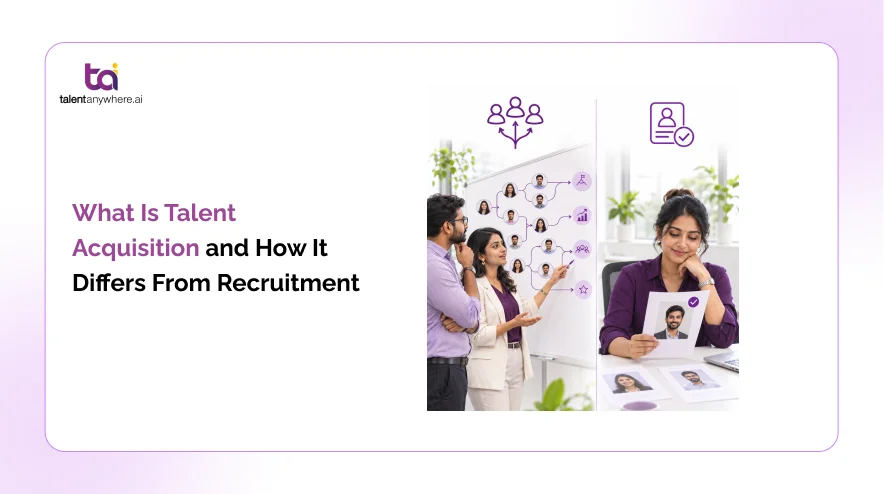
Talent acquisition is the ongoing, strategic work of finding, attracting and building the people a business will need to meet its goals. Recruitment is one part of it: filling a specific vacancy, usually under time pressure. Recruitment reacts to open roles. Talent acquisition plans for them through workforce planning, employer brand, talent pipelines and hiring data.
Plenty of companies say they do talent acquisition. Many of them actually run recruitment with a newer job title on the door. The gap shows up when hiring gets hard. Recruitment teams scramble to fill each vacancy as it opens, while talent acquisition teams already know which roles are coming, where the candidates are and what it will take to win them. If your hiring feels like a constant fire drill, the fix is usually strategic, not operational.
Talent Acquisition Vs Recruitment At A Glance
The two terms get used interchangeably, but they answer different questions. Here is the short version.
| Factor | Recruitment | Talent Acquisition |
| Purpose | Fills an open role | Builds the workforce the business needs over the next one to three years |
| Trigger | Starts when a vacancy opens | Starts with the business plan |
| Time horizon | Works in weeks | Works in quarters and years |
| Scope | Sourcing, screening, interviews and offers | Adds workforce planning, employer branding, pipelines, internal mobility and analytics |
| Success metrics | Time-to-fill and cost-per-hire | Also quality of hire, retention and pipeline health |
| Ownership | Recruiters and hiring managers | Brings business leaders into setting hiring priorities |
Stop Hiring From Zero Every Time
talentanywhere.ai brings AI-powered screening and interviews to your hiring team, so you can build pipelines ahead of demand instead of chasing every vacancy.
Talent Acquisition Meaning Beyond The Textbook
The talent acquisition meaning most people carry is narrow: hiring, with a more strategic-sounding name. In practical terms, talent acquisition is the system an organization uses to make sure the right skills are in place before the business needs them. It treats hiring as a continuous capability rather than a string of one-off searches. Most mature talent acquisition functions rest on six pillars.
Workforce Planning
Everything starts with the business plan. If the company intends to launch a product line or open a new region next year, talent acquisition translates that into roles, skills, timelines and budgets, and flags early where talent will be scarce.
Employer Branding
Candidates research you long before they apply. A clear employer value proposition, honest career pages and visible employee stories decide whether strong people respond to outreach or ignore it. Your current employees are part of that brand too, since candidates increasingly check what staff say about you before they reply to a recruiter.
Sourcing And Pipeline Building
Instead of posting a job and waiting, talent acquisition teams keep warm pipelines for critical roles. Past finalists, referrals, alumni and passive candidates engaged over months all become a bench to draw from.
Assessment And Selection
Strong teams replace gut-feel interviews with structured, skills-based evaluation, so every candidate is measured against the same criteria and hiring managers compare like with like. It also makes decisions easier to defend and far easier to improve.
Onboarding And Internal Mobility
The work does not stop at the offer letter. It covers the handover into onboarding and, increasingly, filling roles from inside the company before going to market at all.
Hiring Analytics
Source quality, funnel conversion, offer acceptance and first-year retention show what is working. Good talent acquisition teams use that data to move budget and effort, not just to report on activity.
Where Recruitment Fits Inside Talent Acquisition
Recruitment is not a lesser version of talent acquisition. It is the execution layer inside it. Without strong recruiting, even the best workforce plan stays on paper.
The Recruitment Cycle
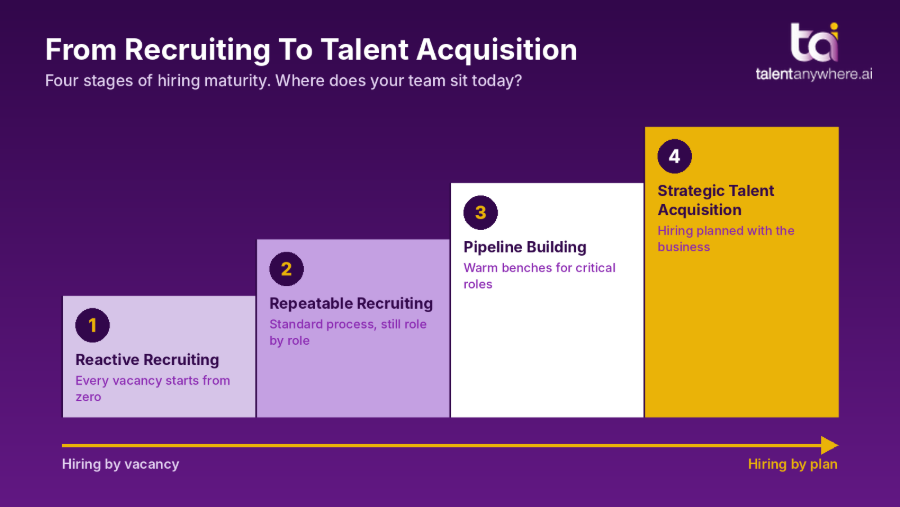
A typical cycle runs from requisition to job description, sourcing, screening, interviews, offer and acceptance. It is focused, measurable and time-bound, which is exactly why it works so well for filling individual roles. Done well, it also produces the raw material talent acquisition depends on: candidate data, interview feedback and a record of where good hires came from.
Why Recruitment Alone Stalls At Scale
The trouble starts when recruitment is the whole strategy. Every vacancy starts from zero, hiring managers wait on thin shortlists and the same hard-to-fill roles reopen every year. SHRM’s 2026 Talent Trends report found that nearly 70% of HR professionals still face challenges recruiting for full-time positions. Better job ads will not fix that. Earlier planning and warmer pipelines will.
How The Two Work Together
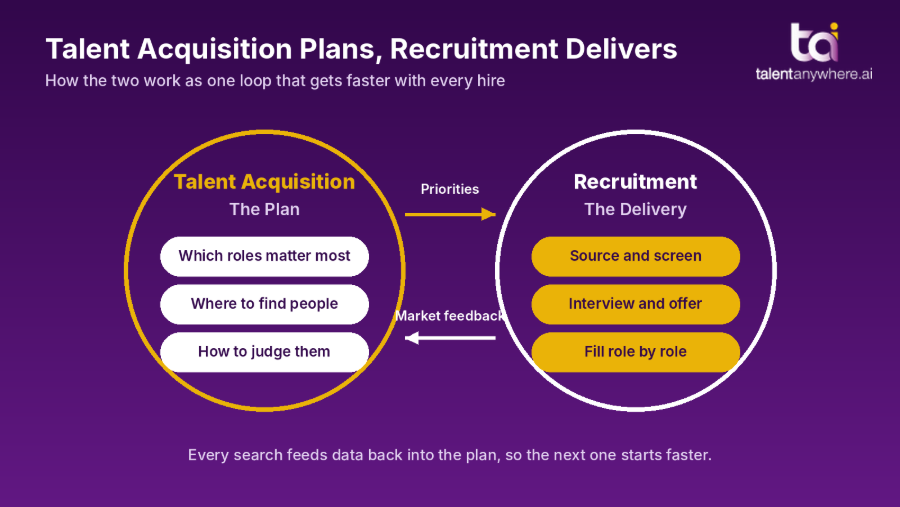
Think of talent acquisition as the plan and recruitment as the delivery. The plan decides which roles matter most, where to find people and how to judge them. Recruitment executes against that plan, role by role, and reports back on what the market is really saying. When the loop works, every search makes the next one faster and every hire teaches the team something about what good looks like.
The Difference Between Recruitment And Talent Acquisition
Definitions only go so far. The real gap shows up in how each team thinks, plans and measures success, across five areas.
Reactive Versus Proactive
Recruitment responds to a resignation or a new requisition. Talent acquisition anticipates those moments and has candidates in conversation before the role is even approved.
Vacancy Versus Workforce Plan
Recruitment asks how to fill this role. Talent acquisition asks whether the role should exist in its current form, whether someone inside can fill it and what skills the team will need next year.
Time-To-Fill Versus Quality Of Hire
Recruitment is judged on speed and cost. Talent acquisition is judged on whether hires perform, stay and grow, which is harder to measure and far more valuable to the business.
Transactional Versus Relationship-Led
Recruitment relationships often end at the offer. Talent acquisition keeps the door open with strong candidates who were not hired this time, because they may be the right fit next quarter.
Hiring Manager Partner Versus Business Partner
Recruiters partner with hiring managers on individual roles. Talent acquisition leaders partner with the leadership team on headcount, location strategy and build-versus-buy decisions.
Who Owns Talent Acquisition Inside A Company
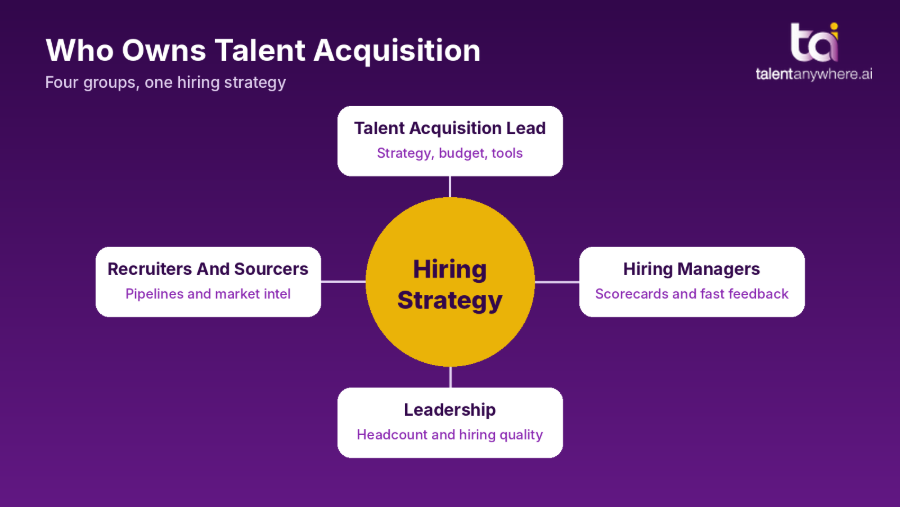
Talent acquisition is a shared responsibility. The structure changes with company size, but four groups usually carry it, and the strategy only works when all four pull in the same direction.
The Talent Acquisition Lead
Sets the hiring strategy, owns the budget and tools, and turns the business plan into a hiring roadmap. In smaller companies, this is often the HR head wearing a second hat.
Recruiters And Sourcers
Run day-to-day searches, engage passive candidates and keep pipelines moving. In a talent acquisition model, they also feed market intelligence back to the business, such as shifting salary expectations or skills that are getting harder to find.
Hiring Managers
Define what good looks like, interview against a shared scorecard and give fast, specific feedback. No hiring strategy survives slow or inconsistent hiring managers.
Leadership
Approves headcount, decides where to build skills internally and where to hire them, and holds the organization accountable for hiring quality, not just speed.
Also Read: AI Recruitment Tools Every Hiring Team Should Know
Signs You Have Outgrown Recruitment Alone
Not every company needs a full talent acquisition function on day one. A 15-person startup hiring three people a year is well served by good recruiting. These signals suggest it is time to think bigger.
- The same roles keep reopening, and each search starts from scratch.
- Hiring managers regularly complain about slow or thin shortlists.
- Offer acceptance is slipping because candidates choose competitors with stronger employer brands.
- Leadership cannot get a clear answer on hiring capacity for next year’s plan.
- New hires leave within the first year, and nobody can say why.
If two or more of these sound familiar, the issue is not effort. Your team is working hard on the wrong layer of the problem, solving each vacancy instead of the system that keeps creating them.
How To Build A Talent Acquisition Strategy That Works
You do not need a large team to start. You need a few deliberate shifts in how hiring is planned, run and measured.
Start With The Workforce Plan
Sit with leadership every quarter and map business goals to headcount and skills. Flag the roles that are hardest to fill and start building pipelines for those first. Keep the plan light enough to update every quarter, because a hiring forecast that only gets reviewed once a year is out of date by spring.
Define Roles By Skills, Not Titles
Write requirements around what a person must be able to do in their first six months. It widens the talent pool and gives every interviewer a clear scorecard to work from.
Build Pipelines Before You Need Them
Keep a shortlist of past finalists, referrals and engaged passive candidates for every critical role. When a vacancy opens, you start with conversations instead of job ads.
Look Inside Before You Look Outside
Internal candidates already know the business, and moving them up is one of the strongest retention levers you have. More employers are leaning into this. SHRM’s 2026 Talent Trends report found that 41% of HR professionals now train existing employees for hard-to-fill roles, a clear sign that building talent matters as much as buying it.
Make Your Employer Brand Specific
Generic claims about culture and growth do not move strong candidates. Show real work, real teams and real career paths, and be honest about what the role demands. Specific beats polished every time.
Fix The Candidate Experience
Slow responses and opaque processes cost you finalists. Set response timelines, explain each stage upfront and give every candidate a clear outcome, even when the answer is no.
Measure What Matters
Track quality of hire, first-year retention, source effectiveness and offer acceptance alongside time-to-fill. Review the numbers quarterly and shift budget toward the channels that produce people who stay. Share the results with hiring managers too. When they see which interview signals predicted strong performance, they start interviewing differently.
Use Technology To Free Up Judgment Time
A recruiter’s real value is judgment: reading a candidate, advising a hiring manager, closing a tough offer. AI-powered hiring tools take over the repetitive layer, from resume screening to first-round interviews, so that time goes where it counts. That is how talentanywhere.ai fits into a talent acquisition strategy. It lets a lean team operate with the reach of a much larger one, without giving up control of the decisions that shape the workforce.
Also Read: Cost Per Hire Formula And How To Reduce Recruitment Costs
Common Mistakes Teams Make When Shifting To Talent Acquisition
Most stalled talent acquisition initiatives fail for predictable reasons. If you are making the shift, watch for these.
- Renaming without changing. Swapping recruiter titles for talent acquisition titles while the work stays reactive changes nothing.
- Planning without business input. A workforce plan built inside HR, without the leaders who own the targets, is a guess.
- Measuring only speed. If time-to-fill is the only number anyone watches, teams will quietly trade quality for pace.
- Overlooking internal talent. Going to market for every role tells employees that growth happens somewhere else.
- Buying tools before fixing process. Technology amplifies whatever process it sits on, good or bad.
Turning Hiring Into A Strategic Advantage
Recruitment fills today’s vacancies. Talent acquisition makes sure tomorrow’s do not turn into a crisis. The companies that hire well are rarely the ones with the biggest budgets. They are the ones that plan early, keep pipelines warm, measure quality over speed and give recruiters room to think. Start with one critical role, build its pipeline before it opens and let the results make the case for the rest.
Give Your Recruiters Time To Think Strategically
Let talentanywhere.ai handle the screening load while your team focuses on workforce planning, candidate relationships and better hiring decisions.
FAQs
What Is Talent Acquisition?
What Is The Main Difference Between Recruitment And Talent Acquisition?
Talent Acquisition Vs Recruitment, Which Does A Small Business Need?
What Does A Talent Acquisition Specialist Do?
Is Talent Acquisition Part Of HR?


talentanywhere.ai
Build professional resumes with AI, improve your ATS score, and apply with confidence. talentanywhere.ai empowers job seekers with smarter resume creation and career tools for every stage.