

Table of Contents
 Set as a preferred Google source
TL;DR
Most internship interview questions test three things: how fast you learn, whether you can prove your skills, and whether a team can rely on you. Prepare four or five real stories from projects, clubs or coursework. Structure every answer with STAR or Claim, Example, Result. Research one specific thing the company did recently, and close with two sharp questions of your own. Interns who prepare this way stop sounding rehearsed and start sounding hireable.
Your first internship interview rarely goes wrong because of what you don’t know. It goes wrong because of vague answers. Recruiters hiring interns already know you have no full-time track record, so they listen for something else: how you think, what you have already built and how quickly you pick things up.
The stakes are also higher than most students assume. Employers converted 63.1% of their 2024-25 interns into full-time hires, the highest rate in five years, according to NACE’s 2026 Internship and Co-op Survey. For many students, the internship interview is quietly the first round of a job interview.
So this guide skips the generic first internship interview advice and sticks to what changes outcomes:
- The internship interview questions recruiters ask most, grouped by what each one is really testing
- Sample answers built from student experience, not job history
- Two answer frameworks that work for almost any question
- A 48-hour prep plan and the small mistakes that quietly cost offers
Rehearse Before It Counts
Sharpen your resume and practise your answers with talentanywhere.ai, so your first interview feels like your second.
What Interviewers Are Really Testing In A First Internship Interview
Every question in an intern interview maps to a handful of signals. Once you know them, you can read any question, however it is phrased, and answer the thing being assessed rather than the literal words.
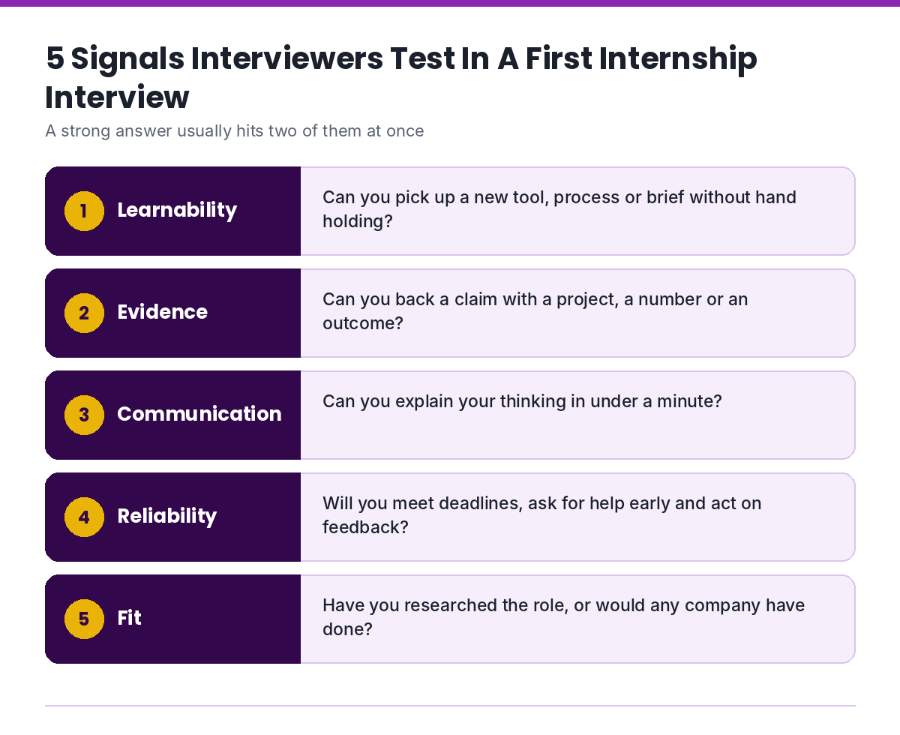
- Learnability. Can you pick up a new tool, process or brief without hand-holding?
- Evidence. Can you back a claim with a project, a number or an outcome?
- Communication. Can you explain your thinking in under a minute, without rambling?
- Reliability. Will you meet deadlines, ask for help early and follow through on feedback?
- Fit. Have you researched the role, or would any company have done?
Keep these five signals in mind as you go through the questions below. A strong answer usually hits two of them at once.
Also Read: 15 Most Common Interview Questions And Answers
Two Frameworks That Fix Almost Any Answer
You will not predict every question, and you don’t need to. You need a structure that turns a raw experience into a clear, 60-second answer. These two cover nearly everything an intern panel will ask.
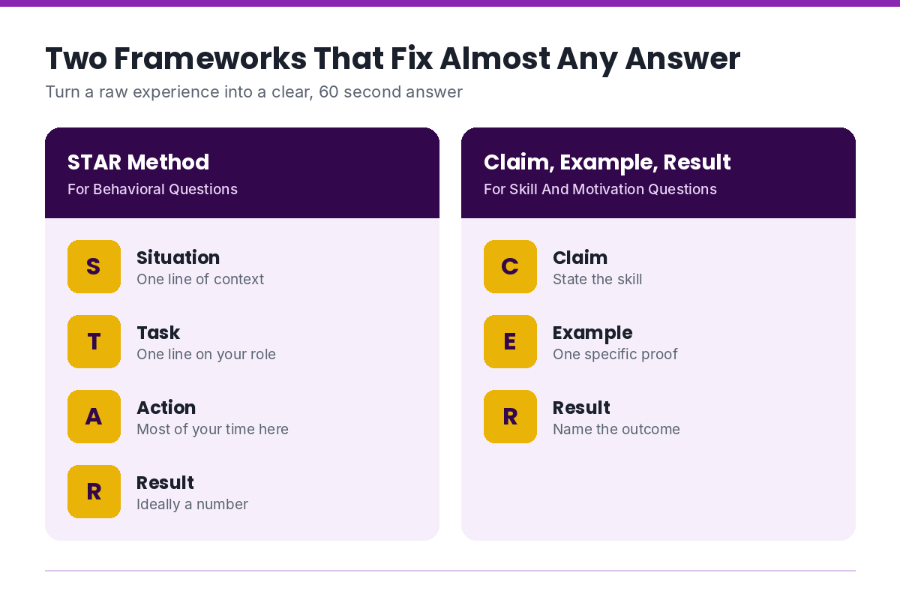
The STAR Method For Behavioral Questions
Use STAR whenever a question starts with “Tell me about a time” or “Describe a situation”. Spend one line each on the Situation and Task, most of your time on the Action you personally took, and close with a Result, ideally a number. If the result was modest, add what you learned. Interviewers care as much about your reasoning as the outcome.
Claim, Example, Result For Everything Else
For skill and motivation questions, make a claim, prove it with one specific example and name the result. “I’m good at research” is a claim. “I compared pricing and Instagram strategy for five D2C brands for a college project, and our team used it to build the strongest pitch in class” is an answer. The second version gives the interviewer something to evaluate and remember.
Introductory And Motivation Questions
These open almost every round, and most freshers lose easy points by improvising them. Treat them as the internship interview questions you can outline fully in advance, though never memorise them word for word.
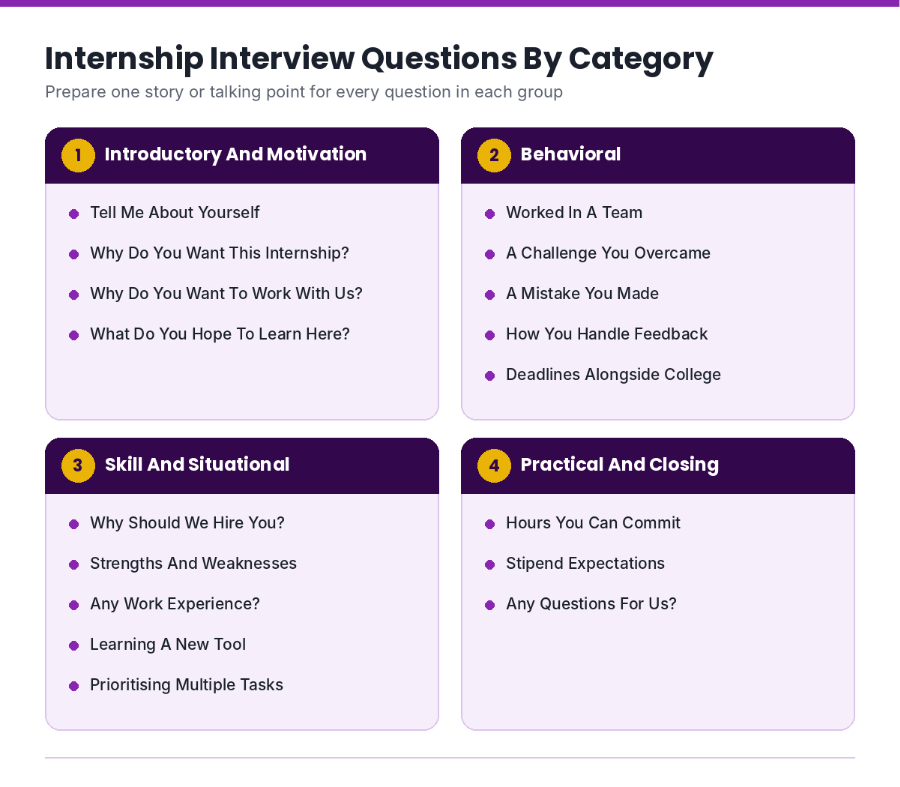
Tell Me About Yourself
This is a pitch, not a biography. Use present, past and future in about 45 seconds: what you study now, what you have done that relates to the role and why this internship is the logical next step.
Sample answer “I’m a third-year B.Com student focused on finance. Over the last year, I built a stock-tracking sheet for our college investment club and wrote weekly market summaries for 200 members. I’m now looking for an internship where I can apply that analysis to real client work, which is why this equity research role stood out.”
Why Do You Want This Internship?
The interviewer is checking whether you read the job description or applied in bulk. Name two responsibilities from the listing and connect each to something you have already tried.
Sample answer “The role involves content research and social media reporting. I’ve done both on a small scale for our college fest page, and I want to learn how they work when there’s a real budget and a real audience behind them.”
Why Do You Want To Work With Us?
Generic praise (“great culture”, “industry leader”) signals zero research. Reference one specific product, campaign, announcement or post, and say why it matters to you.
Sample answer “I noticed your recent shift toward short educational videos for first-time investors. I’ve been studying how finance brands simplify complex products, so seeing that work up close is a big part of why I applied.”
What Do You Hope To Learn Here?
Avoid “everything”. Pick one or two skills tied to the role and show you have already started on them. It tells the interviewer you will arrive with momentum, not a blank slate.
Also Read: Telephonic Interview Questions And How To Answer Them Confidently
Behavioral Questions That Test How You Work
This is where most intern interviews are decided. Employers want proof of soft skills, not a list of them. According to NACE’s Job Outlook 2026 Spring Update, 85% of employers look for evidence of teamwork on a candidate’s resume, and recruiters use behavior-based questions in interviews to check whether that evidence holds up. Prepare a STAR story for each question below.
Tell Me About A Time You Worked In A Team
Pick a story where you did something specific to move the group forward, such as resolving confusion, splitting work or chasing a deadline.
Sample answer “Five of us were building a market-entry presentation, and two weeks in, nobody owned anything. I suggested splitting it into research, financials and design, each with its own internal deadline. We submitted two days early and scored the highest grade in our section.”
Describe A Challenge You Overcame
Choose a real, moderate challenge. A broken code build, a client who changed the brief or a teammate who dropped out all work. Focus on your decision-making, not the drama.
Tell Me About A Mistake You Made
Interviewers are testing ownership. Admit the mistake plainly, explain what it cost and describe the habit you changed afterwards.
Sample answer “On a design project, I started building screens before the content was final. When the copy changed, I had to redo half the work. Now I lock the structure with my team before I open Figma.”
How Do You Handle Feedback?
Show a process: listen, clarify what needs to change, revise quickly and note it so the same comment doesn’t come up twice. If you can, mention a time feedback visibly improved your work.
How Do You Manage Deadlines Alongside College Work?
“I work well under pressure” proves nothing. Describe your system instead, such as weekly planning, internal deadlines set two days early or a shared task tracker, and give one example where it saved you during exams.
Also Read: Remote Jobs No Experience Needed And How To Land One In 2027
Skill And Situational Questions
Once the panel knows how you work, it tests what you can actually do. Answers here should be concrete, short and tied to the role you applied for.
Why Should We Hire You?
Use a three-part answer: what you can do, proof that you have done it and how it maps to the role. Close the loop on their needs, not yours.
Sample answer “I can write clean, tested Python. I built a library management app for my college with 300 active users and fixed bugs reported through a Google Form. Since this internship involves maintaining internal tools, I can contribute from week one while learning your stack.”
What Are Your Strengths And Weaknesses?
For strengths, pick one and attach evidence. For weaknesses, pick a real one that won’t disqualify you and show the fix already in motion. “I work too hard” reads as dodging the question.
Sample answer “I over-polish small details and can lose time on them. I now set a personal deadline a day before the real one, so there’s room to review without slipping.”
Do You Have Any Work Experience?
Never stop at “no”. Redirect to the closest equivalent, such as freelance gigs, club roles, hackathons, a portfolio or a certification project, and walk through your strongest one.
How Would You Learn A Tool You Have Never Used?
Show a method. Read the documentation, try a small version of the task, check a reliable tutorial and only then ask your manager a specific question. Mention a tool you taught yourself recently, such as Excel pivot tables, Figma auto-layout or SQL joins.
How Do You Prioritise Multiple Tasks?
Explain your logic: tasks that block someone else go first, then hard deadlines, then everything else on a checklist. One quick example makes this answer credible.
Also Read: Top 7 AI Skills Experts Say Will Make You Instantly Hireable
Practical And Closing Questions
These sound like admin, but they test honesty and judgement. Clear, realistic answers here build more trust than eager promises.
How Many Hours Can You Commit?
Be precise and realistic. “Four hours on weekdays, with flexibility before agreed deadlines” beats promising eight hours a day during semester exams. Reliability matters more than availability.
What Are Your Stipend Expectations?
If you have flexibility, ask for their budgeted range first. If you have a fixed requirement, state it plainly and politely. Avoiding the question entirely only delays an awkward conversation.
Do You Have Any Questions For Us?
Always say yes. Ask what you would work on in your first month, who you would report to, how feedback is shared with interns and what a successful internship looks like. These questions show intent and help you judge whether the role is worth your time.
How To Prepare For Internship Interview Rounds In 48 Hours
Knowing how to prepare for internship interview rounds matters more than how many answers you read. Most rejections trace back to thin preparation, not weak profiles. Use the two days before your interview like this.
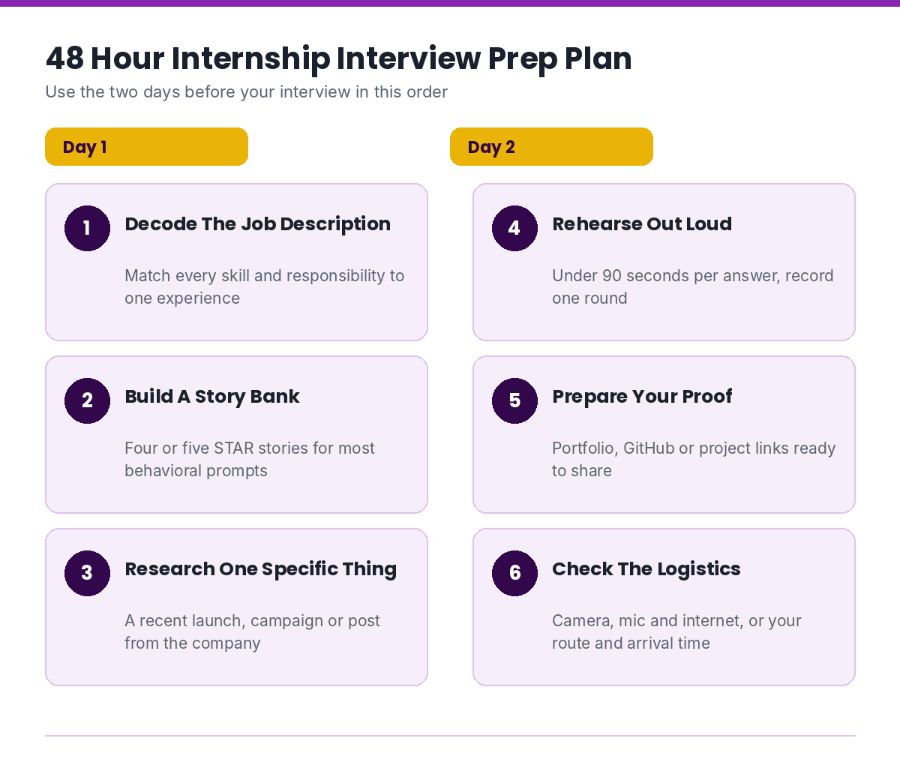
- Decode the job description. Highlight every skill and responsibility, then match each to one experience you can talk about.
- Build a story bank. Write four or five STAR stories covering teamwork, a challenge, a mistake, leadership and learning something fast. Most behavioral prompts can be answered with one of them.
- Research one specific thing. Find a recent product launch, campaign or post from the company and decide what you would say about it.
- Rehearse out loud. Run through the internship interview questions in this guide at least twice, timing yourself to stay under 90 seconds per answer. Record one round and listen back for filler words.
- Prepare your proof. Keep links to your portfolio, GitHub, published work or project files ready to share on screen.
- Check the logistics. Test your camera, mic and internet for virtual rounds, or plan your route and arrival time for in-person ones.
Also Read: How AI Enhanced Resumes Are Getting 3X More Callbacks
Internship Interview Tips That Separate Shortlisted Candidates
Most candidates who miss out don’t lack ability. They lose the offer to avoidable habits. These internship interview tips address the patterns recruiters flag most often.
- Swap adjectives for evidence. “Passionate” and “hardworking” mean nothing without a project behind them.
- Don’t recite memorised answers. Interviewers spot scripts instantly. Memorise your stories, not your sentences.
- Keep answers under two minutes. If the panel wants more detail, they will ask.
- Never criticise a past team or professor. It raises questions about how you handle conflict.
- Follow up within 24 hours. A short thank-you note that references something specific from the conversation keeps you top of mind.
Conclusion
No one expects an intern to have a long resume. What wins the offer is the ability to turn coursework, club roles and side projects into clear, specific proof. If there is one piece of first internship interview advice worth keeping, it is this: prepare stories, not scripts.
Go back through the internship interview questions above, map each one to a story from your bank and rehearse until the structure feels natural. Pair that with a resume that shows the same evidence, and tools like talentanywhere.ai can help you tighten both before the real conversation. Walk in with proof, and the interview stops being a test and becomes a discussion about what you can contribute.
Your First Offer Starts With Your First Interview
Build a resume that shows proof and walk into every round prepared with talentanywhere.ai.
FAQs
What Are The Most Common Questions Asked In An Intern Interview?
How Do I Answer Interview Questions With No Work Experience?
How Long Should My Answers Be?
How To Prepare For Internship Interview Rounds At Short Notice?
What Should I Ask At The End Of An Intern Interview?
Do Internship Interview Tips Differ For Virtual Rounds?


talentanywhere.ai
Build professional resumes with AI, improve your ATS score, and apply with confidence. talentanywhere.ai empowers job seekers with smarter resume creation and career tools for every stage.