


Table of Contents
 Set as a preferred Google source
TL;DR
Interviewers ask this question to judge three things: whether your goals fit the role, whether you are likely to stay, and whether you have thought seriously about your own growth. The strongest answers start with the skills you want to build, connect them to the company’s direction, and end with the contribution you want to make. Avoid naming a title you cannot realistically reach, joking about taking the interviewer’s job, or presenting the role as a stepping stone. Use the sample answers below as frameworks, and rehearse your own version out loud until it sounds like you.
Few interview questions sound as simple, or feel as loaded, as “Where do you see yourself in 5 years?” You are asked to predict a future you cannot fully control, in front of a stranger who is deciding whether to hire you, often near the end of a long conversation when your energy is already dipping.
Here is the reassuring part. Interviewers are not asking you to be a fortune teller. They want to understand how you think about growth, and whether that thinking points toward their company or away from it. Once you see the question that way, answering it becomes a matter of structure rather than guesswork.
This guide explains why hiring managers ask it, gives you a three-step framework for building your response, covers the mistakes that quietly cost candidates offers, and finishes with sample answers for freshers, experienced professionals, career changers and future managers.
Turn Your Five-Year Plan Into Interview-Ready Answers
Practice how you talk about your goals with talentanywhere.ai’s AI-powered career tools and walk into your next interview with clarity and confidence.
Why Interviewers Ask Where Do You See Yourself In 5 Years
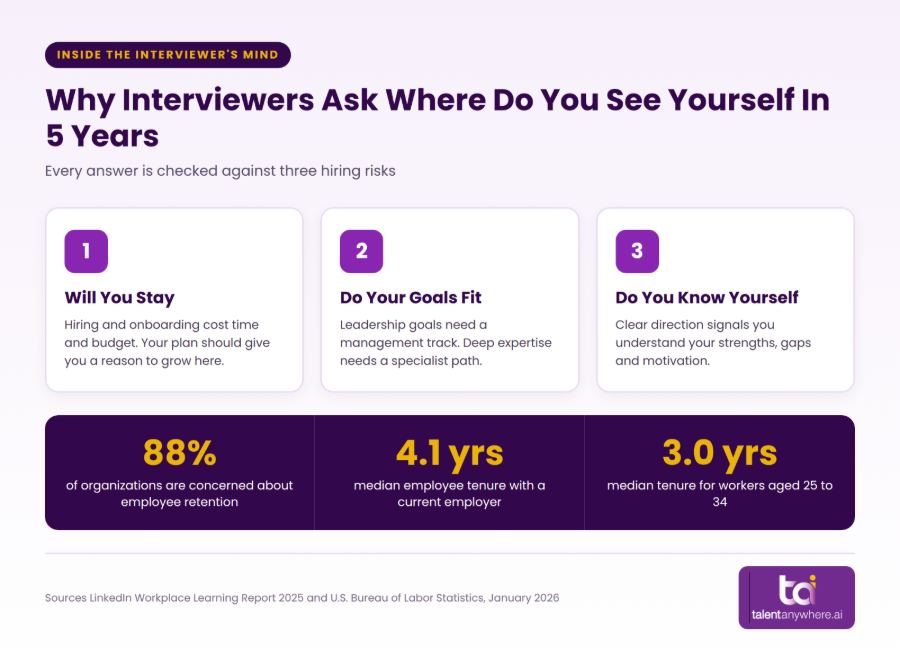
Every question in a structured interview exists to reduce a hiring risk, and this one targets a specific set of them: the risk that a new hire will leave early, stall in the role, or want something the company cannot offer. Retention is firmly on employers’ minds. According to LinkedIn’s Workplace Learning Report 2025, 88% of organizations are concerned about employee retention, and offering learning opportunities is their top strategy for keeping people. Knowing what the interviewer is listening for lets you address those concerns directly.
They Want To Know If You Will Stay
The concern is grounded in how long people actually stay. The U.S. Bureau of Labor Statistics reports that median employee tenure with a current employer was 4.1 years in January 2026, and only 3.0 years for workers aged 25 to 34. A typical younger professional, in other words, changes employers before reaching the five-year mark the question asks about. Hiring and onboarding take real time and budget, so recruiters want evidence that your plans give you a reason to stay and grow with them.
They Want To See If Your Goals Fit The Role
A candidate who wants to lead a team within three years may struggle in an individual contributor role with no management track. A candidate who wants deep technical mastery may feel restless in a role that moves quickly toward people management. Interviewers are checking alignment, not ambition alone, which means the right answer for one role can be the wrong answer for another.
They Want Evidence Of Self-Awareness
Candidates who can describe where they are headed usually understand their strengths, their gaps and what motivates them. That clarity tends to show up later as productive performance conversations and faster learning. A thoughtful answer tells the interviewer you did this thinking before you walked into the room.
Also Read: Common Interview Questions
How To Structure Your Answer In Three Steps
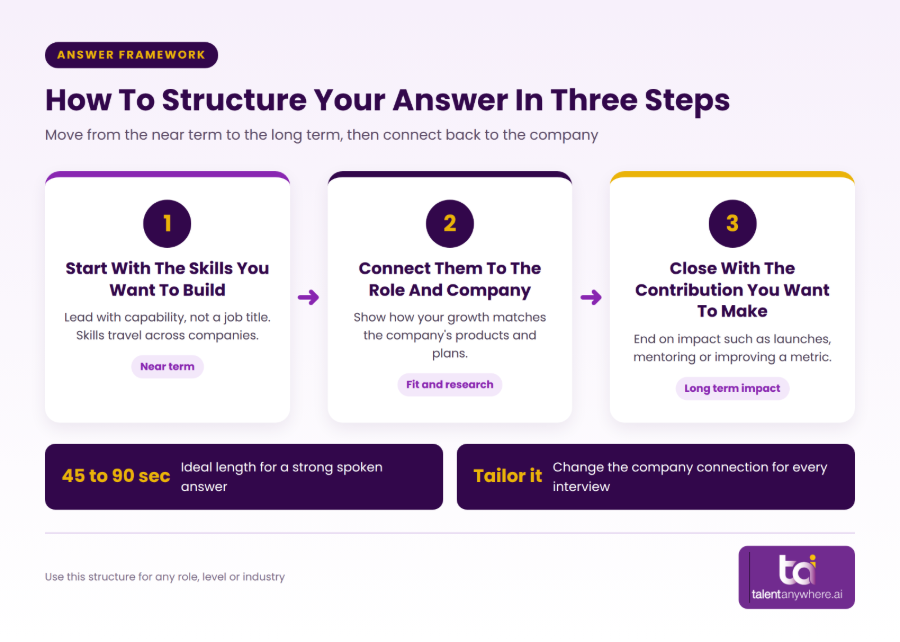
A strong response to where do you see yourself in 5 years usually runs between 45 and 90 seconds. It moves from the near term to the longer term and ends by connecting back to the company. Whether the interviewer asks where do you see yourself in next 5 years, where you want to be by 2031, or what your long-term goals are, the three steps below give you a repeatable structure you can adapt to any role.
Start With The Skills You Want To Build
Open with capability rather than a job title. Titles mean different things at different companies, but skills travel. Saying you want to become highly proficient in performance marketing analytics or in designing scalable backend systems signals focus without locking you into a promotion timeline the company may not offer.
Connect Those Skills To The Role And Company
Before the interview, study the company’s products, growth plans and recent announcements. Then show how the skills you want to develop are the same ones this role, and the company’s next stage, will demand. This step is where a generic answer turns into a memorable one, because it proves you have thought about their future as well as yours.
Add job search Widget
Close With The Contribution You Want To Make
End on impact. Leading a product launch, mentoring newer colleagues, owning a process or improving a key metric all tell the interviewer that your growth will benefit the team and not only your resume. A closing line about contribution also leaves the conversation on a forward-looking, collaborative note.
Mistakes That Weaken Your Answer
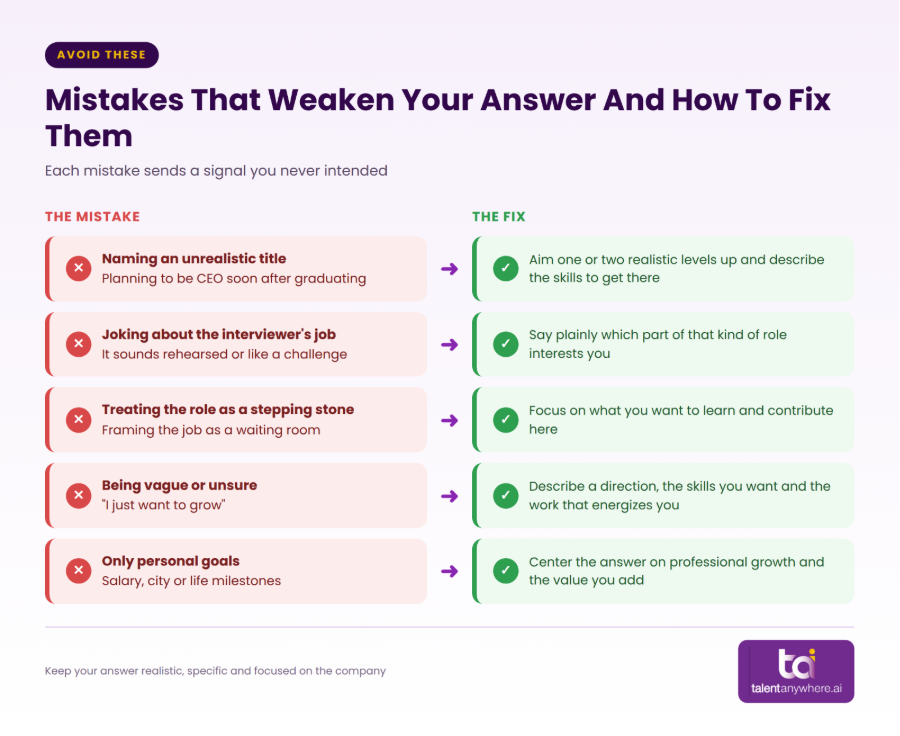
Most weak answers to where do you see yourself in 5 years fail for a handful of predictable reasons. Each mistake below sends a signal the candidate never intended, and each one is easy to fix once you know what to watch for.
Naming A Title You Cannot Realistically Reach
Saying you plan to be the CEO, or a vice president within five years of graduating, rarely comes across as ambitious. More often it suggests you do not understand how careers progress in the field. Aim for the next one or two realistic levels and describe the skills that would get you there.
Joking That You Want The Interviewer’s Job
This line has been used so often that it sounds rehearsed, and some interviewers hear it as a challenge rather than a compliment. If you admire the kind of role your interviewer holds, say so plainly and explain which part of that work interests you.
Presenting The Role As A Stepping Stone
If you plan to start a business, move abroad or switch industries eventually, you do not need to hide it. You do need to avoid framing this job as a waiting room. Focus on what you want to learn and contribute here, and keep plans that point away from the company out of the spotlight.
Being Too Vague Or Saying You Are Not Sure
“I just want to grow” or “I haven’t really thought about it” leaves the interviewer with nothing to evaluate. Even if your long-term path is open, you can describe a direction, the skills you want to build and the kind of work that energizes you.
Focusing Only On Personal Goals
Salary targets, a preferred city or life milestones are valid parts of your plan, but they belong in other conversations. In an interview, keep the answer centered on professional growth and the value you will add.
Also Read: Telephonic Interview Questions
Where Do You See Yourself In 5 Years Sample Answers
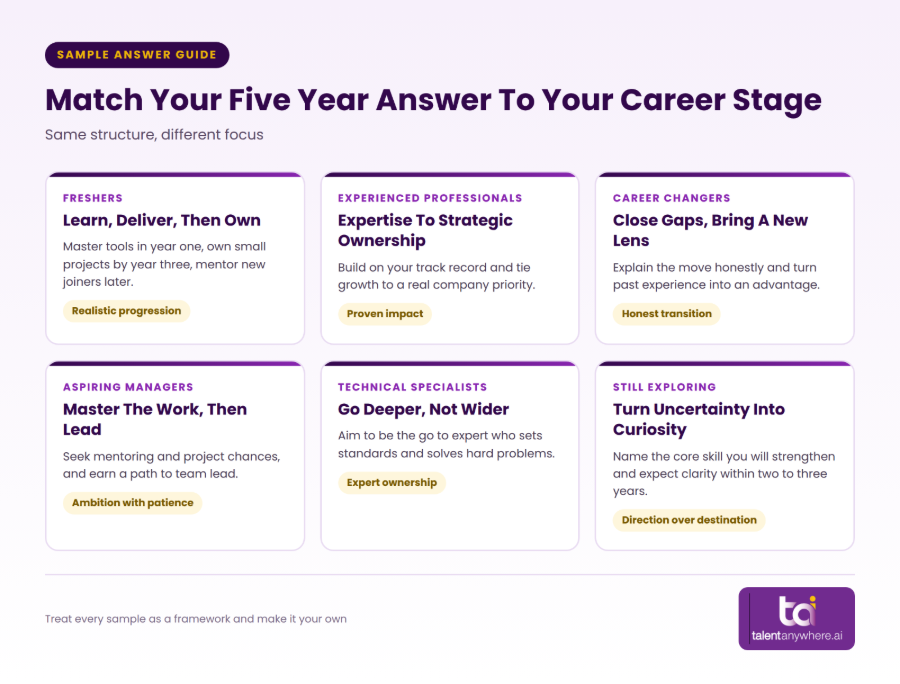
The examples below cover the situations candidates ask about most. Treat each where do you see yourself in 5 years sample answer as a framework rather than a script. Swap in your own field, your real skills and the company’s actual priorities, then rehearse until the wording sounds natural coming from you.
Sample Answer For Freshers
“Over the next five years, I want to become someone the team can rely on for [specific skill, such as data analysis and reporting]. My first year would be about learning your tools and processes thoroughly and delivering consistently on everything assigned to me. By year three, I’d like to be owning small projects from start to finish. Longer term, I hope to be mentoring new joiners the way I hope to be supported here. [Company name]’s focus on [a specific program, product or value] is a big part of why this role fits that plan.”
Why it works: It is realistic about where a fresher starts, shows a clear progression and ties the plan to something specific about the company.
Sample Answer For Experienced Professionals
“I’ve spent the last four years building expertise in [field or function]. In the next five, I want to deepen that into strategic ownership, for example leading [a type of initiative] and shaping how the team approaches [a relevant challenge]. I noticed [Company name] is expanding into [market, product or capability], and I’d like to be one of the people who helps that expansion succeed while developing the leadership skills to guide others through it.”
Why it works: It builds on a proven track record and links personal growth to a real company priority.
Sample Answer For Career Changers
“I’m moving into [new field] because [brief, genuine reason]. My immediate goal is to close the gaps between my previous experience and this role, especially in [specific skill]. Within five years, I see myself as a strong [role] who brings something different to the team, because my background in [previous field] gives me a perspective on [relevant area] that is hard to teach. I’d like to build that combination here.”
Why it works: It addresses the career change honestly and turns past experience into an advantage instead of a gap.
Sample Answer For Aspiring Managers
Interviewer: “Where do you see yourself in next 5 years?”
“I’d like to be leading a small team by then. Over the next couple of years, I want to master the core work of this role, because I believe good managers understand the job they are managing. Alongside that, I’d like to take on chances to mentor, run projects and handle cross-functional coordination. If [Company name] offers a path from [this role] to [team lead or manager], I’d love to earn my way onto it.”
Why it works: It pairs ambition with patience and frames leadership as something to earn rather than something owed.
Sample Answer For Specialists Who Want To Stay Technical
“I see myself going deeper rather than wider. In five years, I want to be the person the team turns to for [specialist area], someone who solves the hardest problems and helps set technical standards. I’m less drawn to people management and more to expert-level ownership, and I noticed [Company name] has [a principal, staff or senior specialist track], which is exactly the kind of growth I’m looking for.”
Why it works: Not every career leads into management. This answer shows self-awareness and checks for fit at the same time.
Sample Answer When You Are Unsure Of Your Long-Term Path
“Honestly, I’m still discovering which direction excites me most, and that’s part of why this role appeals to me. It would expose me to [area one] and [area two]. What I’m certain about is that I want to be significantly stronger in [core skill] than I am today and to be trusted with more responsibility. I’d expect to have a much clearer specialization within the next two to three years, built on what I learn here.”
Why it works: It is honest without sounding directionless, and it turns uncertainty into curiosity.
Also Read : Interview Preparation Books
How To Practice Your Answer Before The Interview
Knowing the right structure is only half the work. The other half is delivering your answer naturally under pressure, and that only comes with deliberate practice.
Write It Down, Then Cut It
Draft a full answer, then trim anything that does not support one of the three steps. Most first drafts are twice as long as they need to be. Aim for something you can say comfortably in about a minute.
Rehearse Out Loud And Record Yourself
Answers that read well on paper can sound stiff when spoken. Record yourself, listen back and adjust the phrases that feel forced. Rehearsing with the AI-powered career tools on talentanywhere.ai is a practical way to test how your answer lands and refine it before the real conversation.
Prepare For Follow-Up Questions
A good interviewer may probe further with questions such as “What are you doing now to build those skills?” or “What happens if that path isn’t available here?” Have a short, honest response ready for each, so your answer holds up beyond the first ninety seconds.
Final Thoughts On Answering The Five-Year Question
Where do you see yourself in 5 years is less a test of prediction than a test of direction. Interviewers want to hear that you know which skills you want to build, why this role helps you build them and how your growth will benefit the team. Answer with a realistic plan, connect it to the company’s priorities and close on contribution. Practice it until it sounds like a genuine conversation, because the best answers are the ones you actually believe.
Your Next Five Years Start With Your Next Interview
From sharper answers to a stronger career story, talentanywhere.ai helps you prepare for the conversations that shape where you go next.
FAQs
How Long Should My Answer Be?
Is It Okay To Say I Want To Start My Own Business Someday?
What If I Plan To Pursue Higher Studies?
Should Freshers Answer This Question Differently?
Can I Use The Same Answer In Every Interview?


talentanywhere.ai
Build professional resumes with AI, improve your ATS score, and apply with confidence. talentanywhere.ai empowers job seekers with smarter resume creation and career tools for every stage.