

Table of Contents
 Set as a preferred Google source
TL;DR
“What are your strengths and weaknesses” isn’t asking for a perfect list, it’s testing self-awareness, job fit, and growth mindset. This guide gives you a simple Strength-Example-Impact and Weakness-Action-Progress framework, 10 strengths and 10 weaknesses to choose from, 3 detailed weakness examples, 5 full sample answers by role, mistakes to avoid, and how to tailor your answer to any job description.
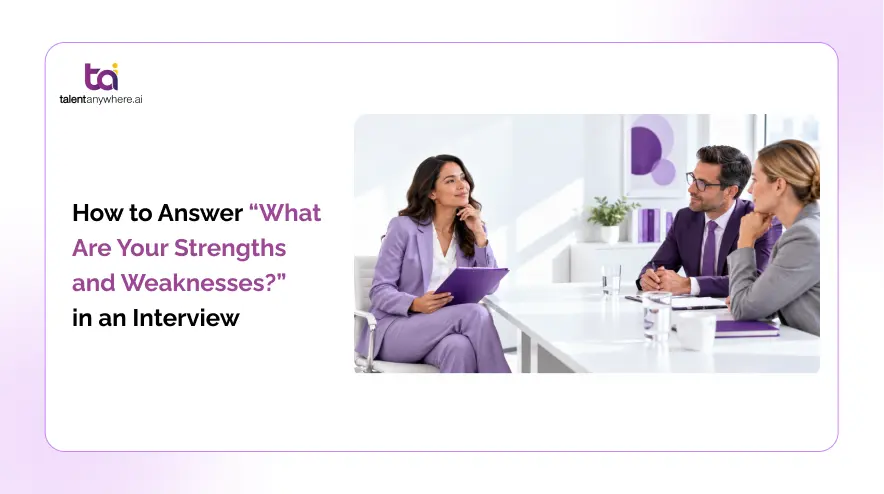
“What are your strengths and weaknesses?” sounds simple, but it’s genuinely hard to answer well, because you have to balance confidence, honesty, and relevance in real time. The interviewer isn’t just collecting a list of good and bad qualities. They’re trying to understand how self-aware you are, whether your strengths actually fit the role, whether you can recognize areas for improvement, and how you respond to feedback.
The best answer isn’t the one with the most impressive strengths or the safest weakness. It’s the one that is relevant to the job, backed by a real example, and shows how you’re growing.
What Do Interviewers Want To Know When They Ask About Your Strengths And Weaknesses
This question gives interviewers a fast read on several things at once, not just your qualities on paper.
Self Awareness
Can you accurately evaluate yourself, or do you default to generic, rehearsed answers? Most people believe they are self-aware, but researchers estimate that only 10 to 15 percent actually meet the criteria for it, according to organizational psychologist Tasha Eurich’s research published in Harvard Business Review. That gap is exactly what this question is designed to surface.
Job Fit
Do your strengths match the skills and behaviors the role actually requires?
Communication
Can you explain your qualities clearly and concisely, without rambling or over-explaining?
Growth Mindset
Can you acknowledge a real weakness and show that you’re actively doing something about it?
Professional Maturity
Can you accept feedback and take responsibility for improvement, rather than getting defensive or dismissive?
Also Read: Telephonic Interview Questions And How To Answer Them
The Framework For Answering This Question
Once you have a simple structure to follow, this question stops feeling like a trap.
Use The Strength Example Impact Framework
Name the strength clearly, give context for where you developed or used it, then show the impact it had.
“One of my strengths is [strength]. I developed this through [experience]. In my previous role or project, I used it to [specific example], which helped me [result].”
Use The Weakness Action Progress Framework
Name a genuine weakness, briefly explain how it affected your work, describe the concrete action you took, then show the progress that resulted.
“One area I’ve been working on is [weakness]. I noticed it affected [situation], so I started [specific action]. Since then, I’ve [progress or result].”
How To Choose The Right Strengths For An Interview
The best strength isn’t the most impressive sounding one. It’s relevant, genuine, and provable.
Match Your Strengths To The Job Description
Identify 2 to 3 important competencies from the job posting and choose a strength that matches.
| Job Requirement | Possible Strength |
| Customer interaction | Communication or empathy |
| Team collaboration | Teamwork |
| Fast-changing environment | Adaptability |
| Analytical role | Problem-solving |
| Leadership role | Decision-making or leadership |
| Content role | Creativity or communication |
Choose Strengths You Can Prove
Ask yourself when you’ve demonstrated this strength, what you accomplished because of it, and whether you can give a specific example on the spot.
Don’t List Too Many Strengths
One or two strong, well-supported strengths land better than five or six vague qualities. A focused answer signals confidence, not limited ability.
10 Good Strengths To Mention In An Interview
Relevance depends on the role, so treat this as a menu rather than a universal top ten.
Communication
Useful for roles involving clients, teamwork, presentations, or cross-functional collaboration.
Problem Solving
Useful when the role requires analyzing challenges and finding practical solutions.
Adaptability
Useful in fast-changing environments, startups, or roles with shifting priorities.
Teamwork
Useful for collaborative roles that depend on coordinating with others toward a shared goal.
Leadership
Useful for roles that involve guiding a team, project, or decision-making process.
Time Management
Useful for roles with multiple deadlines or competing priorities.
Attention To Detail
Useful for roles where accuracy and quality control matter, like finance, QA, or editing.
Creativity
Useful for roles involving content, design, marketing, or original problem-solving.
Quick Learning
Useful for roles involving new tools, fast onboarding, or evolving responsibilities.
Empathy
Useful for customer-facing, HR, healthcare, or support-oriented roles.
Also Read: Video Interview Tips That Help You Show Up Confident
How To Answer “What Are Your Weaknesses?” In An Interview
A good weakness is not a disguised strength. It’s a real area for improvement that you can manage and are actively working on.
Choose a weakness that is genuine, isn’t a critical requirement of the job, can realistically be improved, has a clear improvement strategy, and lets you demonstrate self-awareness.
The 4 Part Weakness Formula
Weakness, then context, then action, then progress.
“I used to struggle with prioritizing tasks when several deadlines came at once. I started breaking projects into smaller priorities and using weekly planning. That has helped me manage competing deadlines more consistently.”
10 Good Weaknesses For An Interview
For each of these, explain the behavior, its consequence, and what you’re doing differently, rather than naming it and stopping there.
- Public Speaking
- Delegating Tasks
- Taking On Too Much Responsibility
- Time Management
- Being Overly Detail Oriented
- Procrastination
- Difficulty Saying No
- Lack Of Experience With A Non Critical Tool
- Hesitating To Ask For Help
- Being Overly Self Critical
Don’t say “I’m a perfectionist” and leave it there. Traits like perfectionism or competitiveness can actually be strengths in some contexts, so you need to explain how the trait creates a genuine, specific challenge.
3 Weaknesses Job Interview Examples With Sample Answers
Example 1: Public Speaking
Weakness: I used to get nervous presenting to large groups and would rush through my points.
Action: I started volunteering for smaller internal presentations and asked for feedback afterward.
Progress: I’m noticeably more confident now and actively participate in client-facing presentations.
Example 2: Taking On Too Much Work
Weakness: I used to say yes to almost every request, which sometimes stretched my bandwidth too thin.
Action: I started prioritizing tasks against deadlines and communicating workload more clearly with my manager.
Progress: I now consistently meet deadlines without last-minute scrambling.
Example 3: Overly Detail Oriented
Weakness: I used to spend too much time refining work before considering it finished.
Action: I started setting time limits for revisions and defining what “done” looks like before I start.
Progress: I maintain the same quality while delivering on time.
Also Read: 12 Best Interview Preparation Books To Land Your Dream Job
5 Sample Answers To “What Are Your Strengths And Weaknesses?”
Sample Answer For A Fresher
Strength: I’m a quick learner and worked well in teams during my final year projects and internship.
Weakness: I don’t have much professional experience yet, so I’ve been using online courses and personal projects to build practical skills faster.
Sample Answer For A Customer Service Role
Strength: Empathy and clear communication help me de-escalate frustrated customers quickly.
Weakness: I used to take difficult interactions personally, so I’ve been working on separating the situation from myself and debriefing with my team afterward.
Sample Answer For A Sales Role
Strength:Relationship building and persistence help me nurture long sales cycles.
Weakness: I used to spend too much time on prospects who weren’t progressing, so I now use clearer qualification criteria to prioritize my pipeline.
Sample Answer For A Technical Role
Strength: Problem-solving and comfort learning new technologies quickly.
Weakness: I have limited hands-on experience with one tool used here, so I’ve been working through tutorials and a small personal project to close that gap.
Sample Answer For An Experienced Professional
Strength: Leadership and stakeholder management across cross-functional projects.
Weakness: I’ve historically delegated too little, so I’ve been consciously handing off more ownership and coaching my team through it.
Also Read: How To Build A Resume With No Work Experience
What Should You NOT Say When Asked About Your Strengths And Weaknesses
Avoid Fake Weaknesses
Lines like “I work too hard,” “I care too much,” or “I’m a perfectionist” tend to sound rehearsed unless you can genuinely support them with context and consequence.
Don’t Mention A Weakness That Is Essential To The Role
If you’re applying for a customer-facing sales role, don’t say you’re uncomfortable talking to people.
Don’t Claim You Have No Weaknesses
This reads as low self-awareness rather than confidence.
Don’t Give A Weakness Without Explaining Improvement
A weakness with no action attached is an incomplete answer.
Don’t Turn Your Answer Into A Life Story
Keep it concise, specific, and relevant to the role.
Don’t Memorize An Answer Word For Word
Over-rehearsed, generic, or AI-sounding answers are easy for interviewers to spot and tend to undercut the authenticity the question is designed to test.
Also Read: How AI Interviews Work And What Candidates Should Expect
How To Tailor Your Strengths And Weaknesses To The Job
There is no universal perfect answer, only one that fits the specific role.
Read the job description, identify 2 to 3 key competencies, match one genuine strength to those competencies, choose a weakness that isn’t a core requirement, prepare one real example for each, then practice saying the answer naturally out loud.
For example, if a job requires communication, teamwork, and client handling, a strong pairing is empathy or communication as the strength, and taking too long to prepare before presentations as the weakness, with a concrete fix like setting preparation time limits and starting earlier.
How To Prepare Your Answer Before The Interview
The 5 Minute Preparation Method
Ask yourself what two things you’re genuinely good at, what evidence proves them, what one area you’re actively improving is, what action you’re taking on it, and how all of this relates to the role you’re interviewing for. Then practice saying the answer aloud rather than memorizing a script, so it comes out sounding natural under pressure.
Practice “What Are Your Strengths And Weaknesses?” Before Your Interview
Preparing your answer is easier when you can practice it before the actual interview. talentanywhere.ai offers AI-powered mock interviews that let candidates practice common and role-specific questions and get feedback on their responses, so you can hear how your answer actually sounds before it counts.
Practice Your Interview Before It Counts
Rehearse common and role-specific interview questions with AI-powered mock interviews, and get instant feedback on how your strengths and weaknesses actually come across.
Quick Checklist Is Your Answer Interview Ready
- My strength is relevant to the role.
- I have a real example to support it.
- I can explain the impact.
- My weakness is genuine.
- My weakness isn’t a core requirement of the role.
- I can explain what I’m doing to improve.
- My answer sounds natural, not memorized.
- I can answer in under 1 to 2 minutes.
Conclusion
The goal isn’t to convince the interviewer that you have no weaknesses. It’s to show that you understand yourself, know where you add value, and take responsibility for improving.
Relevant strength, real example, genuine weakness, and improvement action, that combination makes a strong answer.
And if you want to practice before the real interview, talentanywhere.ai’s AI mock interviews can help you rehearse common and role-specific questions and get feedback before the stakes are real.
Walk Into Your Next Interview Prepared
See how talentanywhere.ai’s AI mock interviews help candidates practice, get feedback, and build real confidence before the interview that matters.
FAQs
What Is The Best Answer For “What Are Your Strengths And Weaknesses?”
What Are Good Weaknesses For An Interview?
What Are 3 Weaknesses Job Interview Examples ?
What Should I Say When Asked “What Are Your Weaknesses?”
How Many Strengths And Weaknesses Should I Mention?
What Are Good Strengths For A Job Interview ?
Should I Mention A Weakness That Is Related To The Job ?
Can A Strength Also Be A Weakness ?


talentanywhere.ai
Build professional resumes with AI, improve your ATS score, and apply with confidence. talentanywhere.ai empowers job seekers with smarter resume creation and career tools for every stage.
![10 Best ATS Resume Checkers to Improve Your Resume [Free + Paid]](https://www.talentanywhere.ai/wp-content/uploads/2026/09/Hero-10-Best-ATS-Resume-Checkers-to-Improve-Your-Resume-FREE-Paid-1-300x168.webp)