

Table of Contents
 Set as a preferred Google source
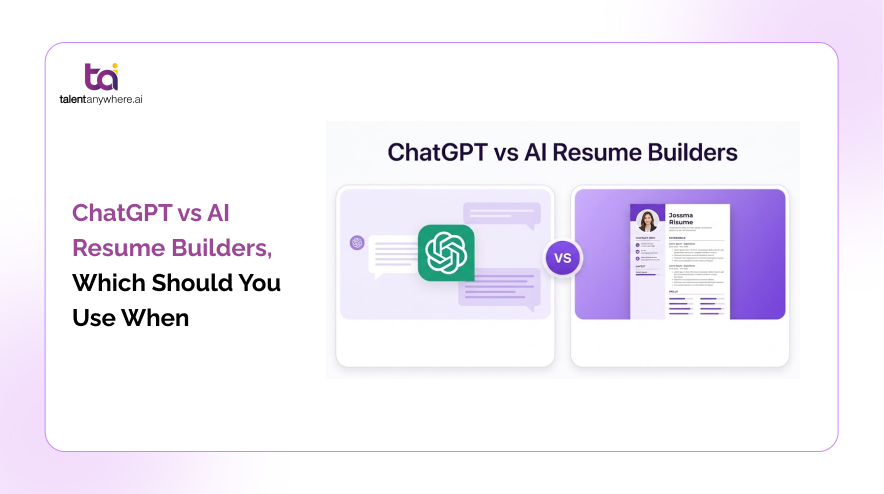
Use an AI resume builder first, to get the layout, structure, and export right, then bring in ChatGPT to sharpen the language once that structure exists. Most people search ChatGPT resume builder expecting one tool to do both jobs, and that is exactly where the confusion starts.
ChatGPT writes a resume in under a minute, and it reads well. That is exactly the problem. A document that reads well in a chat window is not the same as a document that survives the software standing between a candidate and a recruiter, and that gap is where strong applicants lose interviews they should have gotten.
The Short Answer
Start in an AI resume builder for layout, structure, and export. Bring in ChatGPT once that structure exists, to sharpen weak lines and adjust tone. The builder decides whether a resume gets read at all, ChatGPT decides how good it sounds once it does.
Stop losing to the parser, not the reader
Build a resume on a template made for ATS structure from the first line
ChatGPT vs AI Resume Builders, Feature Comparison
Here is a full ChatGPT resume builder comparison, nine categories that decide whether a resume actually gets read.
| Feature | ChatGPT | AI resume builder |
| Formatting and layout | Returns plain text, no layout control | Structured templates built for parsing |
| ATS compliance | Depends on where the text ends up | Checked against ATS parsing rules |
| Content quality | Strong at phrasing, rewriting, and tone | Guided prompts, less phrasing freedom |
| Export options | Copy and paste only | Docx and PDF export |
| Job description matching | Can compare text if it is pasted in | Built in scoring against a posting |
| Accuracy of details | Can invent numbers and dates | Uses only what the candidate enters |
| Speed for one application | Fast draft, manual formatting after | Slower first pass, formatted output |
| Speed across many applications | Requires manual rework each time | Reuses a structure across applications |
| Cost | Free tier covers most drafting | Free tier often gates export or scoring |
Start a resume in the resume builder, then bring ChatGPT in to sharpen the language.
Also Read : How AI Enhanced Resumes Are Getting 3x More Callbacks
When to Use ChatGPT
ChatGPT does its best work once a resume already has a parsing safe structure underneath it, sharpening the language without touching the format the builder already set.
- Turning a list of duties into measurable achievements
- Rewriting a weak or vague bullet point
- Drafting a professional summary from scratch
- Adapting tone for a specific industry
- Explaining an employment gap without over-explaining it
When to Use an AI Resume Builder
A resume builder earns its place first, before a single line of content gets written, because the structure has to be correct before anything goes into it.
- Starting a layout that is built to parse cleanly
- Making sure the file structure is ATS friendly
- Checking a draft against a live job posting
- Keeping dates and section headings consistent
- Exporting a clean docx or PDF file
- Applying to a high volume of roles without rebuilding the format each time
What an ATS Actually Does With Your Resume
An applicant tracking system is a database first and a filter second. It parses a resume into fields, name, contact details, job titles, dates, education, and skills, then stores those fields so a recruiter can search and sort them later. Formatting and parsing are a separate, earlier risk, and the two problems can stack on top of each other without a candidate ever finding out which one cost them the interview.
The problem most job seekers run into is that this failure is silent. A resume can be well written and still return empty fields, and the candidate never finds out why they went quiet.
How Parsing Works
Parsing software reads structure, not layout. It follows the order text appears in the underlying file, not how a design looks to a human eye. A two column resume that looks organized on screen can get read straight across both columns as one broken line. The elements that most reliably break parsing are tables, text boxes, headers, footers, icons, and images used to carry information instead of decoration. This is a formatting and structure problem, and no amount of better sentences fixes it.
What Gets a Resume Filtered Out
- Non standard section headings the system cannot map to a field
- Inconsistent date formats across roles
- Skills that exist on the resume but not as searchable text
- Information carried in a graphic rather than in text
- File formats the system cannot open cleanly
Getting the underlying ats resume structure right matters more than any single line of copy, and it is the one thing writing alone cannot fix.
Also Read : What Is an Applicant Tracking System and How It Reads Your Resume
Where ChatGPT Falls Short
ChatGPT is a strong editor and a weak document designer, and both halves of that matter once a resume has to survive more than a human reading it once.
No Real Control Over Formatting
ChatGPT returns text. What happens to that text once it leaves the chat window, the layout, the file type, the spacing, is entirely on the person pasting it somewhere else. That handoff is where a lot of applications quietly fail. This is exactly the layer a resume builder is built to handle.
Bullet Points That Read Generic
Ask a large number of people the same kind of prompt and a large number of people get back similar phrasing. Recruiters who read hundreds of resumes a week increasingly notice the same structures, spearheaded, orchestrated, leveraged, cross functional, repeating across candidates who have never met.
Invented Details and Drifting Dates
ChatGPT can produce a specific sounding percentage, team size, or revenue figure that the candidate never gave it. Dates can shift between drafts if a resume goes through several rounds of rewriting. Every number needs to be checked against what actually happened, not against what sounds plausible.
No Scoring Against the Job Description
ChatGPT can read a job posting if it is pasted in, but it has no model of how an actual applicant tracking system scores or ranks a submission. It can help a resume sound aligned with a posting. It cannot tell a candidate whether that alignment will register with the system doing the filtering.
Written the resume. Now prove it clears the filter
Run your draft through a check built on real ATS parsing rules
Where AI Resume Builders Fall Short
The honest comparison has to run both directions, and the builder side has real limits too.
Templates produce resumes that look visibly similar to each other, especially at scale. Guided prompts, built to keep formatting intact, can flatten an unusual career path into a shape it does not quite fit. Keyword scoring tools can encourage stuffing in terms a candidate cannot actually defend in an interview. Builders generally offer less phrasing freedom than a blank chat window, since the guided fields exist to protect the parsing structure underneath them. Most gate full export or job matching features behind a paid tier.
A well built resume builder narrows these limits rather than pretending they do not exist. It keeps the parsing safe structure while still leaving room for a candidate’s own phrasing, and it is upfront about what sits behind a paid tier before anyone spends time on a draft.
Can Recruiters Tell If You Used ChatGPT
There is no reliable, widely used detector for AI generated resume text, and most recruiters are not running one. What actually gets noticed is sameness, several applications landing with near identical phrasing, not the use of AI itself. The real risk sits later in the process, in an interview, when a candidate is asked to explain a number or a project they cannot actually speak to in detail. Recruiters are not scanning for a writing style. They are scanning for a candidate who can defend everything on the page, and that has always been true regardless of which tool drafted the sentence.
How to Use Both Together
Used in the right order, a builder and ChatGPT solve different halves of the same problem.
- Start a layout in the builder, using a template built for parsing.
- Draft the raw content directly into the builder’s fields, roles, dates, responsibilities, and outcomes.
- Use ChatGPT resume prompts to sharpen weak bullets against the specific job description.
- Verify every number, date, and detail against what actually happened.
- Run the formatted draft against the job description inside the builder.
- Export a clean docx file, or PDF only if the posting specifically asks for one, then run it through a resume checker to confirm it parses cleanly.
- Reuse the same structure for the next application instead of rebuilding it from scratch.
Free to start, structured to get read
Build on an ATS ready template without paying to see if it works
ATS Rules That Apply Whichever Tool You Use
These rules hold regardless of which tool wrote the words, because they are about structure rather than content.
- Use a single column layout, not a multi column design
- Stick to standard section headings the system can map to a field
- Keep dates in one consistent format across every role
- Put contact details in the body text, not in a header or footer
- Write acronyms out in full at least once
- Avoid icons, charts, and graphics that carry information
- Save as docx unless the posting specifically asks for a PDF
Following this checklist is what makes a resume an ATS friendly resume, not just a well written one.
Conclusion
The short answer holds up under detail. A resume builder is the better tool for turning content into a document a system can actually parse, and ChatGPT is the better tool for sharpening that content once the structure is right. Start a draft in the resume builder, sharpen it with ChatGPT, then confirm it with a resume checker before it goes anywhere near an application. Create your free resume today.
FAQs
Does a ChatGPT Resume Pass ATS?
Is ChatGPT a Free CV Generator?
Is It Safe to Use AI for a Resume ?
What Resume Format Is Most ATS Friendly?


talentanywhere.ai
Build professional resumes with AI, improve your ATS score, and apply with confidence. talentanywhere.ai empowers job seekers with smarter resume creation and career tools for every stage.