

Table of Contents
 Set as a preferred Google source
TL;DR
- A good job description works as both a pitch and a filter. It tells the right people why they should apply and helps poor-fit applicants opt out early.
- Structure it the way candidates read: a clear, searchable title, a short role summary, outcome-focused responsibilities, and a tight list of must-have requirements.
- Keep must-haves separate from nice-to-haves, and drop degree requirements the role does not truly need.
- Share pay ranges and benefits wherever you can. Candidates expect them, and a growing number of jurisdictions require them.
- AI drafting tools can turn a role brief into a structured first draft in minutes, but a hiring manager should always review the final version.
Most hiring problems start before the first resume arrives. A vague title attracts the wrong applicants. A wish list of fifteen requirements scares off people who could do the job well. A missing salary range quietly shrinks your pool. For most candidates, the job description is the first thing they read about your company, and it shapes who decides to apply.
This guide covers how to write a job description that does its job, attracting people who can succeed in the role and filtering out those who cannot. You will find a section-by-section structure, the mistakes that cost teams good applicants, a template you can adapt, and a practical look at how an AI job description generator fits into the process without lowering the quality bar.
What Is A Job Description And Why Does It Matter
A job description is a written summary of a role. It explains what the person will do, what they need to bring, how success will be measured, and what they get in return. Inside the company, it aligns hiring managers, recruiters, and HR on what a strong hire looks like. Outside the company, it is a piece of marketing that competes for attention on job boards, careers pages, and social feeds.
That dual purpose is why learning how to write a job description well pays off across the whole hiring funnel. A clear description improves the quality of applicants at the top, makes screening faster in the middle, and reduces mismatched expectations at the offer stage.
Write Your Next Job Description In Minutes, Not Hours
Give talentanywhere.ai a role title and a few key details, and get a structured, candidate-ready first draft you can refine and post.
Job Description Vs. Job Posting
The two terms are often used interchangeably, but they are not quite the same. A job description is the internal reference document that defines the role, its reporting line, and its core requirements. A job posting is the candidate-facing version, written to persuade as well as inform. Many small and mid-sized teams publish one document that serves both purposes, which is exactly why it should be written with the candidate in mind from the first line. In practice, knowing how to write a job posting and knowing how to write a job description come down to the same skill.
What A Weak Job Description Costs You
A poorly written description rarely fails loudly. Instead, it shows up as a flood of unqualified applications, longer screening cycles, candidates who drop out after the first interview because the role was not what they expected, and new hires who leave early for the same reason. Each of those outcomes costs recruiter hours and hiring manager time, and many of them can be traced back to a few unclear lines in the original posting.
Also Read: How AI Interviews Are Changing Candidate Screening
How To Write A Job Description Step By Step
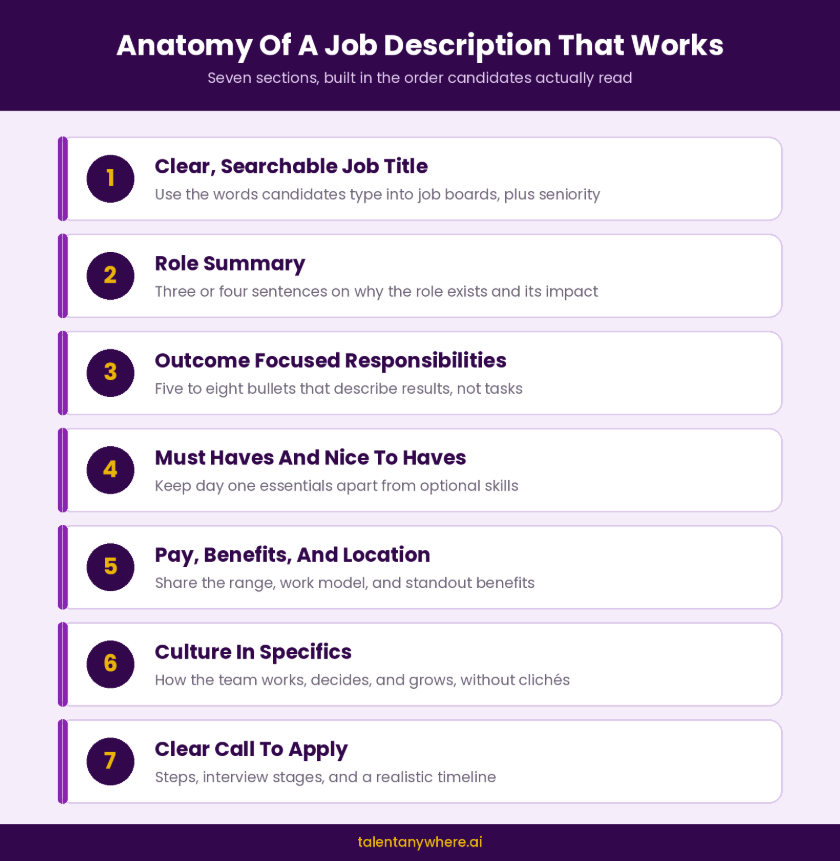
There is no single correct format, but the strongest job descriptions follow an order that mirrors how candidates actually read. Most people scan the title, skim the summary, compare the requirements against their own experience, and look for pay and location details before deciding whether to apply. Build each section with that reading pattern in mind.
Start With A Clear, Searchable Job Title
The title is the single most important line because it decides whether your role shows up in search results at all. Use the words candidates actually type into job boards. “Senior Backend Engineer” will outperform “Code Ninja” or “Engineering Rockstar” every time, and “Customer Success Manager” is clearer than an internal label like “Client Experience Lead II.” Include the seniority level where it matters, and leave internal grade codes out entirely. Those same terms usually mirror the keywords hiring managers look for on resumes, so well matched profiles find your role faster.
Write A Role Summary That Sells The Opportunity
Open with three or four sentences that answer the question every candidate is silently asking: why should I care about this role? Explain why the position exists, who the person will work with, and what impact they will have in their first year. Skip the long company history. One or two lines about what your organization does and why it matters is enough at this stage.
List Responsibilities As Outcomes, Not Tasks
Most descriptions list duties. Better ones describe results. Instead of “Manage social media accounts,” try “Grow engaged followers across LinkedIn and Instagram by building a consistent weekly content calendar.” The second version tells candidates what good looks like and helps them judge whether they have done similar work before.
Keep this section to roughly five to eight bullets. Start each one with an action verb, focus on the work that takes up most of the person’s time, and leave occasional or minor tasks out. If a responsibility would not come up in a performance review, it probably does not belong here.
Separate Must-Have Requirements From Nice-To-Haves
Long requirement lists are one of the fastest ways to lose qualified applicants. Candidates who meet most of the criteria often decide not to apply because they do not meet all of them. Limit must-haves to the skills, experience, and certifications someone genuinely needs on day one, then move everything else into a short “nice to have” list.
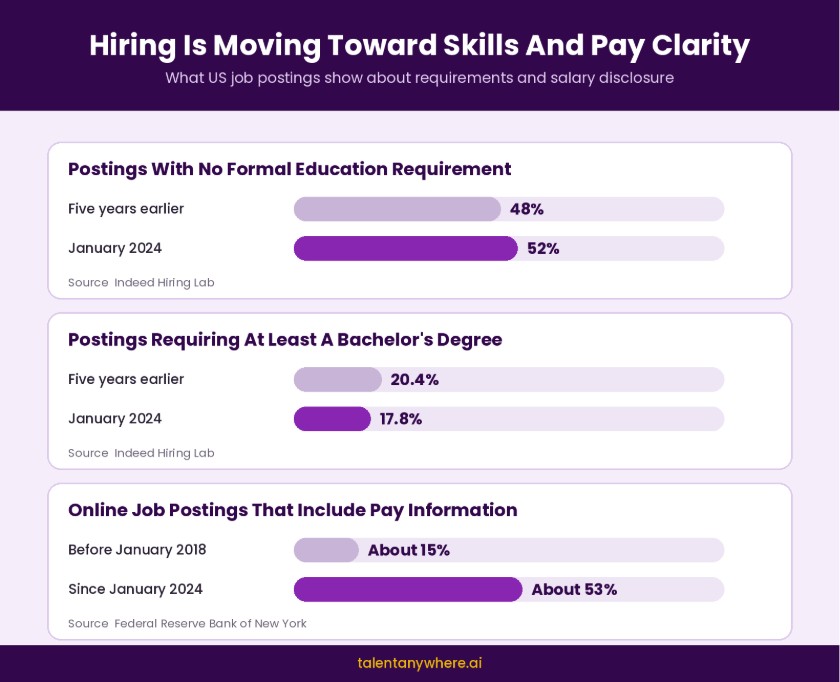
Formal education requirements deserve a second look too, because employers are steadily moving toward skills-first hiring. Indeed Hiring Lab found that 52% of US job postings on Indeed did not mention any formal education requirement as of January 2024, up from 48% five years earlier, while the share requiring at least a bachelor’s degree fell from 20.4% to 17.8%. If a degree is not essential to doing the work, asking for relevant skills or equivalent experience widens your pool without lowering the bar.
Be Transparent About Pay, Benefits, And Location
Pay is one of the first details candidates look for, and leaving it out increasingly reads as a red flag. Disclosure has moved from the exception to the norm. Research from the Federal Reserve Bank of New York shows the monthly share of US online job postings with pay information rose from an average of about 15% before January 2018 to roughly 53% since January 2024. The same analysis estimates that, as of January 2025, about 24% of ads covered by pay transparency requirements still did not comply.
Beyond compliance, a clear range saves everyone time. Candidates whose expectations sit far above your budget can self-select out, and those who apply already know the offer will land in a realistic zone. Add the work model (on-site, hybrid, or remote), the primary location or time zone, and the two or three benefits that genuinely set you apart. For roles in India, state whether the range is fixed pay or total cost to company (CTC), since that is how most candidates compare offers.
Describe Your Culture With Specifics, Not Clichés
Phrases like “fast-paced environment” and “we work hard and play hard” appear in so many postings that candidates skim straight past them. Replace them with concrete details: how the team collaborates, how decisions get made, what flexibility looks like in practice, and how people grow. Specifics build credibility. Clichés erode it.
Close With A Clear Call To Apply
End by telling candidates exactly what to do and what happens next. Explain how to apply, what the interview stages look like, and roughly how long the process takes. This small addition reduces drop-off and signals that your team respects the candidate’s time. If your first round is an online evaluation, say so here and run it through a structured candidate assessment tool so every applicant is judged on the same criteria.
Common Mistakes To Avoid When Drafting Job Descriptions
Even experienced recruiters fall into a few predictable traps. Catching them during review is far easier than fixing a weak applicant pool after the role has been live for weeks.
Listing Every Possible Skill
When a description reads like a wish list, strong candidates assume the role is either unrealistic or poorly defined. Prioritize the handful of skills that matter most, and trust the interview process to explore the rest.
Using Jargon And Exclusionary Language
Internal acronyms, buzzwords, and unnecessarily gendered or age-coded phrases can discourage qualified people from applying. Write the way you would explain the role to a smart friend outside your industry, and run a quick review for language that might signal the role is only meant for a narrow type of person.
Copying Old Descriptions Without Updating Them
Roles evolve. Reposting a description from two years ago often means advertising tools the team no longer uses or responsibilities that have shifted to someone else. Ask the hiring manager to confirm current priorities every time a role opens.
Burying The Most Important Details
If location, work model, or pay only appear at the very bottom, many candidates will never see them. Put the details people use to make a quick yes-or-no decision near the top, ideally right after the role summary.
Also Read: Telephonic Interview Questions To Screen Candidates Faster
A Simple Job Description Template You Can Adapt
If you are still working out how to write a job description that stays consistent across teams, a shared template is the easiest place to start. Use the structure below as a baseline and adjust the tone to match your employer brand.
| Job Description Template | |
| Job Title | [Seniority] [Function] [Specialization], for example “Senior Product Designer, Mobile” |
| Location And Work Model | [City or time zone], [On-site, hybrid, or remote] |
| Pay Range | [Minimum] to [Maximum] per [year or hour], plus [bonus or equity, if applicable] |
| About The Role | Three to four sentences on why the role exists, who the person works with, and what success looks like in the first year |
| What You Will Do | Five to eight outcome-focused responsibilities, each starting with an action verb |
| What You Will Bring | Four to six must-have skills or experiences |
| Nice To Have | Two to four optional skills that would help but are not required |
| What We Offer | The benefits, growth opportunities, and flexibility that set you apart |
| How To Apply | Application steps, interview stages, and the expected timeline |
Keep each section short. A description that reads comfortably on a phone screen will almost always perform better than one that demands endless scrolling. Once a role is filled, save the final version as a job description example your team can reuse for similar openings.
Also Read : Most Common Interview Questions And Answers
How An AI Job Description Generator Speeds Up The Process
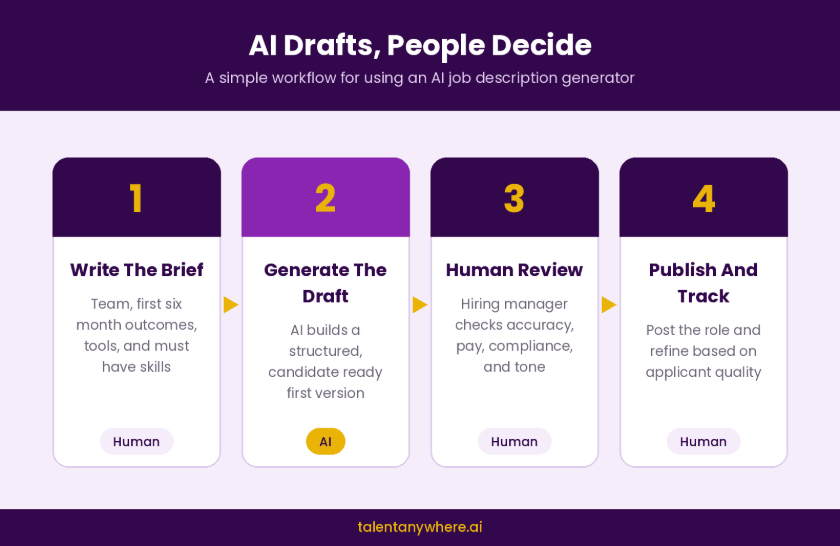
Drafting every description from a blank page is slow, especially for teams hiring across several functions at once. A job description generator takes a few inputs, such as the title, seniority, key responsibilities, and must-have skills, and produces a structured first draft that a recruiter or hiring manager can refine.
What AI Does Well
AI tools are strongest at the repetitive parts of the work. They can produce a consistent structure every time, suggest outcome-focused phrasing for responsibilities, flag overly long requirement lists, and adapt the same role for different seniority levels or locations. For high-volume hiring, that consistency alone can save recruiters hours each week. The same structure pays off once applications arrive, because AI candidate search can match profiles against the exact requirements you wrote.
Where Human Review Still Matters
AI does not know the specifics of your team, your culture, or the real reason a role is open. A hiring manager still needs to confirm that responsibilities reflect the actual work, that requirements are genuinely essential, that pay information is accurate and compliant with local law, and that the tone sounds like your company. Treat the output as a strong first draft, not a finished product.
How To Get Better Output From AI Tools
The quality of the draft depends on the quality of the brief. Give the tool specific context: the team the person will join, the outcomes expected in the first six months, the tools they will use, and the profile of people who have succeeded in similar roles. The more concrete your inputs, the less editing the draft will need.
This is the workflow talentanywhere.ai is built around. Its AI-powered hiring tools help recruiters move from a rough role brief to a polished, structured description quickly, so more of the team’s time goes into conversations with candidates rather than formatting documents.
Write For The Candidate You Want To Hire
A job description is not paperwork. It is the first conversation you have with your future hire, and it decides whether that conversation continues. Knowing how to write a job description that is clear, honest, and specific gives you a stronger applicant pool before the first screening call ever happens.
Start with a searchable title, describe outcomes instead of tasks, keep requirements realistic, share pay openly, and close with a clear next step. Then let AI handle the heavy lifting of drafting, so your team can focus on the part only people can do well: choosing the right person.
Better Job Descriptions Bring Better Candidates
Use talentanywhere.ai’s AI hiring tools to draft clear, inclusive, outcome-focused job descriptions for every role you open.
FAQs
How Long Should A Job Description Be?
Should I Include The Salary Range In A Job Description?
Can I Use AI To Draft Job Descriptions?
How Often Should Job Descriptions Be Updated?
What Is The Difference Between Responsibilities And Requirements?


talentanywhere.ai
Build professional resumes with AI, improve your ATS score, and apply with confidence. talentanywhere.ai empowers job seekers with smarter resume creation and career tools for every stage.