

Table of Contents
 Set as a preferred Google source
TL;DR
- Pay benchmarking compares what you plan to offer for a role with what the market pays for similar work, seniority, and location.
- Offers built on market data get accepted faster because they cut back-and-forth negotiation, speed up internal approvals, and build candidate trust.
- The core steps are defining the role, choosing reliable data sources, matching jobs by content rather than title, adjusting for level and location, setting a range, and refreshing it regularly.
- Labor costs keep climbing, so ranges built on data more than a year old can leave your offers behind the market.
- Share the range early in the process to avoid surprises at the offer stage.
Few things stall a hiring process like an offer that misses the mark. The candidate asks for time to think, a counteroffer appears, approvals bounce between HR and finance, and two weeks later the role is back to square one. Most of those delays trace back to one root cause: the offer was never anchored to reliable market data.
This guide explains what salary benchmarking is, how to conduct salary benchmarking step by step, and how to turn the results into offers candidates are ready to accept quickly.
Stop Losing Great Candidates At The Offer Stage
Move candidates from final interview to signed offer faster with talentanywhere.ai’s AI-powered hiring tools.
What Is Salary Benchmarking
Salary benchmarking is the practice of comparing the pay for a role in your organization with the pay for similar roles in the external market. The goal is to understand where your offers sit, whether below, at, or above the market, so you can make deliberate decisions instead of educated guesses.
It is one part of the wider discipline of compensation benchmarking, which looks beyond base pay to include bonuses, equity, benefits, and other rewards. Most teams start with base salary because it is the number candidates compare first, then expand to total compensation as their approach matures.
Salary Vs. Total Compensation Benchmarks
A base salary benchmark tells you what the market pays in fixed cash for a role. A total compensation benchmark adds variable pay, equity, and the value of benefits. Both matter. A candidate weighing two offers will often look at base pay first, but the final decision frequently comes down to the full package, especially for senior roles where bonuses and equity make up a larger share of the total.
| Aspect | Base Salary Benchmark | Total Compensation Benchmark |
| What It Measures | Fixed cash pay for a role | Fixed pay plus variable pay, equity, and benefits value |
| Best Used For | Setting offer ranges and screening expectations | Senior roles and competitive final stage offers |
| What Candidates Compare | The headline number on the offer | The full package across competing offers |
Why Salary Benchmarking Matters More In 2026
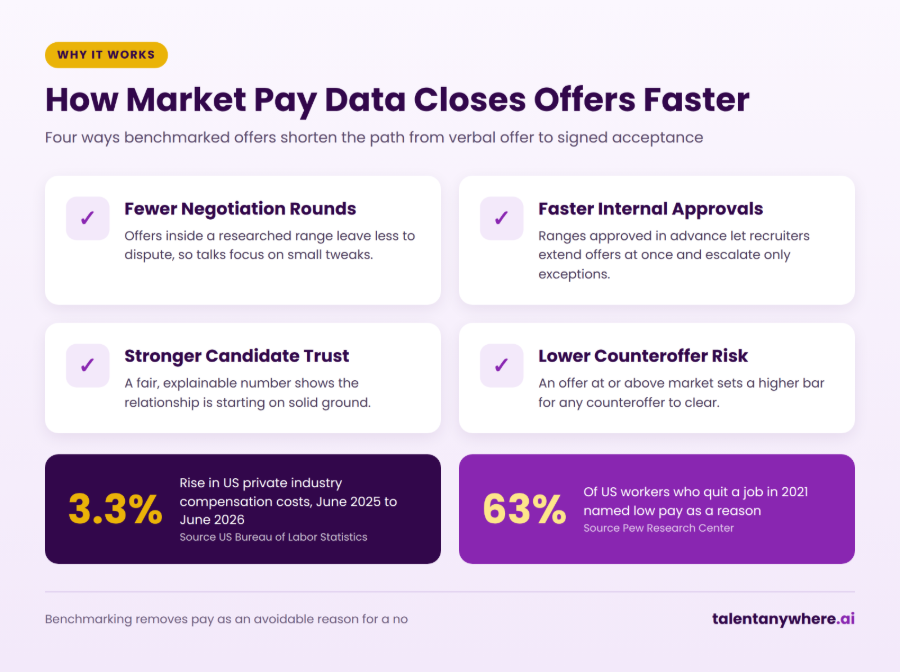
Pay does not stand still, and neither do candidate expectations. According to the US Bureau of Labor Statistics, compensation costs for private industry workers rose 3.3% from June 2025 to June 2026, with wages and salaries up 3.1% and benefit costs up 3.8%. A range set eighteen months ago may already sit noticeably below where the market is today, and candidates with competing offers in hand will notice the gap.
Also Read: High Paying Skills In 2026 And What Employers Actually Want
How Market Pay Data Helps You Close Offers Faster
Benchmarking is often treated as an annual HR exercise, but its biggest payoff shows up during live hiring. When the number on the offer letter is grounded in market data, every step between the verbal offer and the signed acceptance moves faster.
Fewer Rounds Of Negotiation
Candidates negotiate hardest when an offer feels arbitrary or low. An offer that already sits within a well-researched market range leaves less room for dispute, and when negotiation does happen, it tends to be about small adjustments rather than a complete reset.
Faster Internal Approvals
Offers often stall internally while finance questions the number or a senior leader asks for justification. Pre-approved, benchmarked ranges for each role remove that bottleneck. Recruiters can extend offers within the range immediately and escalate only the true exceptions.
Stronger Candidate Trust
Pay is rarely the only factor in a career decision, but it is often the deciding one. A Pew Research Center survey found that 63% of US workers who quit a job in 2021 named low pay as a reason, tied with a lack of advancement opportunities as the most common factor. Candidates who sense they are being underpaid start looking elsewhere before they even join. A fair, explainable offer signals that the relationship is starting on solid ground.
Lower Risk Of Losing Candidates To Counteroffers
Strong candidates usually have options, including their current employer. If your offer sits at or slightly above the market for the role, a counteroffer has to clear a much higher bar to change the candidate’s mind.
Also Read: AI Recruitment Tools Every Hiring Team Should Know In 2026
How To Conduct Salary Benchmarking Step By Step
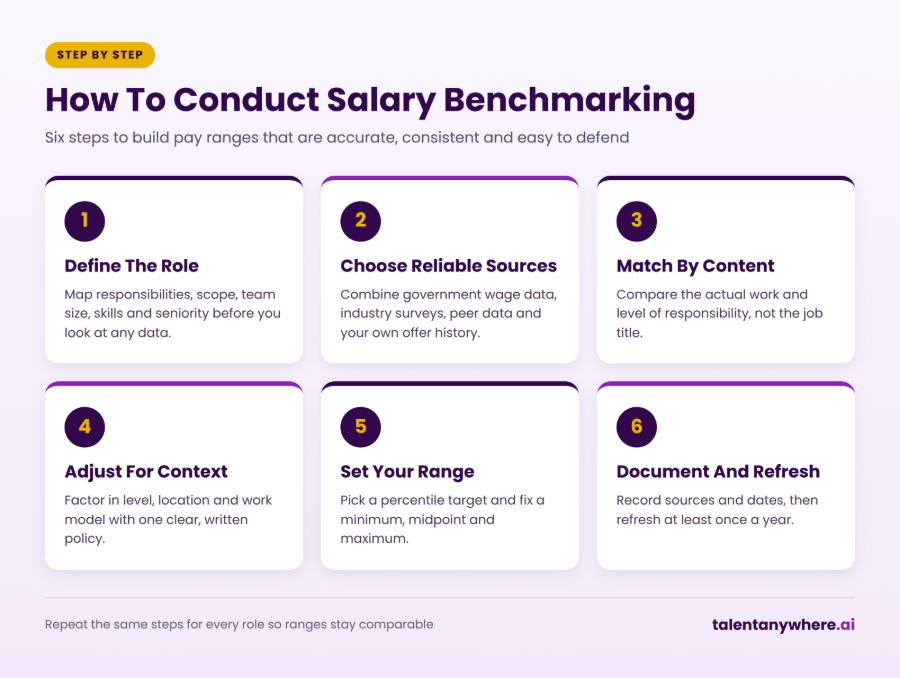
A reliable compensation benchmarking process does not require a large HR team, but it does require consistency. Follow the same steps for every role so your ranges stay comparable across the organization and easy to defend when someone asks how a number was reached.
Define The Role Before You Look At Data
Start with what the job actually involves: core responsibilities, scope of decision-making, team size managed, required skills, and seniority. Two roles with the same title can differ dramatically in scope, and comparing pay without a clear definition is how teams end up pricing a team lead against a department head.
Choose Reliable Data Sources
Use more than one source, and favor data that is current, methodologically transparent, and relevant to your industry and region. Common options include government wage data, such as the Occupational Employment and Wage Statistics program from the US Bureau of Labor Statistics, industry compensation surveys, peer data shared through professional networks, and your own historical offer and acceptance records. Self-reported salary websites can work as a sense check, but they should never be your only input.
Match Jobs By Content, Not Title
Titles vary wildly between companies. A “Manager” at a startup might carry the responsibilities of a “Senior Specialist” at a large enterprise. When you compare against a survey or dataset, match on the description of the work and the level of responsibility, not the job title alone.
Adjust For Level, Location, And Work Model
Pay for the same role can vary significantly across cities, regions, and countries. Decide how you will handle location. Some companies pay a single national rate, others use location-based tiers, and remote-first teams often choose a blend of both. Make the policy explicit so recruiters apply it consistently.
Set A Range And Decide Where You Want To Sit
Benchmark data is usually reported by percentile. The 50th percentile, or median, represents the middle of the market. Paying at the 25th percentile means three-quarters of comparable roles pay more, while paying at the 75th percentile places you ahead of most competitors.
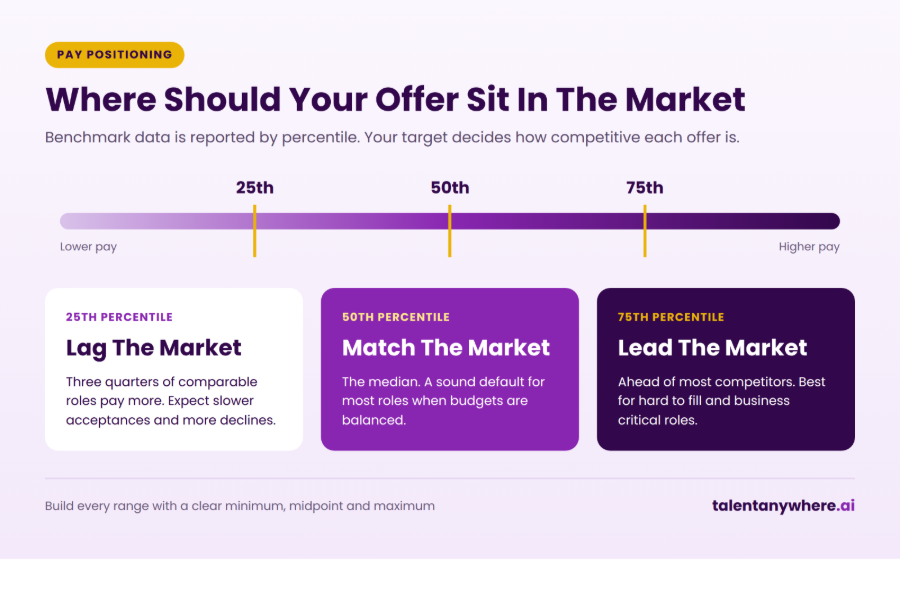
Choose a deliberate strategy for each role. Many teams match the market for most positions and lead the market for hard-to-fill or business-critical roles. Build each range with a clear minimum, midpoint, and maximum so recruiters know exactly how much flexibility they have.
Document And Refresh Regularly
Record your sources, the date of the data, and the reasoning behind each range. Refresh benchmarks at least once a year, and sooner for roles where you are seeing frequent offer declines or an unusually long time-to-fill.
Using Benchmark Data During The Offer Stage
Good data only speeds up hiring if recruiters use it well in conversations with candidates. These practices help turn your research into faster acceptances.
Share The Range Early
Discuss the pay range in the first screening call, or include it in the job posting. Candidates whose expectations sit far outside the range can opt out early, and those who continue already know the offer will land in a realistic zone. That alone eliminates many of the late-stage surprises that derail offers.
Explain How The Number Was Built
Candidates are more likely to accept an offer they understand. A short explanation, such as “This role is benchmarked against comparable positions in our industry and region, and your offer sits above the midpoint based on your experience,” builds credibility and reduces the urge to negotiate for the sake of it.
Know Your Flex Before The Conversation
Before extending an offer, confirm how much room you have on base pay, sign-on bonus, start date, and other levers. Recruiters who can respond to a counter in the same conversation close faster than those who need to go back for approval.
Track Acceptance And Decline Reasons
Every accepted and declined offer is a data point. Log the offered amount, the candidate’s expectation, and the reason for the outcome. Over time, this internal record becomes one of your most valuable sources, because it reflects the candidates you are actually competing for.
Also Read :15 Best Interview Questions To Ask Candidates
What A Benchmarked Offer Looks Like In Practice
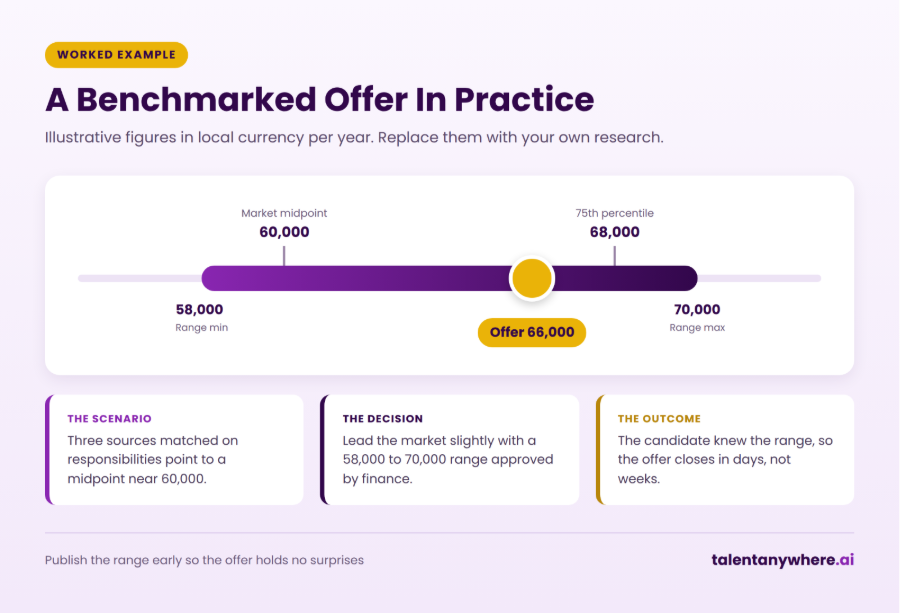
It helps to see how the pieces fit together. The example below uses illustrative figures rather than real market data, so treat the numbers as placeholders for your own research.
The Scenario
Imagine you are hiring a mid-level data analyst for a hybrid role. After defining the scope, you compare three sources: a government wage dataset for the region, an industry compensation survey, and your own offers from the past year. Matched on responsibilities rather than title, the sources point to a market midpoint of roughly 60,000 a year in your local currency, with the 75th percentile near 68,000.
The Decision
Because analysts with this skill set have been hard to hire, you choose to lead the market slightly. You set a range of 58,000 to 70,000, get it approved by finance in advance, and publish it in the job post. Your preferred candidate, who brings strong experience with the exact tools the team uses, receives an offer of 66,000 along with a short explanation of how the figure was built.
The Outcome
The candidate already knew the range from the posting, so the offer holds no surprises. Any negotiation focuses on small items such as start date or a modest sign-on bonus, and the recruiter can approve those on the spot because the flex was agreed beforehand. What could have been a two-week back-and-forth becomes a conversation that wraps up in days.
Common Pay Benchmarking Mistakes To Avoid
Benchmarking only works when the inputs are sound. These are the errors that most often lead to inaccurate ranges and stalled offers.
Relying On A Single Source
Every dataset has gaps and biases. Cross-check at least two or three sources before setting a range, and dig deeper whenever they disagree sharply.
Using Stale Data
Market pay moves every year. Data that is more than twelve months old should be adjusted or replaced, especially in fast-moving fields like technology and healthcare.
Ignoring Internal Equity
Offering new hires far more than existing employees in the same role creates resentment and retention risk. Compare benchmarked offers against current team pay, and plan adjustments for existing staff where gaps appear.
Benchmarking Titles Instead Of Work
Title-only matching produces misleading comparisons. Always benchmark against the responsibilities and level of the role, not the label on the org chart.
Turn Market Data Into Faster Yeses
Slow, uncertain offers cost companies their best candidates. Grounding every offer in current market data shortens negotiations, speeds up internal approvals, and gives candidates a clear reason to say yes.
Pair that data with a hiring workflow built for speed. talentanywhere.ai’s AI-powered hiring tools help recruiters keep candidates moving from application to offer, so the time you save on pay decisions is not lost somewhere else in the funnel.
Fair Offers. Faster Hires.
Pair market-backed pay decisions with a hiring workflow built for speed on talentanywhere.ai.
FAQs
How Often Should The Compensation Benchmarking Process Be Repeated?
What Data Sources Are Best For Pay Benchmarking?
What Percentile Should We Pay At?
What Is The Difference Between Salary Benchmarking And Compensation Benchmarking?
How Do You Benchmark Pay For Remote Roles?
Is Pay Benchmarking Only For Large Companies?
Does Benchmarking Guarantee That Candidates Will Accept?


talentanywhere.ai
Build professional resumes with AI, improve your ATS score, and apply with confidence. talentanywhere.ai empowers job seekers with smarter resume creation and career tools for every stage.