


Table of Contents
 Set as a preferred Google source
TL;DR
- CTC stands for Cost to Company, the total yearly amount an employer spends on you, not the money you receive each month.
- It can include fixed salary, allowances, employer PF, a gratuity provision, insurance and variable pay.
- In-hand salary is what reaches your bank account after employee PF, professional tax, income tax and other deductions.
- Dividing CTC by 12 rarely gives your take-home pay. In this guide’s illustrative ₹6 LPA example, the monthly credit is about ₹41,975, not ₹50,000.
- Before accepting an offer, check the fixed and variable split, which employer contributions are included and your estimated monthly take-home.
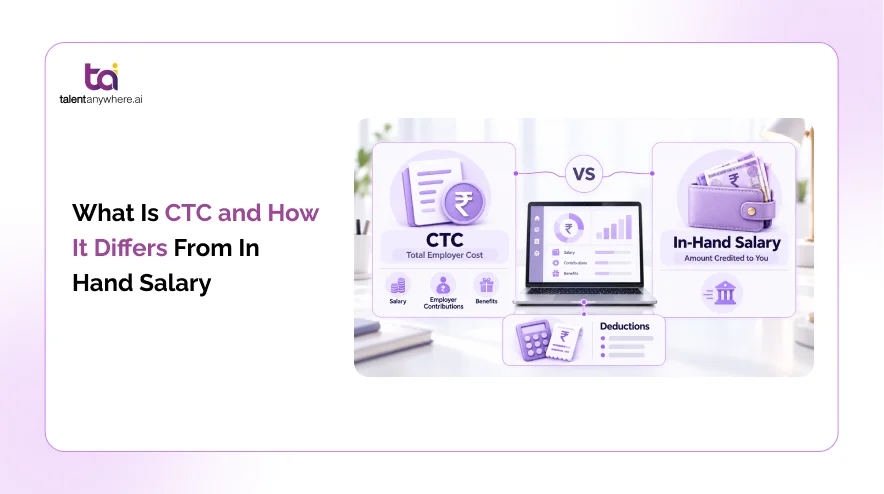
The CTC full form is Cost to Company, and it refers to the total annual amount an employer spends to hire and retain you. That figure can include your salary, employer contributions, benefits and variable pay, which is why it is rarely the same as the money that lands in your bank account each month. Your in-hand salary is what remains after deductions such as provident fund, professional tax and income tax.
Picture this. You accept an offer of ₹8 LPA and expect roughly ₹66,667 every month. Then your first salary credit arrives, and it is noticeably lower. Nothing has necessarily gone wrong. This guide explains how CTC is structured, how to estimate your take-home pay and what to check before you sign an offer letter.
What Is The CTC Full Form In Salary?
The CTC full form in salary is Cost to Company. It is the total annual cost an organisation incurs to employ you, covering everything from your monthly pay to the contributions it makes on your behalf. The key word is cost. CTC measures what the employer spends, not necessarily what you receive directly, and that distinction shapes almost every salary conversation you will have.
What The CTC Meaning Actually Tells You
The CTC meaning goes beyond a single number. Depending on company policy, it may bundle together direct salary, employer-paid benefits, retirement contributions, insurance premiums and performance-linked pay. Two companies can quote the same CTC while structuring it very differently, so the headline figure tells you the size of the package but not its shape.
What Is CTC In Salary With An Example?
If you are wondering what is CTC in salary terms, a simple example helps. Suppose a company offers you ₹6,00,000 as annual CTC. Dividing it by 12 gives ₹50,000 per month as an equivalent monthly CTC figure. That ₹50,000 is a useful reference point, but it is not necessarily your gross monthly salary, and it is almost never the amount credited to your bank account. To see why, you need to look at what sits inside the package.
Also Read High Paying Skills In 2026 That Employers Actually Want
What Are The Main Components Of CTC?
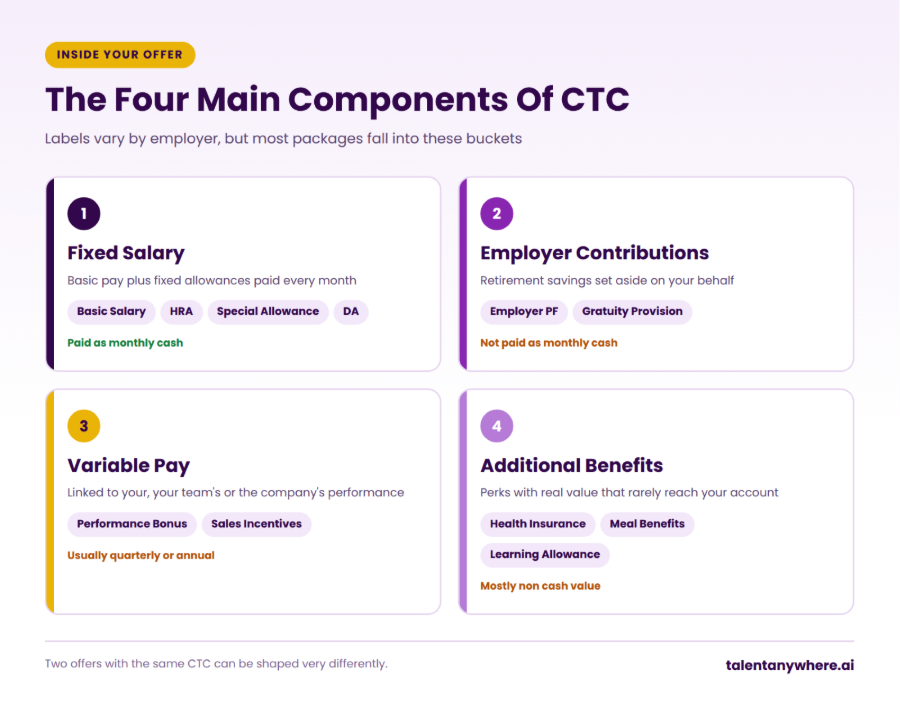
Most employers divide CTC into four broad buckets: fixed salary, variable compensation, employer contributions and additional benefits. The exact split differs from one organisation to the next, and the labels used in offer letters are not standardised, so treat the components below as a guide to what you are likely to see rather than a fixed template.
Basic Salary
Basic salary is the core of your pay. It is a fixed amount, and several other components are often calculated from it, including employer provident fund contributions and gratuity. Under the Code on Wages, 2019, which came into force on 21 November 2025, basic pay, dearness allowance and retaining allowance are treated as wages, and if excluded components exceed half of total remuneration, the excess is counted back as wages. In practice, this pushes many salary structures towards a larger basic component, which can change how much of your package goes to PF and gratuity versus your monthly credit.
Allowances
Allowances are fixed payments added on top of basic salary. Common ones include:
- House Rent Allowance (HRA), meant to support rental costs
- Special allowance, often a balancing figure in the salary structure
- Dearness Allowance (DA), more common in public sector roles and some private organisations
- Other allowances, such as conveyance, phone or internet reimbursements, offered under the employer’s salary structure
The names, amounts and tax treatment of allowances vary by employer and by the tax regime you choose, so check how each one is described in your salary breakup.
Employer Contributions To Provident Fund And Gratuity
Employers usually contribute to your Employees’ Provident Fund (EPF) account and set aside a provision for gratuity, and many include both in the quoted CTC. Social security coverage in India rose from about 19% of the workforce in 2015 to more than 64% in 2025, according to the Ministry of Labour and Employment. For a growing share of employees, that makes these line items worth understanding.
Neither component arrives as monthly cash. The PF contribution builds your retirement savings, while gratuity is a lump sum paid when you leave after meeting the eligibility conditions, so it is not immediately payable. Under the four Labour Codes that came into effect on 21 November 2025, fixed-term employees become eligible for gratuity after one year of continuous service instead of five, according to the Ministry of Labour and Employment. Structures still differ between employers, so confirm how yours calculates each contribution.
Variable Pay, Bonuses And Benefits
Variable pay covers performance bonuses, sales incentives and similar payouts. It may depend on your performance, your team’s results or the company’s, and it is often paid quarterly or annually rather than monthly, which means it might not be paid in full. Some offers also include health insurance premiums, meal benefits, learning allowances or other perks. These add real value to the package, but many of them never appear as cash in your account.
Every Offer Has Two Numbers. Know Both.
Prepare for salary conversations and evaluate offers with confidence using talentanywhere.ai’s AI-powered career tools.
What Is The Difference Between CTC, Gross Salary And In-Hand Salary?
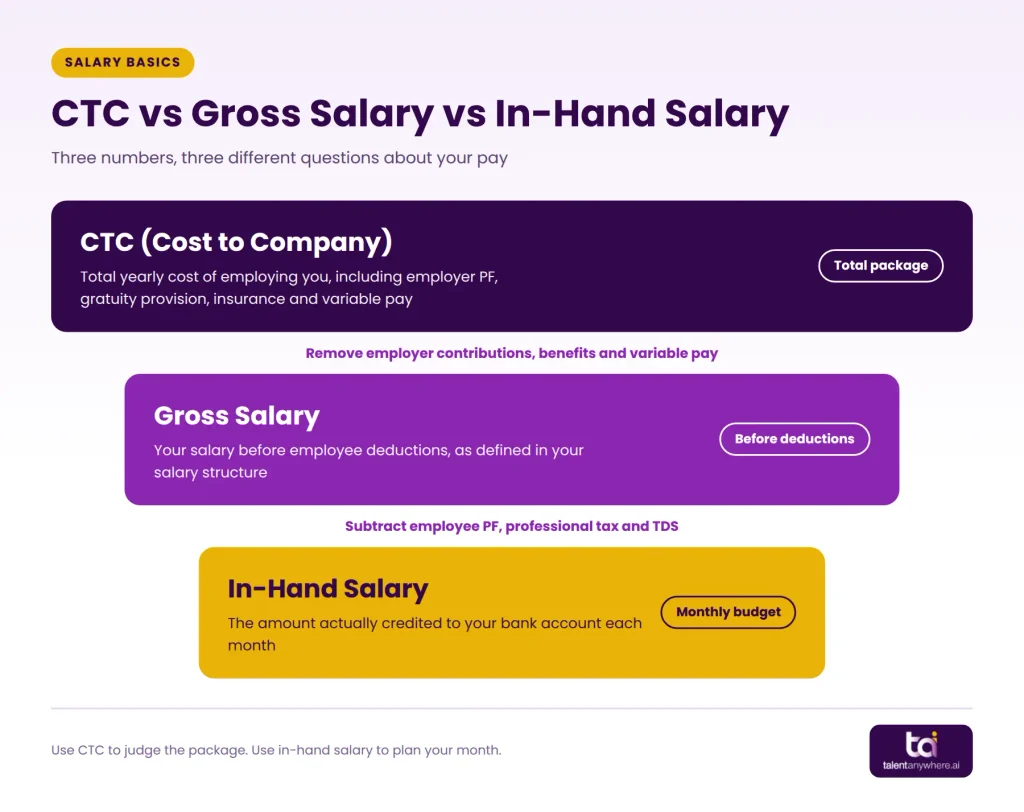
Once you know the CTC full form, the next step is separating three figures that often get used interchangeably. Each one answers a different question about your pay.
- CTC is the total annual cost of employing you, including employer contributions and benefits.
- Gross salary is your salary before employee side deductions, as defined in your salary structure. Definitions vary, so check how your employer treats each component.
- In-hand salary is the amount credited to your account after applicable deductions and adjustments.
| Aspect | CTC | Gross Salary | In-Hand Salary |
| What it represents | Total employer cost | Earnings before employee deductions | Take-home pay |
| Employer contributions and benefits | May include them | Generally excludes employer-only costs | Not received as monthly cash |
| Income tax and employee deductions | Not simply deducted from the headline CTC | Usually before deductions | Reflected in the final amount |
| Best used for | Understanding the total package | Understanding salary before deductions | Monthly budgeting |
Use CTC to understand the full value of a package, and use in-hand salary to plan your monthly budget, r
ent and savings.
Also Read Top Job Portals In India To Find Your Next Role
How To Calculate In-Hand Salary From CTC
There is no single formula that turns a CTC figure into an exact take-home amount. Your salary breakup, the components your employer includes and your tax situation all play a part. What you can do is follow a clear sequence that gets you to a reliable estimate.
Step 1 Identify What Your CTC Includes
Start with your offer letter or salary annexure. List every component and note whether it is fixed salary, variable pay, employer PF, a gratuity provision, insurance or another employer-paid benefit. If the letter only shows a single CTC figure, ask HR for the detailed breakup before you go further.
Step 2 Estimate Your Gross Salary
Take the annual CTC and set aside the parts that are not regular cash salary. These usually include employer-only contributions such as employer PF and gratuity, benefits such as insurance premiums and any variable pay that depends on conditions. Follow your actual salary structure here rather than assuming every component should be removed the same way, because some employers include certain items in gross salary and others do not.
Step 3 Account For Employee Deductions
Next, subtract the deductions taken from your side of the payslip. Common ones include:
- Employee provident fund contribution
- Income tax deducted at source (TDS)
- Professional tax, in states where it applies
- Other deductions or employee contributions listed in your payslip
Your TDS depends on the tax rules for the year, the tax regime you choose and any other income or eligible deductions you declare.
Step 4 Estimate Your Monthly Take-Home Pay
Divide the estimated annual cash salary after deductions by 12. Keep bonuses and incentives separate, since they are usually paid quarterly, annually or on meeting specific conditions.
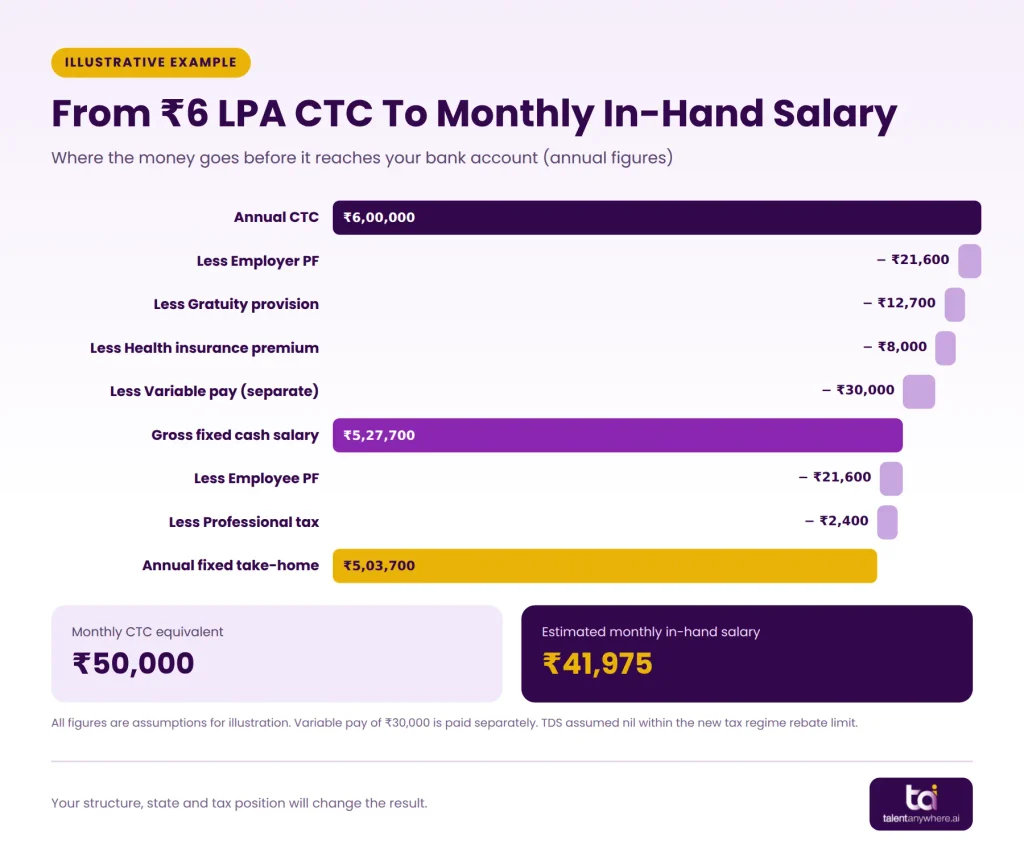
Here is an illustrative breakup for an employee with ₹6 LPA CTC. Every figure below is an assumption used for this example, not a standard you should expect from any employer.
| Illustrative Component (All Figures Assumed) | Annual Amount |
| Annual CTC | ₹6,00,000 |
| Less employer PF (12% of an assumed ₹15,000 monthly PF wage) | ₹21,600 |
| Less gratuity provision (about 4.81% of an assumed ₹2,64,000 annual basic) | ₹12,700 |
| Less group health insurance premium | ₹8,000 |
| Less variable pay (paid separately, assumed in full) | ₹30,000 |
| Gross fixed cash salary (₹43,975 per month) | ₹5,27,700 |
| Less employee PF (12% of ₹15,000 per month) | ₹21,600 |
| Less professional tax (₹200 per month) | ₹2,400 |
| Less income tax (TDS), assumed nil for this illustration | ₹0 |
| Annual fixed take-home | ₹5,03,700 |
| Estimated monthly in-hand salary | ₹41,975 |
In this illustration, the employee receives about ₹41,975 a month, compared with the ₹50,000 monthly CTC equivalent. The ₹30,000 variable pay, if paid in full, arrives separately. Income tax is shown as nil only because this assumed taxable income stays within the new tax regime’s rebate limit. A different structure, state or tax position would produce a different result, which is why a ₹6 LPA offer never translates to one fixed in-hand figure.
Your Next Role Should Pay Off Every Month
Explore opportunities, sharpen your applications and walk into salary discussions prepared with talentanywhere.ai.
What Current CTC Means During A Job Interview
Recruiters often ask about your current CTC in the very first screening call. In simple terms, current CTC means the total annual compensation package attached to your present job, as defined by your employer’s salary structure. It is not your monthly take-home, and quoting the wrong figure can affect how an offer is built.
How Is Current CTC Different From Expected CTC?
Three related terms come up during hiring:
- Current CTC is the compensation package at your present job.
- Expected CTC is the compensation you are seeking in a new role.
- Offered CTC is the package a prospective employer proposes.
Before you answer a recruiter, check your latest offer letter or salary revision letter. Separate fixed compensation from variable pay and benefits, so you can explain your package accurately and anchor your expectations on numbers you can back up.
Why Is Your In-Hand Salary Lower Than Your CTC?
Knowing the CTC full form explains the label on your offer letter, but it does not explain the gap between that number and your monthly credit. Several factors usually work together to create it.
- Employer contributions and benefits sit inside CTC without being paid out as monthly cash.
- Your own PF contribution and other employee contributions reduce take-home pay.
- Income tax may be deducted from your salary every month as TDS.
- Variable pay may be paid quarterly or annually, or only when targets and conditions are met.
- Insurance premiums or other deductions may apply, depending on your employer’s policy.
A lower monthly credit does not automatically mean your employer has made a mistake. Compare your offer letter, salary breakup and first payslip line by line. If something still does not add up, raise it with HR with those three documents in hand.
Also Read Top 7 AI Skills Experts Say Will Make You Instantly Hireable
What Should You Check In A CTC Offer Before Accepting A Job?
An offer letter deserves the same attention you gave the interview. Before you sign, get clear answers to these questions:
- What is the annual fixed salary?
- How much of the CTC is variable pay?
- Are employer PF and gratuity included in the quoted CTC?
- Are insurance premiums or other benefits included?
- What are the estimated monthly deductions and in-hand salary?
- When is the bonus paid, and what conditions apply?
- Are there any eligibility rules or clawback terms for incentives?
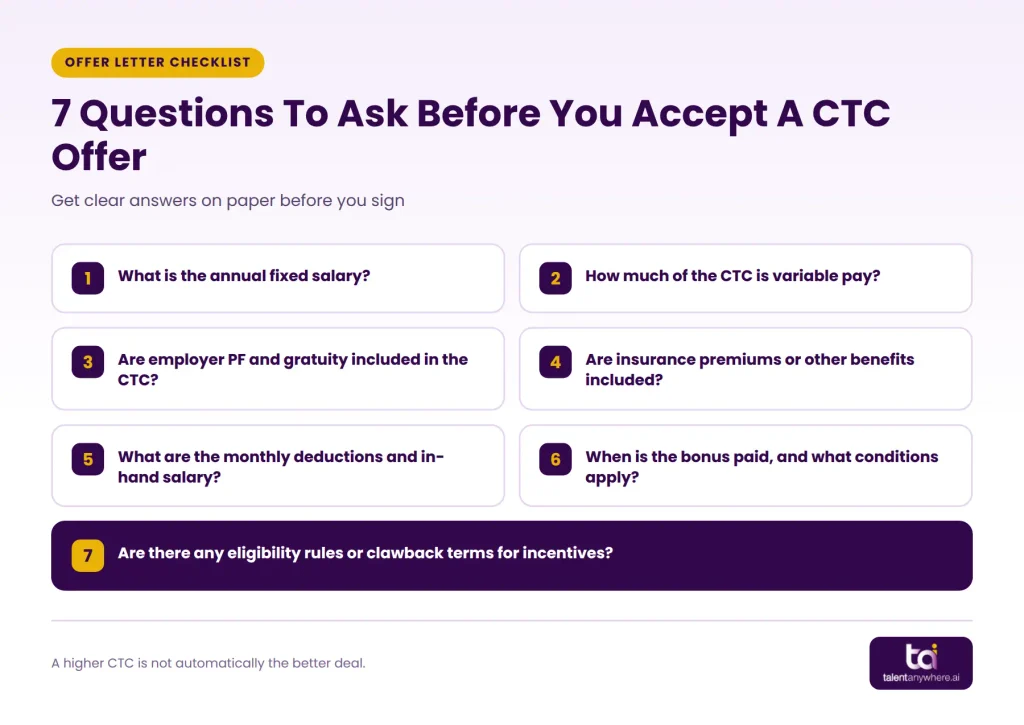
Then compare offers on fixed pay, expected take-home, benefits and the growth the role offers. A higher CTC is not automatically the better deal if most of it is variable or locked into long-term contributions.
Conclusion
The CTC full form, Cost to Company, describes everything an employer spends on you, while in-hand salary describes what you actually receive. Understanding the components in between, from basic pay and allowances to PF, gratuity and variable pay, helps you read any offer with clarity. Before you accept, check the fixed and variable split, the employer contributions, the benefits and the likely deductions. If you are weighing offers or preparing for your next salary conversation, talentanywhere.ai’s AI-powered career tools can help you explore roles and make each career decision with more confidence. Try talentanywhere.ai today!
FAQs
What Does CTC Stand For In Salary?
What Is The CTC Meaning In Simple Words?
Is CTC The Same As In-Hand Salary?
How Do I Calculate My Monthly Salary From CTC?
What Does Current CTC Mean?
Does A Higher CTC Always Mean A Higher In-Hand Salary?


talentanywhere.ai
Build professional resumes with AI, improve your ATS score, and apply with confidence. talentanywhere.ai empowers job seekers with smarter resume creation and career tools for every stage.